The human quest to comprehend the nature of reality is a profound and enduring endeavor, captivating scientists, philosophers, and artists across disciplines. This inherent curiosity fuels explorations into the very fabric of our perceived existence, prompting questions about perception, interpretation, and the fundamental truths that underpin our world. In the realm of speculative fiction, authors have consistently pushed the boundaries of imagination, crafting narratives that delve into the intricate and often unsettling possibilities of a malleable reality. These stories offer a unique lens through which to examine abstract concepts, from the manipulation of physical laws to the ephemeral nature of memory itself. This article explores five notable science fiction, fantasy, and horror books that masterfully engage with these reality-bending themes, showcasing the diverse ways authors conceptualize and portray altered states of existence.
Ninefox Gambit: When Mathematics Bends the Laws of Physics
Yoon Ha Lee’s Ninefox Gambit, first published in 2016, stands as a seminal work within the space opera genre, renowned for its intricate and challenging world-building. The novel plunges readers into a universe where the established laws of physics are not immutable constants but rather phenomena that can be influenced and even rewritten through the application of complex mathematical formations and the collective belief of sentient beings. This core concept allows for the existence of weapons and technologies capable of fundamentally altering reality, leading to scenarios of both immense power and profound destruction.

The narrative centers on Captain Cheris, a decorated officer tasked with a critical mission: to reclaim the Fortress of Scattered Needles, a vital star base that has fallen under the control of heretical factions. Cheris is not alone in this perilous undertaking. She is compelled to collaborate with the disembodied consciousness of Jedao, a legendary general whose tactical brilliance is matched only by his notorious ruthlessness and questionable sanity. Jedao has an unparalleled record of victory, but his past is shrouded in controversy, and his current state—lacking a physical body—adds a layer of complexity to their alliance.
While Ninefox Gambit demands significant intellectual engagement from its readers, particularly in its early stages where the unique mechanics of its universe are introduced, its compelling narrative and well-developed characters often make the effort worthwhile. The author’s ability to weave a captivating story around such abstract and challenging concepts is a testament to its literary merit. The novel’s exploration of how belief systems and mathematical frameworks can directly impact the physical world offers a unique perspective on the nature of reality, suggesting that our understanding of the universe is not fixed but is, in fact, a product of our collective interpretation and application of knowledge. The novel’s success and critical acclaim have cemented its place as a must-read for those interested in hard science fiction that pushes the boundaries of conceptual thought.
This Is How You Lose the Time War: A Multiversal Love Story Across Shifting Timelines
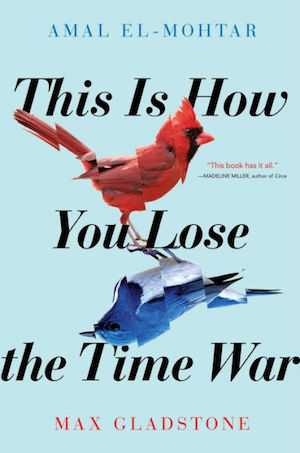
Amal El-Mohtar and Max Gladstone’s This Is How You Lose the Time War, published in 2019, transcends the typical narrative of time travel by presenting a story that not only bends reality but also profoundly challenges the reader’s perception. The novel is set against the backdrop of an unending war waged across time itself, pitting two powerful empires against each other. The primary agents of this conflict are Red and Blue, two highly skilled operatives on opposing sides, whose constant temporal interventions result in the perpetual alteration of current realities.

Each intervention by Red and Blue creates a new timeline, and while these shifting realities are described with breathtaking lyrical prose, they are intentionally kept somewhat vague, leaving the reader in a state of perpetual disorientation. This deliberate ambiguity mirrors the unmoored experience of the characters themselves, who navigate a universe in constant flux. The true anchor within this temporal maelstrom is the burgeoning relationship between Red and Blue. What begins as a series of taunting letters exchanged between rivals evolves into an unlikely and deeply affecting pen pal correspondence. Their growing bond becomes the emotional core of the story, a steadfast element that endures despite the ever-changing landscapes of their temporal battles.
The novel’s exploration of time travel as a reality-altering force is exceptionally well-executed. It prompts reflection on causality, consequence, and the subjective experience of time. The narrative structure, characterized by its fragmented and non-linear progression, further enhances the theme of a fluid reality. The authors skillfully use language to evoke distinct atmospheres for each altered timeline, demonstrating how subtle shifts in historical events can lead to vastly different outcomes. The enduring love story between Red and Blue, set against this backdrop of temporal chaos, highlights the resilience of human connection even when faced with the dissolution of objective reality. Its critical reception, including winning the Hugo Award for Best Novella, underscores its impact and its unique contribution to the genre.
There Is No Antimemetics Division: The Horrors of Forgotten Truths
The 2020 novel There Is No Antimemetics Division by qntm (a pseudonym) delves into a particularly chilling aspect of reality manipulation: the erasure of memory. The story introduces the Antimemetics Division, a clandestine organization tasked with combating anomalous entities known as "antimemetics." These entities possess the terrifying ability to consume human memories and, more disturbingly, to erase themselves from collective and individual recollection. This means that the very fabric of reality, as experienced by most people, is constantly being rewritten without their awareness, as events, objects, and even people are wiped from existence and memory.
The protagonist, Marie Quinn, serves as the director of the Antimemetics Division. While her own memory is not entirely intact, she possesses the crucial awareness that humanity is engaged in a desperate, unseen war against these memory-devouring entities. This internal struggle and the constant threat of forgotten truths create an atmosphere of profound paranoia and suspense. The novel’s horror stems from the insidious nature of its antagonists; the threat is not overt destruction but a subtle, pervasive unmaking of reality.
The concept of antimemetics is a powerful metaphor for the fragility of truth and the potential for reality to be shaped by what we choose, or are forced, to forget. The narrative cleverly uses the characters’ forgetfulness to build tension, as readers often possess more knowledge than the characters themselves, creating a sense of dramatic irony. The initial publication of There Is No Antimemetics Division as a serial online between 2015 and 2020 before its traditional publication in 2025 also adds an interesting layer to its reception. It garnered a significant cult following online, drawn to its inventive premise and unsettling exploration of existential dread. The novel’s success highlights the appeal of horror that plays on psychological and existential fears, pushing the boundaries of what constitutes a tangible threat.
We Used to Live Here: Questioning Perception in a Haunted House
Marcus Kliewer’s 2024 novel, We Used to Live Here, offers a more intimate and psychologically charged exploration of altered reality, blurring the lines between external events and internal perception. Unlike the other books on this list where reality is definitively manipulated by external forces or abstract concepts, We Used to Live Here leaves the reader constantly questioning whether the narrative’s unsettling occurrences are a genuine alteration of reality or the manifestation of the narrator, Eve’s, descent into madness. The reviewer strongly leans towards the former, suggesting the author’s intent to present a world where objective reality is indeed compromised.

The story follows Eve and her girlfriend, Charlie, who have recently purchased a house with the intention of renovating and reselling it for a profit. Eve finds herself alone one evening when a family appears at their doorstep. The father, Thomas, claims to have previously lived in the house and requests a tour. Eve, characterized as a people-pleaser, agrees, a decision she quickly comes to regret. Once inside, the situation rapidly escalates into a terrifying ordeal that forces Eve to question her own sanity, the nature of the house, and ultimately, the very foundation of reality itself.
The novel masterfully employs unreliable narration to create a sense of deep unease. The reader is placed directly into Eve’s subjective experience, privy to her growing confusion and terror. The ambiguity surrounding the events—whether supernatural, psychological, or a combination of both—makes the horror all the more potent. The slow burn of the narrative, punctuated by increasingly bizarre and disturbing occurrences, effectively builds suspense. We Used to Live Here taps into primal fears associated with home invasion and the loss of control, amplified by the unsettling possibility that the very ground beneath one’s feet is not stable. Its recent publication positions it as a contemporary addition to the genre of psychological horror that plays with the concept of a destabilized reality.
Lucky Day: Absurdity and Existential Dread in the Face of Improbability
Chuck Tingle’s 2025 novel, Lucky Day, injects a potent dose of darkly comedic horror into the discussion of reality-bending. The story centers on Vera, a statistics professor whose life is poised for significant personal milestones: the publication of her first book and the nerve-wracking task of coming out to her estranged mother as bisexual and engaged to her girlfriend, Annie, dispelling any notions of them being mere roommates. However, her life takes a catastrophic turn as an improbable series of horrific events unfolds, resulting in the deaths of approximately eight million people.

This catastrophic event becomes known as the "Low Probability Event." The sheer statistical unlikelihood of such a disaster plunges Vera into a deep, nihilistic depression. However, her despair is interrupted by Layne, a government agent who believes Vera’s expertise in statistics is crucial. Layne suspects that the Low Probability Event, along with a series of subsequent smaller, equally improbable disasters, is linked to an unusual casino located in Las Vegas.
Lucky Day distinguishes itself through its "gruesomely creative and comically unlikely horror scenarios." Tingle’s signature style, often described as having a delicious flavor of absurdity, is on full display, reminiscent of the elaborate death scenes in the Final Destination film series but amplified to a societal scale. Beyond the inventive and often darkly humorous demise of its characters, the novel also tackles profound themes, including the destructive nature of capitalistic greed and the societal issue of bi-erasure. The premise that statistically improbable events can manifest as catastrophic realities challenges our understanding of order and chaos, suggesting that even the most unlikely occurrences can shatter the perceived stability of our world. Tingle’s work consistently pushes the boundaries of genre, blending humor, horror, and social commentary in unique and memorable ways.
The Enduring Fascination with Altered Realities
The exploration of reality-bending phenomena in literature is far from exhaustive, with countless other SFF and horror novels offering unique perspectives on this compelling theme. These narratives serve not only as thrilling diversions but also as thought-provoking meditations on the nature of existence, consciousness, and the very foundations of our perceived world. They invite readers to question the limits of possibility and to consider the profound implications of a universe that may be far more fluid and malleable than we commonly assume. The continued popularity and critical acclaim of these works underscore a universal human fascination with the unknown and a persistent desire to understand what lies beyond the edges of our current comprehension.