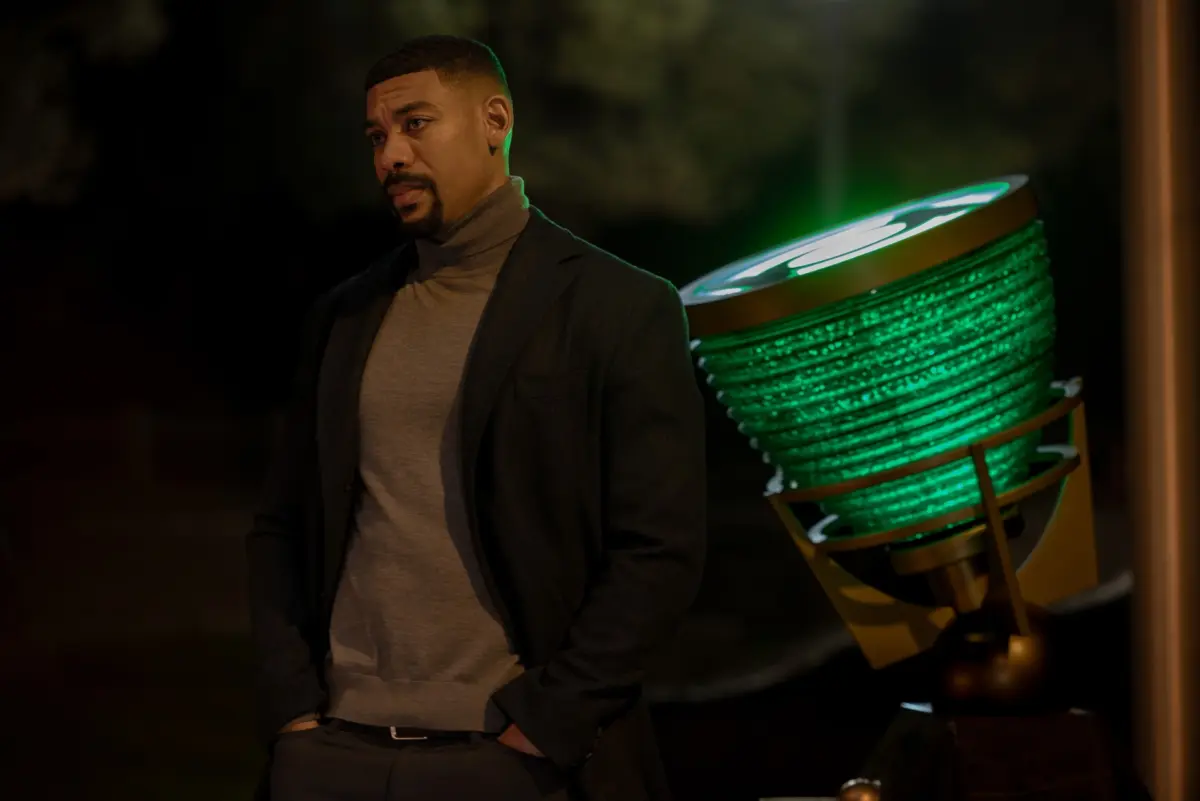
The conclusion of the inaugural season of HBO and DC Studios’ television series Lanterns has ignited intense debate across the science-fiction fandom, centering specifically on a subtle yet profound alteration to the iconic Green Lantern oath. As uttered by John Stewart—portrayed within the broader continuity of the DC Universe—the final lines of the season finale subvert decades of established comic book lore. Instead of reciting the traditional vow to vanquish fear, Stewart’s character boldly declares an intent to embrace it, setting up a complex narrative trajectory for future installments of the shared universe currently being architected by DC Studios co-CEOs James Gunn and Peter Safran.
The first season finale left viewers with a lingering ambiguity regarding the alignment of John Stewart, particularly as questions arose over whether the character is pivoting toward rogue status or incorporating elements historically associated with the Yellow Lantern Corps, traditionally fueled by the yellow light of fear. With the creative minds behind the production offering contrasting perspectives on the season’s final sequence, analysts and fans alike are dissecting the implications of Stewart’s symbolic departure from the standard Intergalactic Police Corps.
The Anatomy of the Alteration: Breaking Down Stewart’s Oath
To understand the gravity of the finale’s final sequence, one must examine the precise wording delivered by John Stewart. In the closing moments of season one, Stewart adapts the century-old creed: "In brightest day, in darkest night, I’ll embrace my fear, I’ll do what’s right. I choose this ring, I choose this fight in service to this lantern’s light."
This version deviates sharply from the traditional Green Lantern oath, which reads: "In brightest day, in darkest night, no evil shall escape my escape… let those who worship evil’s might, beware my power, Green Lantern’s light!"
By substituting the pledge to combat evil with a promise to "embrace my fear," the narrative introduces a fundamental philosophical shift. In the mythology of the DC Universe, the emotional electromagnetic spectrum governs various lantern corps, with green representing willpower and yellow representing fear—most notably wielded by the villainous Sinestro Corps. The deliberate modification of the oath signals a psychological integration of fear rather than its standard rejection, aligning with long-standing alternate-continuity comic storylines while charting a novel course for live-action television adaptation.
Creative Team Insights: Tom King and Chris Mundy Weigh In
In the wake of the season finale, key members of the Lanterns creative team have stepped forward to clarify the narrative intent behind Stewart’s paradigm-shifting declaration.
Renowned comic writer and series architect Tom King provided a direct assessment of the character’s current status within the cosmic hierarchy during recent post-finale interviews. According to King, the framing of the scene explicitly demonstrates that Stewart is no longer operating under standard Corps regulations.
"What we see at the end is that John is not 100% a Green Lantern anymore," King stated. He elaborated that the character utilizes a power source infused with the yellow attribute of fear, resulting in an "unsanctioned" status akin to a rogue operative. Because Stewart’s fundamental relationship with the power ring differs from his peers, his verbal affirmation necessarily reflects that existential divergence.
Showrunner Chris Mundy offered a complementary, more character-driven interpretation of the events. Mundy emphasized that Stewart’s journey to wielding the ring bypassed the traditional automated selection process seen with standard recruits.
"John’s path was not the normal path. The ring didn’t choose him; he was interviewed. He was raised for it," Mundy explained. The showrunner noted that Stewart initially resisted the burden before choosing to shoulder the responsibility entirely on his own terms. Regarding the dialogue rewrite, Mundy acknowledged the deliberate effort to honor the legacy of the original franchise while injecting thematic relevance centered around the psychological weight of fear.
Chronology of Development: From Comics to the Screen
The conceptualization and execution of Lanterns mark a pivotal milestone in the restructuring of DC’s live-action properties. Announced as a cornerstone of the newly minted DC Universe (DCU) Chapter One: Gods and Monsters slate, the television project was designed to adopt a grounded, prestige-drama approach reminiscent of True Detective, contrasting sharply with previous cosmic adaptations.
The inclusion of John Stewart alongside seasoned veteran Hal Jordan established a dynamic mentorship framework early in the season. Throughout the eight-episode run, the narrative steadily unspooled a cosmic mystery involving interplanetary conspiracies and jurisdictional friction within the Green Lantern Corps. The slow-burn pacing allowed the writers to establish Stewart’s psychological resilience, laying the groundwork for his eventual reliance on unconventional power sources—specifically, utilizing a relic associated with Sinestro to charge his ring when traditional battery access was compromised.
This trajectory reflects historical comic book precedents where characters like John Stewart or Kyle Rayner occasionally tapped into alternate emotional spectra. However, translating this dynamic into the primary live-action continuity represents an unprecedented narrative risk for Warner Bros. Discovery and DC Studios.
Broader Implications for the DC Universe Chapter One
As the entertainment industry awaits official confirmation regarding a potential second season, the ripples of Stewart’s transformation extend far beyond the confines of his standalone series. The interconnected nature of the DCU ensures that television events carry direct consequences for the broader cinematic landscape, overseen by James Gunn.
With upcoming cinematic projects such as Superman: Man of Tomorrow slated to further define the tone and texture of the shared universe, the status of earth’s localized guardians remains a critical variable. If John Stewart is operating as an unsanctioned, fear-wielding hybrid lantern, his relationship with the Guardians of the Universe—and with fellow human green lanterns—will inevitably face severe friction.
Furthermore, the thematic exploration of fear as a constructive, manageable element rather than an inherently corrupting force positions Stewart as one of the most psychologically complex heroes in modern superhero television. Whether this evolution leads to a formal schism within the Corps or establishes a new precedent for cosmic law enforcement will depend heavily on the greenlit continuation of the series and the overarching master plan devised by the DC Studios creative council.
For now, the audience is left in a state of suspended anticipation, mirroring the uncertain, independent path that John Stewart has chosen to walk at the conclusion of a landmark first season.