The cinematic landscape is often reshaped by the visionary storytelling of Steven Spielberg, and his latest offering, "Disclosure Day," co-written with screenwriter David Koepp, is no exception. This ambitious space-alien conspiracy adventure, while delightfully absurd, grapples with profound themes, blending the meticulous suspense reminiscent of Hitchcock’s "North by Northwest" with the intricate plotting of Christopher Nolan’s "Inception," all filtered through Spielberg’s signature blend of wonder and dramatic resonance. The director’s personal endorsement, as seen in the film’s trailer, where he expresses a profound belief in its narrative, echoes the earnest conviction of C.S. Lewis in his Narnian world, suggesting a deeply personal connection to the film’s speculative core.
"Disclosure Day" dares to take two of the most enduring hoaxes of the 20th century – the alleged alien crash at Roswell and the enigmatic phenomenon of crop circles – and imbues them with a surprising degree of deadpan seriousness. Spielberg, with his characteristic heartfelt idealism, prompts audiences to consider a future where the truth of extraterrestrial contact is revealed. The film posits that humanity’s primary reaction would be one of profound upset at the past mistreatment of captured alien life forms, a notion that, while noble, prompts a subtle analysis of human priorities in the face of such an unprecedented revelation. The film’s narrative framework suggests that the potential for widespread public outrage over ethical breaches in alien research might, in the grand scheme of global upheaval, be a secondary concern compared to the existential implications of such contact.
At the heart of this unfolding drama is Margaret Fairchild, portrayed with vibrant energy and comedic timing by Emily Blunt. Fairchild is a local TV weather presenter in Kansas City, Missouri, a profession often depicted as a symbol of superficial ambition. However, within the film’s escalating narrative, her character transcends this stereotype. During a tense period of international geopolitical instability, marked by escalating nuclear tensions with North Korea, Margaret experiences a bewildering encounter with a small red bird. This seemingly minor event acts as a catalyst, unlocking latent, almost telekinetic abilities within her. She finds herself speaking fluent Russian and Korean without any prior knowledge, demonstrating an uncanny ability to intuit the thoughts of a traffic officer, and on air, her pronouncements transform into an otherworldly, clicking language, akin to a dolphin relaying urgent cosmic dispatches. This transformation of a seemingly ordinary individual into a conduit for extraordinary knowledge underscores the film’s exploration of hidden potential and the unexpected ways truth can manifest.
Parallel to Margaret’s unfolding awakening is the perilous journey of Dr. Daniel Kellner, a brilliant cybersecurity analyst portrayed with a stoic, almost martyred determination by Josh O’Connor. Kellner is a whistleblower within the clandestine corporation known as Wardex. For decades, Wardex has operated in the shadows, advising successive U.S. administrations on managing "incursions from unusual parties" and the subsequent suppression of information. Kellner, now a fugitive, is in possession of a mysterious artifact, a MacGuffin of immense significance, which he intends to use to expose these deeply guarded state secrets. His companion in this dangerous endeavor is his girlfriend, Jane, played by Eve Hewson. Jane, a former novitiate nun, grapples with reconciling her lost spiritual path with the profound revelations she is now encountering, adding a layer of spiritual and existential conflict to their mission.

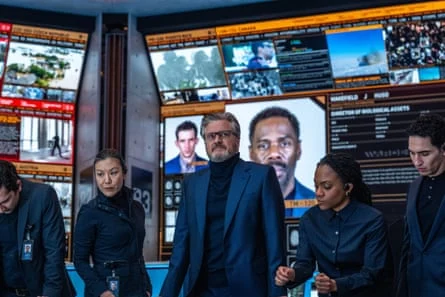
The pursuit of Kellner is orchestrated by Noah Scanlon, the formidable Wardex supremo, brought to life with chilling intensity by Colin Firth. Scanlon, characterized by his clenched jaw and impeccably tailored dark suits, embodies the embodiment of institutional secrecy and ruthless control. Yet, Kellner’s escape is not solely reliant on evading physical capture; he is also in clandestine communication with his former mentor and fellow whistleblower, Hugo Wakefield, portrayed by Colman Domingo. During one such crucial coordination call, Wakefield appears to be constructing an elaborate, almost occult stage set, a detail that subtly hints at the arcane and ritualistic elements potentially interwoven with the extraterrestrial narrative, drawing parallels to the genre-bending explorations seen in films like Kane Parsons’ "The Backrooms" and Nathan Fielder’s conceptually ambitious series "The Rehearsal."
The converging paths of Daniel Kellner and Margaret Fairchild culminate in a moment of profound, albeit terrifying, clarity. This shared epiphany signifies a surrender to forces beyond their comprehension, ushering them into a heightened, almost childlike state of awareness. It is a coronation of their intertwined purity and their profound emotional connection to beings who, the film suggests, prioritize empathy above all else. This idealistic notion of universal empathy is a recurring motif, prompting reflection on humanity’s own professed belief in its primacy and how it has historically intersected with complex geopolitical actions.
"Disclosure Day" is an undeniably entertaining film, a rare example of pure, unadulterated fun that propels itself forward with exhilarating set pieces, breathtaking chases, and sharp, witty dialogue. Emily Blunt delivers a performance that could be career-defining, potentially solidifying her as a formidable talent comparable to Tom Hanks in her ability to command the screen. However, the film occasionally revisits an age-old Spielbergian trope: the most potent antagonists, whether a shark or an alien, are often at their most terrifying when their presence is implied rather than explicitly revealed. While the film’s narrative benefits from its visual spectacle, there are moments where the direct depiction of the extraterrestrial elements risks undermining the subtle dread that characterized Spielberg’s earlier, more ambiguous encounters with the unknown.
Thematic Underpinnings and Societal Reflections
The film’s narrative is deeply rooted in historical events and persistent cultural phenomena that have fueled public fascination with extraterrestrial life. The Roswell incident of 1947, involving the alleged recovery of a crashed alien spacecraft and its occupants near Roswell, New Mexico, remains one of the most debated events in UFOlogy. Decades of declassified documents and eyewitness accounts have done little to quell the speculation, with proponents maintaining that the U.S. government has engaged in a sustained cover-up. Similarly, crop circles, intricate patterns appearing in agricultural fields, have captivated imaginations for decades, with theories ranging from elaborate hoaxes to more extraordinary explanations involving extraterrestrial intelligence. "Disclosure Day" synthesizes these enduring mysteries into a coherent, albeit fantastical, framework for exploring humanity’s relationship with the unknown.
Chronology of the Conspiracy
The film’s timeline suggests a multi-decade conspiracy orchestrated by Wardex. Established in the mid-20th century, the corporation’s mandate, as inferred from Daniel Kellner’s research, has been to manage and conceal evidence of extraterrestrial encounters. This timeline posits that governments, influenced by Wardex’s counsel, have systematically suppressed information, fostering an environment of skepticism and ridicule around the subject of UFOs and alien life. Kellner’s current actions represent a pivotal moment, an attempt to shatter this long-standing edifice of secrecy. The narrative implies that his efforts are not isolated but are part of a broader, albeit clandestine, movement of whistleblowers who have been working within the system to expose the truth.

Supporting Data and Scientific Context
While "Disclosure Day" operates within the realm of speculative fiction, its themes resonate with ongoing scientific and public discourse regarding the search for extraterrestrial intelligence (SETI). The discovery of thousands of exoplanets in recent years has significantly bolstered the scientific community’s belief in the potential for life beyond Earth. Projects like the James Webb Space Telescope are actively analyzing the atmospheres of distant planets for biosignatures, further fueling the scientific quest for answers. The film, however, shifts the focus from scientific discovery to the societal and governmental implications of confirmed contact, exploring the complex ethical and political challenges that would arise from such a paradigm-shifting event. The concept of "disclosure" itself has become a significant topic within UFO research communities, with many advocating for transparency from governments regarding their knowledge of unexplained aerial phenomena.
Inferred Statements and Reactions
Although the film does not present direct interviews with external parties, the narrative implicitly suggests a range of reactions. The fictionalized portrayal of government officials within Wardex’s purview indicates a deep-seated desire to maintain societal order and control, prioritizing stability over transparency. The public, as depicted through Margaret’s initial interactions, is largely unaware, existing in a state of comfortable ignorance. However, the film hints at a growing undercurrent of curiosity and a segment of the population that actively seeks answers, evidenced by the existence of whistleblowers like Kellner and Wakefield. The potential for widespread public shock and a reevaluation of humanity’s place in the cosmos is a central, implied consequence of the film’s titular "Disclosure Day."
Broader Impact and Implications
The film’s exploration of alien contact and government cover-ups raises significant questions about trust, truth, and humanity’s capacity for self-governance in the face of profound existential revelations. "Disclosure Day" suggests that the unveiling of extraterrestrial intelligence would not only challenge our scientific understanding but also our philosophical and religious frameworks. The potential for societal upheaval, ranging from widespread panic to a reawakening of spiritual or philosophical beliefs, is a potent implication of the film’s narrative. Furthermore, the film touches upon the ethical responsibilities that come with advanced technology and the potential for its misuse in controlling information and suppressing dissenting voices. The film’s concluding moments, while offering a sense of wonder and connection, also serve as a stark reminder of the complex and potentially unsettling realities that await humanity should the universe reveal itself in ways we have only begun to imagine.
Spielberg’s enduring fascination with childhood wonder and the transformative power of the unknown is palpable in "Disclosure Day." The film offers a poignant, albeit fantastical, recapturing of that primal sense of awe, a return to a state where the extraordinary was not only possible but actively sought. It is a cinematic journey that, much like his autobiographical "The Fabelmans," speaks to the enduring power of memory and the will to rediscover a past imbued with the potential for rapture. The film ultimately serves as a testament to Spielberg’s unique ability to blend spectacle with soul, inviting audiences to ponder the vastness of the universe and our own intricate place within it.