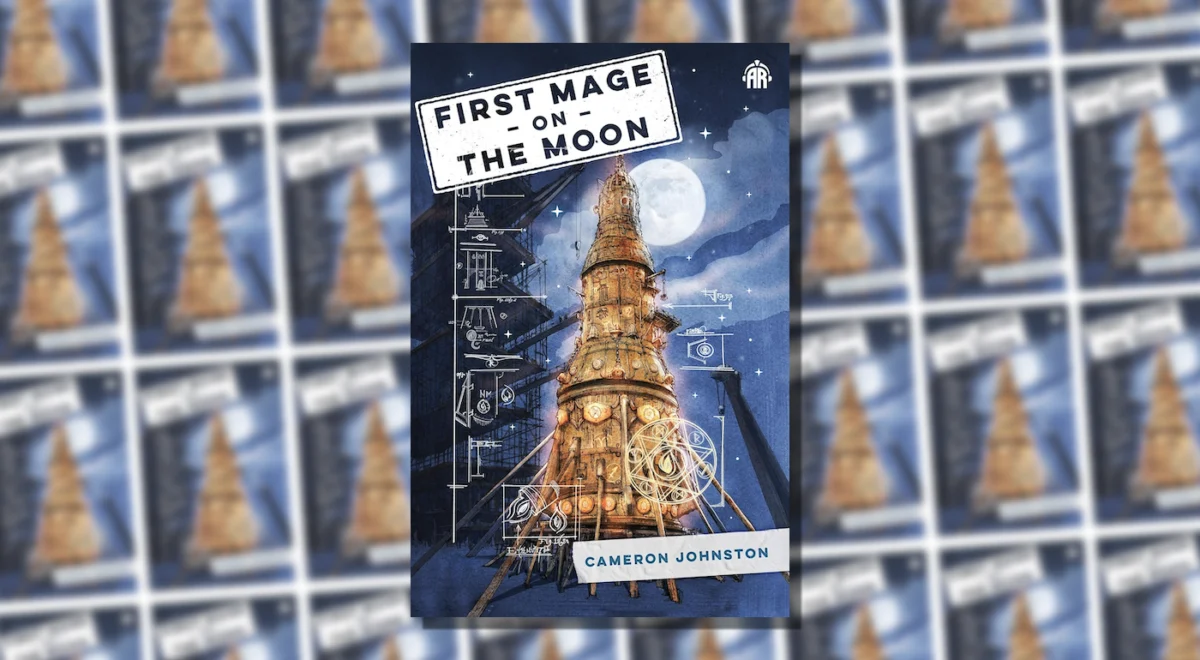
The realm of Unity finds itself on the precipice of an unprecedented endeavor, one that transcends the conventional boundaries of warfare and innovation. At the heart of this ambitious undertaking lies the vision of military engineer Ella Pickering, a visionary whose imagination was ignited by a serendipitous encounter with alchemical forces. A stray bolt of lightning, channeled through an alchemical cannon, not only illuminated the night sky but also sparked a revolutionary idea within Pickering: the possibility of harnessing such potent energy to journey to the moon. This celestial body, a distant silver disk 240,000 miles away, has long been the subject of myth and lore, housing the fabled Silver Palace of the gods. For centuries, these divine entities have silently observed the protracted and devastating conflict between the nation of Unity and the Ranneas Empire, a struggle that has bled both nations into a ruinous stalemate. While prayers and pleas for divine intervention have yielded no solace, Pickering posits a bold, almost heretical, proposition: an emissary dispatched to the heavens to demand an end to the bloodshed.
This audacious plan, deemed mad and treacherous by some, and deeply blasphemous by others, hinges on the ingenuity of Unity’s brightest minds. However, securing official military funding for such a speculative project, one not directly aimed at enhancing military might against the Empire’s mages and princes, proves to be an insurmountable obstacle. The military establishment, entrenched in the pragmatic realities of ongoing conflict, views such a venture as unthinkable. Yet, Jackan Grissom, the man overseeing the alchemical design department, finds himself captivated by Pickering’s moonshot concept. Weary of his role in forging instruments of destruction, Grissom yearns for alchemy to serve a more noble purpose, a sentiment that aligns perfectly with Pickering’s aspirations. Together, they embark on the complex calculations, meticulously detailing the combination of gunpowder, flame, and levitation runes required to break free from Earth’s gravitational pull and venture into the void of space.
The scope of the project expands as other key figures become involved. Jackan Grissom, alongside the ambitious Guylan Bluford, retrieves an experimental prototype from the desolate and magically scarred landscape of No Man’s Land. This retrieval mission is fraught with peril, as they are ambushed by mages from the Ranneas Empire, intent on seizing Unity’s advanced technology. In a tense confrontation, Grissom manages to broker a fragile truce by revealing the true nature of their creation – a rocket devoid of any combat capabilities. This revelation profoundly impresses Imperial Sergeant Andriyan Korolev, who, while allowing them to depart with half the prototype, promises to report back to his superior, Taeban Tereshkova. Bluford, initially skeptical of Grissom’s conciliatory approach, eventually embraces the project, recognizing the immense prestige and glory that would accompany being the first to achieve spaceflight. Back at Unity’s base, Ella Pickering, ever the astute recruiter, enlists the aid of Katherine Goddard, a mathematical prodigy whose cheerful demeanor belies her sharp intellect. To secure the necessary resources, Pickering employs a masterful deception, assuring a captivated noble that their research is solely focused on developing a method to drop war golems behind enemy lines, a prospect that elicits enthusiastic support and promises of near-unlimited funding. The realization dawns, however, that this funding, intended for military application, is now being diverted to a moon landing – a transgression that escalates from potential treason to a definitive act of defiance against the established order.
The Allure and the Challenge of Lunar Ambition
The ambition to reach the moon, a concept that has captivated humanity for millennia, takes on a unique dimension within the narrative of First Mage on the Moon. The book’s premise, blending arcane arts with nascent aerospace engineering, presents a fascinating reimagining of historical challenges. The fundamental principles of rocketry, particularly the exponential increase in fuel requirements dictated by the Tsiolkovsky rocket equation, are ingeniously addressed through magical means. Ella Pickering’s expertise as a skymage allows her to devise levitation runes, effectively circumventing the fuel-intensive limitations of conventional rocketry. Similarly, the life-sustaining challenge of providing breathable air in a sealed capsule for an extended journey is overcome by summoning air elementals, a feat far more practical within this magical framework than advanced atmospheric processing. The necessity for wireless communication is also elegantly solved through scrying crystals, a magical analogue to radio technology.
A Linear Trajectory: The Narrative’s Ascent and Descent
Despite its innovative approach to technical challenges, First Mage on the Moon is criticized for its narrative structure. The story, characterized by its relentless forward momentum directly towards the lunar objective, is perceived to steamroll over opportunities for character development and suspense. The review highlights a missed opportunity to explore the potential spiritual and philosophical conflicts that might arise from a society deeply rooted in religious faith attempting to ascend to the celestial abodes of deities. In a world where prayers are offered for storms and priests guide souls to the underworld, the prospect of standing as equals with the gods in their Silver Palace presents a profound theological quandanza. However, the narrative sidesteps these complexities, with the characters exhibiting no apparent religious qualms about their lunar ambition. Even enemy combatants, such as Andriyan Korolev and Taeban Tereshkova, are depicted as readily embracing the moonshot once its purpose is explained, their initial animosity dissolving in the face of this shared, awe-inspiring goal. This lack of internal conflict and unwavering commitment from all involved, while simplifying the logistical hurdles, diminishes the narrative tension and reader engagement.

The Craft of Storytelling: Prose and Exposition
Beyond its narrative trajectory, the book’s prose is also subject to critique for its directness and lack of subtlety. Passages are cited where characters explicitly articulate their emotions and motivations, a technique that, while ensuring clarity for a passive audience, sacrifices the richness of implied meaning and reader interpretation. An example provided illustrates an engineer stating, "So, we don’t like each other much. That’s fine, but know I will watch your back out there. Let’s get this over with and get back to proper work as soon as we can," a line that spells out the animosity and underlying loyalty rather than allowing the reader to infer it. Similarly, a narration that states, "Her self-recrimination gave way to anger and a measure of paranoia," after a character’s emotional arc, is seen as overly expository. This "casual viewing" style of writing, where every element is explicitly explained, is contrasted with the more profound literary experience of books that invite readers to actively engage their imaginations and interpret character actions. For a story that purports to explore themes of aspiration and wonder, the narrative’s insistence on overt explanation leaves little room for the reader’s imagination to soar.
Contextualizing the Ambition: Historical Parallels and Real-World Echoes
The drive to explore the unknown, particularly the vast expanse of space, has historically been a powerful motivator for scientific and technological advancement. The mid-20th century Space Race between the United States and the Soviet Union serves as a potent historical parallel, a period marked by intense competition, groundbreaking innovation, and immense national pride. The Apollo program, culminating in the 1969 moon landing, was not merely a scientific achievement but a geopolitical statement, demonstrating the technological prowess and unwavering resolve of a nation. The famous words of President John F. Kennedy, "We choose to go to the moon, not because it is easy, but because it is hard," encapsulate the spirit of that era, a testament to humanity’s capacity to overcome monumental challenges for the sake of progress and discovery.
In contemporary times, the ambition to return to the moon and establish a sustained presence is experiencing a resurgence. Initiatives like NASA’s Artemis program aim to land the first woman and the next man on the lunar surface, paving the way for long-term exploration and resource utilization. The recent successful splashdown of the Artemis II astronauts, carrying the hopes of the world, underscores the enduring inspiration that space exploration continues to evoke. This real-world context highlights the inherent human fascination with the cosmos and the drive to push the boundaries of what is possible.
Implications and the Future of Lunar Endeavors
The narrative of First Mage on the Moon, despite its literary shortcomings, taps into this deep-seated human desire for exploration. The idea of combining magic and science to achieve such a monumental feat presents a compelling "what if" scenario. The implications of such a successful mission, even within a fictional context, are far-reaching. It could signify a paradigm shift in inter-factional relations, potentially forcing warring nations to confront shared challenges and cooperate for the greater good. The discovery of resources or advanced knowledge on the moon could alter the balance of power and reshape the geopolitical landscape.
However, the critique of the book’s execution suggests that a compelling premise is only the first step. The true success of any endeavor, whether fictional or real, lies not only in the ambition but also in the meticulous planning, the overcoming of unforeseen obstacles, and the nuanced portrayal of the human experience within those challenges. As the real-world Artemis program continues to push the boundaries of human exploration, the fictional narrative of First Mage on the Moon serves as a reminder that while the destination may be inspiring, the journey, and how it is told, is equally crucial.
First Mage on the Moon is published by Angry Robot.