Based on Satoru Noda’s multi-awarded manga, which has sold over 18 million copies, the anime adaptation of Golden Kamuy stands as one of the most distinctive and impactful titles of the past decade. The series, which began its televised run in 2018, concluded with its final season in 2026, solidifying its reputation as a unique blend of historical adventure, ethnographic exploration, and intense action. The adaptation initially saw Hitoshi Nanba at the helm before Shizutaka Sugahara took over directing duties, with production transitioning from Geno Studio to Brain’s Base across its five seasons.
From its inception, Golden Kamuy carved out a singular niche within the shonen landscape by placing a strong emphasis on an Ainu protagonist and meticulously portraying the language, culture, and customs of Japan’s indigenous people. This commitment to authenticity was not merely superficial; it was rigorously supervised by Hiroshi Nakagawa, a distinguished Ainu language linguist. This dedication ensured a level of cultural fidelity rarely observed in mainstream anime, transforming the series into both an entertaining narrative and an educational resource. The resulting work consistently transcended its minor narrative and pacing issues, providing audiences with an immersive and informative experience that stands apart in the medium.
A Chronology of Acclaim and Production
The journey of Golden Kamuy began in August 2014 with the serialization of Satoru Noda’s manga in Shueisha’s Weekly Young Jump. The manga quickly garnered critical praise, winning the prestigious Manga Taishō award in 2016 and the Grand Prize at the 22nd Tezuka Osamu Cultural Prize in 2018, underscoring its significant impact on the industry. Its serialization concluded in April 2022, accumulating 31 tankōbon volumes and a dedicated global fanbase.
The anime adaptation commenced in April 2018 with its first season, directed by Hitoshi Nanba at Geno Studio. Its immediate success led to a second season, which aired just months later in October 2018, maintaining the initial production team and high standards. The third season followed in October 2020, further cementing the series’ critical and commercial appeal. A notable shift occurred with the fourth season, which premiered in October 2022, when Brain’s Base took over animation production, with Shizutaka Sugahara stepping in as director. This season, while praised for its continued narrative depth, experienced a brief hiatus due to production challenges, resuming its broadcast in April 2023. The eagerly anticipated final season, bringing the saga to its conclusion, was announced for 2026, promising a climactic resolution to the long-running treasure hunt. Throughout its run, the anime consistently maintained high production standards, with each season building upon the last, refining animation quality and deepening character development, even when facing production transitions.
The Post-War Hokkaido Setting and Central Conflict
The narrative of Golden Kamuy unfolds in the harsh, unforgiving landscapes of Hokkaido in the aftermath of the Russo-Japanese War (1904-1905). This conflict, a pivotal moment in early 20th-century global geopolitics, saw Japan emerge as a major world power, but at a tremendous cost in human lives and resources. The series expertly captures the grim reality faced by returning veterans, many of whom struggled with physical and psychological trauma and economic hardship.
At the heart of the story is Saichi Sugimoto, a decorated veteran of the Battle of 203 Hill, a notoriously brutal siege during the Port Arthur campaign. His ferocity in combat and uncanny ability to survive earned him the moniker "Immortal Sugimoto." Haunted by the promise to provide for the widow of a fallen comrade, Sugimoto now toils as a gold miner in Hokkaido. His life takes a dramatic turn when he learns of a vast, hidden trove of Ainu gold, rumored to be enough to spark a revolution. The location of this legendary treasure is ingeniously encoded in the elaborate tattoos covering the bodies of escaped convicts from Abashiri Prison, a notorious penal colony in northern Japan known for its harsh conditions.
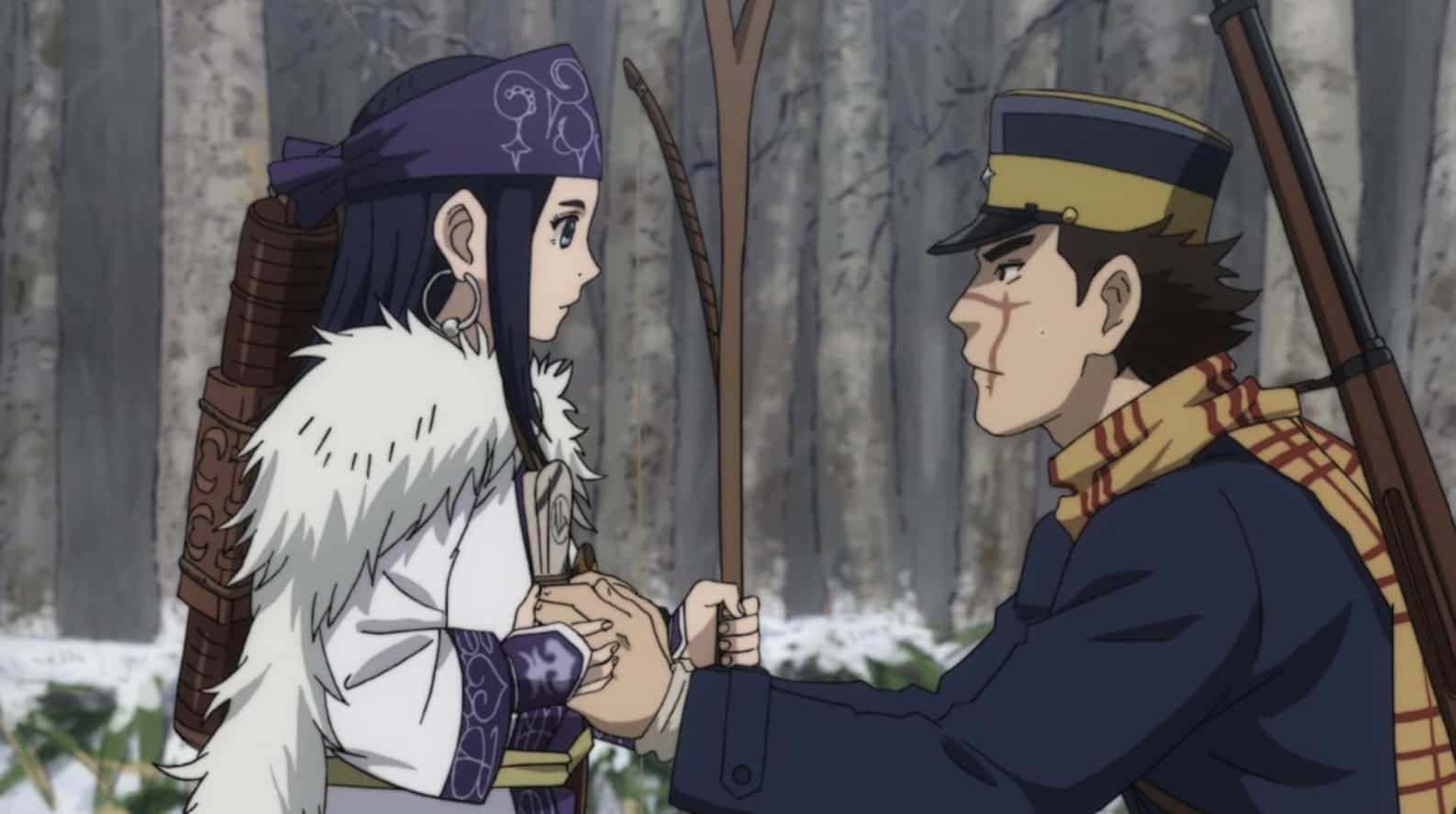
Sugimoto’s quest quickly intertwines with that of Asirpa, a resourceful young Ainu girl who saves him from a bear attack. Asirpa’s father was deeply involved in the gold’s history, making her an indispensable guide to the Ainu culture, survival skills, and the true meaning behind the cryptic tattoos. Their unlikely partnership forms the emotional core of the series, driven by mutual goals and a growing bond of trust and respect.
As they journey through the treacherous terrains of Hokkaido and beyond, Sugimoto and Asirpa encounter a diverse and often dangerous array of allies and adversaries. Key among these are Yoshitake Shiraishi, a master escape artist whose cunning often provides unexpected aid, and formidable antagonists such as Lieutenant Tokushiro Tsurumi. Tsurumi, the sociopathic leader of the 7th Division of the Imperial Japanese Army, seeks the gold to fund his own ambitions of establishing an independent Hokkaido, driven by a warped sense of patriotism and the psychological scars of war. Another powerful figure is the legendary Toshizo Hijikata, the last samurai and a historical figure who fought for the Tokugawa Shogunate during the Boshin War (1868-1869). Now an aging but still formidable warrior, Hijikata seeks the Ainu gold to resurrect a new republic in the north, embodying the dying embers of a bygone era. The intricate web of shifting alliances, betrayals, and desperate pursuits for the gold propels the multifaceted narrative forward.
Deep Dive into Ainu Culture and Historical Context
One of Golden Kamuy‘s most profound contributions to the anime landscape is its meticulous and respectful portrayal of Ainu culture. The Ainu are an indigenous people of northern Japan, particularly Hokkaido, and parts of Russia (Sakhalin and the Kuril Islands). For centuries, they faced assimilation policies and discrimination from the Japanese government, leading to the erosion of their language, traditions, and land rights. Golden Kamuy serves as a vital platform for raising awareness and appreciation for their rich heritage.
The series integrates Ainu language, customs, and spiritual beliefs into every facet of the narrative. Audiences are introduced to key Ainu concepts such as "kamuy," the divine spirits that inhabit all aspects of nature, from animals and plants to mountains and rivers. This spiritual worldview deeply influences Ainu interactions with their environment, particularly their hunting practices, which are conducted with reverence and gratitude. The preparation and consumption of food are also presented with remarkable detail, from the making of "chitatap" (minced meat dish) to the intricate process of preparing bear meat, turning these everyday activities into integral storytelling elements that highlight cultural differences and survival strategies.
Hiroshi Nakagawa’s role as an Ainu language linguist supervisor was instrumental in ensuring the accuracy of dialogues, pronunciations, and cultural nuances. This rigorous approach extends to the depiction of Ainu clothing, tools, hunting rituals (such as the "iomante" bear ceremony), and their profound connection to the natural world. Through Asirpa’s teachings, Sugimoto – and by extension, the audience – learns about edible plants, animal tracking, and sustainable living, providing a fascinating educational layer that enriches the adventure narrative. The series not only showcases these elements but also explores the historical pressures the Ainu faced, offering subtle commentary on colonization and cultural resilience.
Beyond the Ainu, Golden Kamuy broadens its ethnographic scope to include other indigenous groups, such as the Matagi, traditional Japanese winter hunters. The narrative also delves into Russian culture and history, particularly as the search for gold extends to Sakhalin. This expansion incorporates historical parallels to revolutionary movements and the complex geopolitical landscape of the region following the Russo-Japanese War, adding layers of historical depth and intrigue.
Genre Blending and Narrative Dynamics
Golden Kamuy masterfully blends various genres, distinguishing itself from conventional shonen anime. While it features intense action and a clear quest, its mature themes, explicit violence, complex moral ambiguities, and focus on adult characters set it apart. It operates simultaneously as a historical drama, a survival thriller, a dark comedy, and an ethnographic study.
The action sequences are brutal and intricately choreographed, emphasizing the physical toll of combat in a harsh wilderness. Sniper duels, close-quarters knife fights, and large-scale skirmishes are executed with precision and intensity. The survival aspect is equally prominent, with characters constantly battling not just human adversaries but also the formidable forces of nature. Bears, wolves, wolverines, and even Siberian tigers become integral, terrifying elements of the narrative, forcing all factions to adapt or perish.
A defining characteristic of Golden Kamuy is its unique brand of dark, often absurd humor. This "pedantic humor" manifests through exaggerated expressions, bizarre character quirks, and comedic interludes that often juxtapose sharply with the preceding violence or drama. While initially serving as an effective counterpoint, this comedic balance occasionally becomes uneven in later seasons, sometimes detracting from the narrative tension. However, when successfully implemented, the crude humor aligns well with the rough-and-tumble historical context and even reflects aspects of traditional Ainu storytelling, which often incorporates bawdy or exaggerated elements. This unpredictable tonal shift is a hallmark of the series, contributing to its distinct identity.
The narrative structure also evolves throughout its run. While earlier seasons maintain a relatively cohesive storyline centered on the immediate hunt, later seasons adopt a more episodic, road-movie approach. This allows for a broader exploration of characters and themes as the groups encounter diverse individuals and situations in each episode. While this "villain of the week" format occasionally risks diluting the main plot, it also provides opportunities for rich character development and the introduction of new cultural and historical facets. The constantly shifting alliances, where former enemies may become temporary allies, add an unpredictable and thrilling dimension to the evolving quest.
Technical Excellence and Artistic Craftsmanship
From a technical standpoint, Golden Kamuy consistently showcases a high level of craftsmanship, even amid changes in production staff and studios. The series’ visual presentation is a cornerstone of its appeal.
Kenichi Oonuki’s character designs for the initial seasons are exceptional, rendering each character with meticulous detail and distinct personalities. This attention to detail results in a cast of truly memorable figures, whose appearances vividly reflect their inner selves and backgrounds. Even when drawing inspiration from other works, the designs maintain a unique identity. When Takumi Yamakawa took over in later seasons, the designs remained strong, though the sheer number of characters occasionally led to some figures appearing somewhat similar, a minor drawback in an otherwise impressive roster.
The animation, initially spearheaded by Geno Studio, is excellent. It features highly realistic movement in non-action sequences, grounding the characters in their environment. During action scenes, the choreography is impressively dynamic and fluid, capturing the brutality and speed of combat. The depiction of violence is particularly noteworthy, with intricate and visceral encounters that emphasize the physical toll on the characters. While the CGI used for certain animals, especially bears, could be improved in earlier seasons, it generally does not significantly detract from the overall quality.
With the transition to Brain’s Base for the later seasons, the animation quality remained robust. Character movement retained its fluidity, and interactions with the environment became even more refined. The action sequences reached their peak in the final season, with both one-on-one duels and large-scale battles executed with remarkable precision and intensity. The sniper duel, in particular, stands out as a masterclass in tension and visual storytelling, both aesthetically compelling and narratively crucial.
The backgrounds and environmental design deserve significant praise. The series captures the harsh, often brutal beauty of Hokkaido, Sakhalin, and other locations with a high degree of detail and historical accuracy. Snow-covered forests, desolate plains, dense woodlands, and burgeoning urban settings are all rendered with care, contributing significantly to the immersive quality of the narrative. While the coloring occasionally appears somewhat too bright for the story’s grim tone, the overall visual presentation remains a powerful element of the series. The precise integration of cultural elements into the visual design, such as Ainu clothing, tools, and the intricate details of food preparation, further enhances the authenticity and depth of the series’ world-building.
The musical score and opening and ending themes also contribute significantly to the series’ distinctive atmosphere. Tracks like "Reimei" and "Tokeidai no Kane" stand out for their ability to complement the tone, amplify emotional impact, and provide memorable auditory identifiers for each season. The voice acting across all characters is consistently strong, bringing depth, humor, and pathos to the diverse cast.
Broader Impact and Enduring Legacy
Golden Kamuy ultimately emerges as a truly great series that largely transcends its few issues, seamlessly combining intense action, complex characters, and a profound exploration of history and culture. While certain aspects, such as the occasional uneven balance between drama and comedy or the narrative’s fragmentation in later seasons, might prevent it from achieving absolute perfection, these flaws are relatively minor in the context of its overall achievements.
The anime has not only entertained but also educated its global audience, sparking interest in Ainu culture, Japanese history, and the broader context of indigenous peoples. Its meticulous research and respectful portrayal of the Ainu, supervised by an actual Ainu linguist, set a new standard for cultural representation in mainstream media. This commitment to authenticity has been widely lauded by critics and cultural commentators, underscoring the series’ significant contribution to cultural discourse.
Across its multiple seasons, the anime consistently retained the high standards set at its beginning, continually improving its shortcomings and building upon the legacy of one of the most compelling series of recent years. Its unparalleled ability to blend historical realism with genre conventions, and to present a diverse and memorable cast of characters driven by multifaceted motivations, ensures its place among the most significant anime productions of its era. As the story concluded with its final confrontation for the Ainu gold, Golden Kamuy left an unwavering legacy of intrigue, education, and entertainment, securing its status as a landmark achievement in animation.