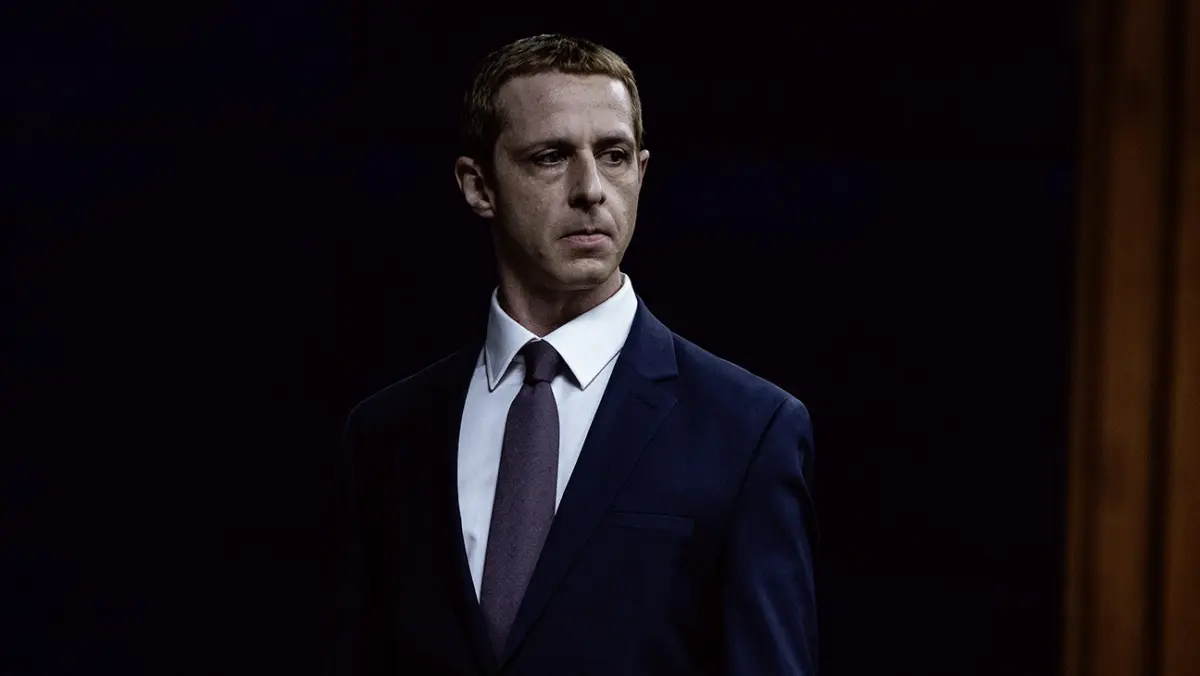
Jeremy Strong, the Emmy-winning star of HBO’s Succession, has issued a definitive stance regarding his controversial approach to performance, asserting that while he never intends to disrupt his colleagues, he refuses to apologize for the intensity of his craft. The actor, currently receiving critical acclaim and an Oscar nomination for his role in The Apprentice, addressed the persistent narrative surrounding his "method" acting during a recent appearance on The New Yorker Radio Hour. His comments come at a time when the efficacy and ethics of immersive acting techniques are being scrutinized more heavily than ever within the Hollywood community.
Strong’s philosophy, which often involves profound, round-the-clock immersion into the psychological makeup of his characters, has long been a subject of public fascination and private tension. While his results—characterized by a high degree of authenticity and emotional nuance—are rarely questioned, the professional friction his process occasionally causes remains a point of contention.
The Evolution of a Contested Craft
Method acting, a set of techniques originated by Constantin Stanislavski and popularized in the United States by Lee Strasberg and Stella Adler, has historically been viewed as the gold standard for dramatic realism. However, in the modern studio environment, where productions require rapid turnaround times and high-level interpersonal coordination, the boundaries between the actor and the role have become increasingly blurred.
Strong’s career trajectory, marked by his transformative turn as Kendall Roy in Succession, brought these tensions into the public consciousness. During his tenure on the series, his tendency to remain in character between takes and his demanding, singular focus on the material sparked public criticism from veteran cast members, most notably Brian Cox. In a viral 2021 New Yorker profile, Cox described the approach as a "particularly American disease," suggesting that such intensity is unnecessary for a professional ensemble and can foster a climate of hostility on set.
For Strong, the criticism is fundamentally a misunderstanding of his objectives. "It is never my intention to interfere with anyone else’s experience or anyone else’s way of working," he told host David Remnick. "First, do no harm, right? But commit to what you’re doing, and utterly."
Chronology of Tensions and Public Discourse
The dialogue regarding Strong’s methodology has unfolded over several years, punctuated by specific projects that highlighted his unconventional process:
- 2018–2023 (The Succession Era): As the Succession phenomenon grew, reports emerged of the "difficult" environment created by the show’s intense rehearsal and performance process. While the cast generally lauded the show’s quality, anecdotes about Strong’s isolation from the group solidified his reputation as an actor who prioritized the internal life of his character over the social dynamics of the set.
- December 2021: The publication of a New Yorker profile by Michael Schulman catalyzed the debate. The article painted a portrait of a man so deeply invested in Kendall Roy that he seemed to lose the ability to distinguish between the performance and reality, drawing sharp rebukes from his peers.
- 2024 (The Apprentice): In his portrayal of Roy Cohn in The Apprentice, Strong’s dedication was evidenced by his active contribution to the film’s structure, including the addition of scenes not present in the original script. This level of involvement, while lauded by directors for its creative insight, reignited discussions regarding the boundaries between actor and collaborator.
- 2025 (The Social Reckoning): Most recently, Aaron Sorkin’s The Social Reckoning provided a case study in how directors perceive Strong’s process. Unlike critics who view the method as a nuisance, Sorkin embraced it, actively managing the set environment to accommodate Strong’s total immersion as Mark Zuckerberg.
The Director’s Perspective: Managing the Intensity
The friction often reported on sets featuring method actors is frequently a matter of management rather than purely interpersonal conflict. Aaron Sorkin’s approach to working with Strong on The Social Reckoning suggests that the perceived "hostility" is often a deliberate, if difficult, tool for achieving a specific dramatic result.
Sorkin’s account of the production illustrates a high level of intentionality: "I told all the other actors in his scenes: ‘Guys, he’s not going to be hanging out with you at craft service. He’s not going to be yucking it up with you between takes. He is going to treat you the way he imagines Mark treats the people around him.’"
This validation from a high-profile director highlights a significant divide in the industry. For some, the actor’s job is a trade—a collaborative, social exercise in professional performance. For others, like Strong, it is a form of psychological exploration that requires a complete shedding of the self. Sorkin’s conclusion, "You cannot argue with the results," serves as the primary defense for practitioners of the method.
Analysis: The Impact on Ensemble Dynamics
The implications of this debate extend beyond the individual actor. In an era where "on-set culture" and "psychological safety" are prioritized, the traditional view of the "tortured artist" is under fire.
Data from film studies and actor union surveys suggest that collaborative environments generally report higher satisfaction and lower turnover rates. However, the quality of artistic output is harder to quantify. Strong argues that the discomfort felt by his peers is often personal, rather than professional. "If some people feel that I’m taking it too seriously, or it changes the molecules in the room in a way that makes something uncomfortable, I guess that’s something that I don’t feel that I need to apologize for," he asserted.
From a production standpoint, this creates a binary: either the director accommodates the actor’s need for isolation and character-based intensity, or they enforce a strict professional boundary that may limit the actor’s performance. Strong’s success suggests that as long as his performances remain of the highest caliber, directors will continue to provide the space he requires, even if it disrupts the traditional social fabric of the set.
Reflections on the "Safe Forum"
Strong’s relationship with the media has also been tempered by his past experiences. Reflecting on the 2021 New Yorker piece, he admitted to feeling betrayed by what he believed would be a "safe forum." This sense of vulnerability has made him more cautious in how he discusses his craft, though it has not dampened his commitment to the work itself.
When asked if he felt hurt by the dismissive comments of his Succession co-stars, Strong acknowledged the pain but contextualized it within the broader framework of their relationship. "We’re a family in every sense of the word," he noted. "But foundationally, there’s deep respect and even love." This nuance is often lost in the headlines, where "feud" narratives gain more traction than the complexities of long-term professional relationships.
Future Implications for the Craft
As Strong prepares for his upcoming roles, the discourse surrounding his work serves as a microcosm for a larger shift in Hollywood. The industry is currently balancing the need for efficient, respectful workplaces with the historical veneration of "the method."
If, as Strong suggests, the reactions to his process are often born of personal discomfort rather than professional failure, the future of the industry may see a more segmented approach to casting and set management. Directors may be increasingly required to disclose the intended acting style of lead performers to the ensemble beforehand, a practice already seen in Sorkin’s handling of The Social Reckoning.
Ultimately, Jeremy Strong stands as a sentinel for a dying breed of performer—one who prioritizes the truth of the character over the comfort of the set. Whether this approach remains sustainable in an increasingly bureaucratic and team-oriented industry remains to be seen, but as long as the critical reception to his work remains as positive as it has been for his recent performances, the debate is unlikely to resolve in favor of moderation. For Strong, the "molecules in the room" changing is not a side effect of his acting; it is the purpose of it.