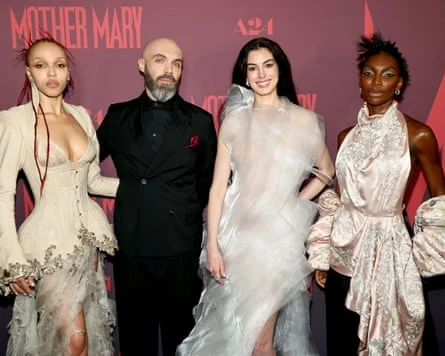
As David Lowery meticulously crafted the persona of Mother Mary, the fictional pop superstar at the heart of his latest film, his sonic landscape was initially dominated by the titans of contemporary music. For the initial stages of development, the director immersed himself in the sounds that defined the last quarter-century of the pop industry. This deep dive included extensive listening sessions featuring Taylor Swift, whose powerful stadium performances in her "Reputation" concert film served as a direct inspiration for the on-screen renditions within "Mother Mary." The introspective artistry of Lorde and the boundary-pushing experimentalism of FKA twigs, who portrays Imogene, a medium in the film, also formed crucial sonic touchstones. However, as the narrative of "Mother Mary" evolved from a broad exploration of pop stardom to a more intimate, haunted love story between the titular artist, portrayed by Anne Hathaway, and her former best friend and designer, Sam Anselm, played by Michaela Coel, Lowery’s musical inclinations underwent a significant metamorphosis.
The Shifting Sonic Palate of "Mother Mary"
"The pop music began to recede, and other sonic textures started to enter that creative space," Lowery explained during an interview with A24 in their New York offices, seated alongside FKA twigs and Anne Hathaway the day after the film’s premiere in the city. This shift in his musical focus was directly linked to the evolving emotional core of the film. "James Blake and Aldous Harding, in particular, really captured the raw emotion I was trying to articulate in the complex dynamic between Sam and Mother Mary. Their music became instrumental in helping me channel the very essence and feeling of the movie itself."
This duality in the film’s approach is reflected in its structural and thematic division. One segment presents a starkly intimate two-woman drama, primarily unfolding within the confines of Sam Anselm’s atelier. Here, a broken and profoundly humanized Mother Mary is depicted pleading with her former confidante for a dress so exceptional that it might facilitate a genuine pop rebirth. This contrasts sharply with the other facet of the film, which showcases Mary in her full, god-like pop diva regalia, commanding colossal stages with an otherworldly magnetism that underscores her status as a cultural icon who has cultivated a fervent, almost cult-like, multi-generational fanbase.
Anne Hathaway, tasked with embodying the deeply vulnerable and desperate humanity of Mother Mary before her public resurgence, found herself entering the production with a degree of uncertainty regarding the sonic landscape of the character’s music. "There were almost department heads for different aspects of the character," Hathaway recounted. "I felt like her sound was pretty low on the totem pole, especially when we began." Her initial exposure to the music was limited to early demos of songs like "Burial" and "Holy Spirit," which were penned by the acclaimed artists Charli XCX and Jack Antonoff.
The Soundtrack as a Character
While "Mother Mary" has garnered a polarized reception in its early critical reviews, the film’s musical elements and performance sequences have been widely lauded. The lion’s share of the soundtrack was meticulously composed by Jack Antonoff and Charli XCX. A notable exception is "My Mouth Is Lonely for You," a sensuously evocative track contributed by FKA twigs. This particular song, however, was ultimately omitted from the final cut, having been developed during her "Eusexua" sessions.
"I really love the lyrics, but I knew it wasn’t for me [in its original context]," FKA twigs shared. She explained that she submitted two songs to Lowery when he expressed a need for additional musical material for the film. The other track, described as more "ethereal," is utilized during a pivotal scene where Mary commissions the crucial dress from Sam. "As soon as David said he needed a song, I knew I wrote [My Mouth Is Lonely for You] for a reason," twigs added, underscoring the serendipitous alignment of her creative output with the film’s narrative requirements.

Even though FKA twigs’ contributions were developed independently of Antonoff and XCX’s work, the collective soundtrack coalesces to paint a distinct and cohesive portrait of a 21st-century pop phenomenon. This artist is portrayed as being of a magnitude sufficient to fill vast arenas, yet possessing a unique artistic sensibility that cultivates both a devoted underground following and an avant-garde fashion acumen. This artistic trajectory mirrors the recent career milestones of both FKA twigs and Charli XCX, both of whom have spent over a decade in the industry, recently achieving significant accolades such as their first Grammy Awards and headlining arenas for the first time. Nonetheless, the film subtly implies that its fictional pop diva possesses a slightly more polished and broadly accessible commercial appeal. Intriguingly, the narrative bypasses a detailed exposition of her commercial success, allowing the power of the performances and the resonance of the songs to speak for themselves.
"For me, Mother Mary represents a style that is almost on the other side of the glass from my own," FKA twigs elaborated. "Even within my own industry, there’s a level of stardom that I’ve observed from a distance, a kind of visibility that she truly embodies. Everything about her appears so meticulously curated, so flawless, so immense, and overwhelmingly perfect."
Hathaway’s Transformative Vocal Journey
Anne Hathaway, despite her formidable background in theater and her Academy Award-winning performance in the musical "Les Misérables," found the recording process for Lowery’s film to be a profoundly novel experience. She dedicated significant time to working with Jack Antonoff to record "Mother Mary: Greatest Hits," the aptly titled soundtrack album. This endeavor required her to explore not only her vocal capabilities but also to gain an understanding of the intricacies of music production. Hathaway even took the initiative to modify minor lyrical passages, having lived with the character for an extended period and developed an intimate understanding of her authentic voice and potential reservations. In collaboration with Antonoff, she advocated for a nuanced approach to sound layering, drawing significant inspiration from Tori Amos’s seminal album "Little Earthquakes," which served as a pivotal reference point as she delved into the character of Mary.
"One of the things I realized is that lyrics are very important, but the feeling of the lyrics is the most important," Hathaway explained. She referenced the recording of Earth, Wind & Fire’s iconic hit "September" as an illustrative example, noting how the band members may not have fully grasped the song’s precise lyrical meaning but nevertheless managed to transform it into one of the most universally recognized and beloved songs of all time. "The way you perform the sound of a word is just as, if not more, important than the word itself."
The Unseen Force of Fandom
A palpable specter looms over the relationship between Mary and Sam, but the unspoken ghost in the narrative is the immense and implicitly understood fandom that Mother Mary has cultivated. Lowery deliberately chose not to make this aspect explicit, allowing it to be conveyed through subtle cues. Scenes backstage reveal the toll her performances take, and her physical condition when she surprises Sam hints at the extreme limits she has pushed her body for her shows. Her very name, coupled with the ever-present halo she wears, further reinforces the profound impact of her stardom on millions of fictional fans eagerly anticipating her return.
"In the original script, there was a considerable amount of exposition detailing who Mother Mary was as an artist, the depth of her fandom, and what her songs had come to signify for her audience," Hathaway disclosed. The film eschews overt explanations, opting instead for an abstract representation of her fanbase, suggested through visual cues, fleeting headlines, and, crucially, the music itself. However, Hathaway possesses a clear perception of the demographic drawn to Mother Mary. She likens the artist to a "neon plasma" contained within a glass vessel, struggling to avoid shattering it and causing harm to those who look up to her, a dynamic that resonates with the broader landscape of contemporary pop stardom.
"Her fans are people who could feel safe around her. They could come to her for a feeling of ecstasy, whoever they were. Everybody was welcome," Hathaway elaborated. "She loved them so much. They were people she saw as vulnerable, people who needed a mother. She was twisting herself into this terrible state to avoid hurting them." This depiction underscores the immense responsibility and emotional burden that comes with such profound artistic and emotional connection with a devoted audience. The film, through its nuanced portrayal, explores the complexities of fame, vulnerability, and the deep-seated need for connection that both artists and their fans often share. The sonic landscape of "Mother Mary," intricately woven with the visual narrative, serves as a powerful testament to the multifaceted nature of artistic creation and the enduring power of music to shape identity and foster community, even within the realm of fiction.