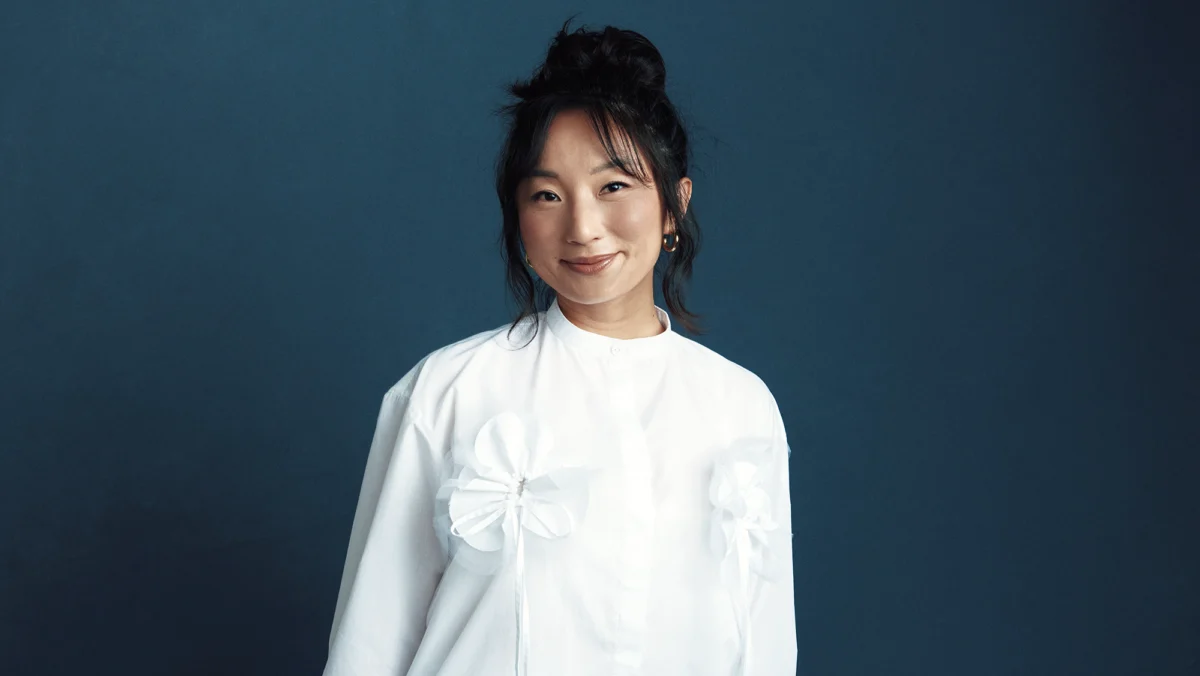
Poppy Liu is undeniably entering a significant new phase in her burgeoning acting career, marked by a palpable shift towards higher-profile cinematic roles and a deeply reflective approach to her craft. The actress, who recently garnered widespread recognition for her role in the critically acclaimed series Hacks, is now poised to make a formidable impact on the silver screen, spearheaded by her involvement in Boots Riley’s highly anticipated film, I Love Boosters. This transition, as Liu herself articulates, represents a new level of "visibility or mainstream-ness" that she is actively processing in real time, signaling a pivotal moment in her artistic journey.
The Ascent to Mainstream Visibility
Liu’s career trajectory is a testament to perseverance and a discerning eye for projects that resonate with her artistic and social values. For much of her adult life, particularly throughout her twenties, Liu immersed herself in the world of independent and grassroots theatre, honing her skills away from the glare of mainstream Hollywood. Her early forays into filmmaking similarly gravitated towards the indie sphere, characterized by a focus on authentic storytelling and community collaboration. This foundation, built on a dedication to the craft and a clear sense of artistic purpose, would eventually serve as a springboard for her ascent into broader recognition.
The turning point arrived with Hacks, the HBO Max comedy series that rapidly became a cultural phenomenon. In Hacks, Liu portrayed Kiki, the insightful and often hilarious assistant to Deborah Vance (Jean Smart), a role that earned her significant praise and introduced her to a wider audience. The series, lauded for its sharp writing and stellar performances, offered Liu her first taste of widespread Hollywood success. Its critical acclaim, including multiple Emmy Awards, solidified its status as a landmark streaming production and cemented Liu’s reputation as a talent to watch. The experience of filming Hacks, particularly its initial season amidst the unprecedented challenges of the COVID-19 pandemic in 2020, formed a unique chapter in her career. Living out of an RV for social distancing and navigating a world shrouded in protective measures, Liu witnessed the industry adapt in real-time, an experience that underscored the resilience and dedication required in filmmaking. The show’s subsequent release coincided with the global rollout of vaccines and a gradual reopening of society, creating a symbiotic narrative between its emergence and a world eager for connection and humor. As Liu reflects, Hacks was the "catalyst" that propelled her into a continuous stream of work, for which she expresses profound gratitude.
Boots Riley’s Vision: Art as Activism
Now, Liu finds herself starring in I Love Boosters, a project that not only boasts an impressive ensemble cast including Keke Palmer, Demi Moore, Taylour Paige, Eiza Gonzalez, Naomi Ackie, and Lakeith Stanfield, but also aligns deeply with her artistic sensibilities. Directed by Boots Riley, known for his distinctive voice and maximalist, absurdist approach to social commentary, the film marks Liu’s first high-profile theatrical release. Riley’s previous work, most notably Sorry to Bother You (2018), established him as a filmmaker unafraid to tackle complex socio-political themes through surrealism and satire, often challenging capitalist structures and societal norms.
Liu’s admiration for Riley is unequivocal, describing him as a "bucket list director." She extols his singular artistic voice, his embrace of maximalism and absurdism, and his masterful use of satire and surrealism to deliver "very poignant social commentary." What truly sets Riley apart in Liu’s eyes is his integrity; he "walked the walk for forever," embodying the values and revolutionary spirit he champions in his art. This alignment between the artist’s life and their work is crucial for Liu, reinforcing her respect for Riley’s contributions. The prospect of I Love Boosters serving as the "kickoff for this era" in her career feels "exciting" and "fitting," she states, underscoring the film’s significance beyond just another acting credit.
The "Trojan Horse" of Storytelling
A key aspect of Riley’s filmmaking that particularly resonates with Liu is his employment of the "Trojan horse" narrative strategy. This involves embedding profound social commentary within a visually arresting, humorous, or otherwise entertaining framework. As Liu explains, audiences might be initially drawn to I Love Boosters by its aesthetics, its fashion, or the promise of a "fun, awesome fashion heist," only to emerge from the experience realizing they’ve engaged with a story about "global class solidarity and how all of our oppressions are interlinked."
This disarming approach, she contends, is a powerful form of "soft power." It bypasses the immediate "allergic reaction" some individuals have to explicit social commentary, allowing the message to penetrate defenses that might otherwise be erected. By presenting complex ideas about capitalism, exploitation, and collective struggle through the veneer of beauty, humor, and captivating narrative, Riley’s films create an environment where audiences are more open to introspection and critical thought. This method of using art to subtly shift perspectives and encourage deeper engagement with societal issues is, for Liu, a profoundly important and effective artistic tool, enabling difficult truths to be confronted without immediate ideological resistance.
Navigating Hollywood’s Contradictions: Art, Activism, and Capitalism
The promotional circuit for I Love Boosters has brought into sharp focus the inherent contradictions of operating within a capitalist system while simultaneously promoting anti-capitalist themes. Liu openly grapples with the "cognitive dissonance" of participating in opulent red-carpet premieres and elaborate press junkets – hallmarks of peak capitalism – all to promote a film fundamentally about anti-capitalism, global class solidarity, and revolution.
This realization, she notes, is particularly acute given her recent entry into the highest echelons of film visibility. While she has experienced the "circus and the performance of the press" with TV shows, the scale and theatrical release of I Love Boosters represent an unprecedented level of mainstream exposure. The industry, in this context, transforms artists into commodities, their presence and personas part of the "labor" of selling the film. Liu articulates this with insightful clarity, reflecting on the experience of "performing capitalism at its highest" to achieve the desired outcome: for the movie to be seen and its message to resonate.
This predicament extends beyond the individual artist; it reflects a broader societal complicity under capitalism. Liu candidly acknowledges the hypocrisy inherent in criticizing worker exploitation while using an iPhone manufactured under potentially questionable labor conditions. She views this unavoidable complicity as a daunting challenge, one that can lead to feelings of hopelessness and debilitation – emotions she identifies as tactics of the ruling class to suppress collective action. The question of how to ethically engage with and critique a pervasive system while being inextricably linked to it is a central theme in her current reflections.
The Power of Mutual Aid
To combat the overwhelming nature of systemic issues and the feelings of helplessness they can engender, Liu advocates for the practical, tangible solution of mutual aid. For her, the true "evil of buying into the system" lies in succumbing to the lie of individualism – the belief that "it is every man for himself." Instead, she emphasizes the fundamental truth that "we live collectively, and we live interdependently."
Mutual aid, therefore, becomes a crucial counter-narrative and a concrete means of resistance. It transcends political spectrums; Liu prioritizes whether an individual practices mutual aid within their community over their specific political affiliations. In times of crisis, she asks, "Who do you show up as?" Are you the person who takes responsibility for those around you, doing what you can to support them, or do you adopt an attitude of "Fuck off, I got mine. The hell with the rest of you." This philosophy underscores a commitment to collective well-being and a rejection of self-serving isolation, offering a practical framework for navigating a world fraught with systemic inequalities.
A Diverse Slate of Future Endeavors
Beyond I Love Boosters, Liu’s upcoming projects showcase a remarkable breadth of artistic ambition and a commitment to diverse storytelling. She is slated to star alongside Stephanie Hsu and Andrew Liu in Dang!, a new adult animated comedy for Netflix. This venture into animation demonstrates her versatility and willingness to explore different mediums and genres.
Perhaps most intriguingly, Liu is actively developing a feature film she describes as "erotic horror." This project delves into themes of "sexual awakening" experienced by her character, triggered by a ghost from the Chinese Exclusion Act period. This concept is rich with historical and cultural layers, promising a unique blend of genre thrills and poignant social commentary, much like the "Trojan horse" approach she admires in Boots Riley’s work. The Chinese Exclusion Act, enacted in 1882, was one of the most restrictive immigration laws in U.S. history, prohibiting Chinese laborers from entering the country and denying Chinese immigrants citizenship. Setting an "erotic horror" narrative within this historical backdrop offers a fertile ground for exploring trauma, identity, and the lingering specters of past injustices through a uniquely personal and visceral lens.
Additionally, Liu is actively shaping a long-term "dream project": a Chinese American western. This genre-bending concept holds significant potential for re-examining American history, challenging traditional narratives, and providing a platform for underrepresented voices and experiences within a quintessentially American storytelling form. The Western genre, traditionally dominated by white male protagonists, offers a powerful opportunity for reimagining and diversifying historical perspectives through a Chinese American lens, a pursuit that aligns with broader industry calls for more inclusive storytelling.
Reflecting on the Hacks Legacy
The conclusion of Hacks marks the end of a pivotal chapter for Liu. She likens it to "graduating from high school," a bittersweet culmination of an era that brought her significant professional growth and mainstream recognition. For her character, Kiki, whose appearances were more sporadic, the impact isn’t necessarily a radical change in daily routine, but rather a profound emotional shift. The show’s production began in the challenging environment of 2020, amidst the initial waves of the pandemic, and its subsequent success coincided with a global reopening. This temporal synchronicity imbued the Hacks experience with an almost mythic quality for the cast and crew, marking a period of intense change both personally and professionally. Liu’s consistent work since Hacks underscores its transformative power as a career catalyst, solidifying her place in Hollywood.
The Liminality of the Artist’s Life
Liu also offers a revealing glimpse into the often-unseen realities of life on a film set, recalling her experience of living in a "windowless" hotel bedroom in Atlanta while filming I Love Boosters. Though the hotel itself was "beautiful," designed for longer-term stays with amenities like a kitchenette, the specific layout meant her bedroom was a "completely pitched black cave." This seemingly minor detail takes on symbolic weight when juxtaposed with the demanding schedule of film production. Long days on set, often extending into late nights and early mornings, meant Liu would often sleep for "15 hour stretches," waking into a world devoid of natural light.
This experience highlights the liminality of the artist’s life, where circadian rhythms are disrupted, and the boundaries between work and rest, day and night, become blurred. Days without sunlight, spent in a "windowless room" while the world outside continued, underscore the isolating yet intensely focused environment of a film shoot. It’s a testament to the commitment and endurance required, transforming a simple hotel room into a detached space where the outside world ceases to exist, allowing for complete immersion in the demanding schedule of filmmaking.
In sum, Poppy Liu stands at the precipice of a remarkable career evolution. Her engagement with Boots Riley’s I Love Boosters serves as both a launchpad and a thematic touchstone for her current era. Coupled with a slate of projects that defy easy categorization – from animated comedy to erotic horror and Chinese American Westerns – Liu is demonstrating an unwavering commitment to art that challenges, provokes, and entertains. Her candid reflections on navigating Hollywood’s complexities and her steadfast belief in mutual aid further cement her status as an artist who not only shapes narratives on screen but also thoughtfully engages with the world beyond it. This new phase promises not just increased visibility for Liu, but also a continued contribution of deeply considered, impactful storytelling to the cultural landscape.