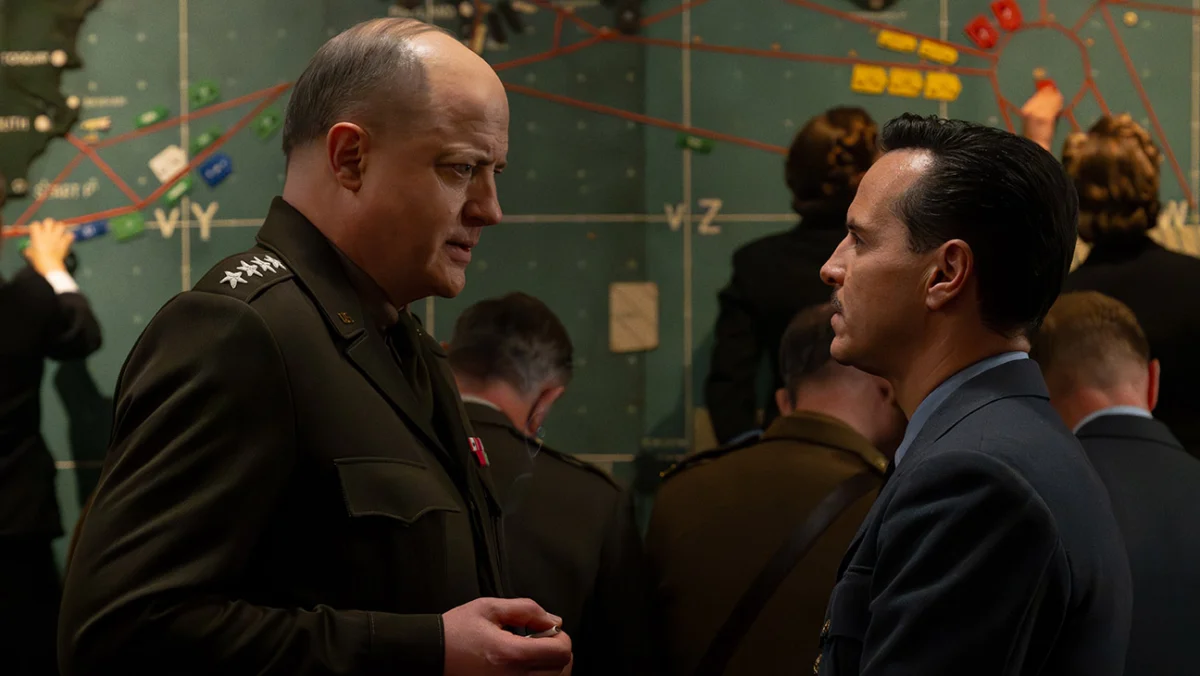
The new film by Anthony Maras, Pressure, delves into one of the most critical yet often overlooked episodes of World War II: the intense meteorological challenges and the high-stakes forecasting decisions that preceded the D-Day invasion. While it might seem that every narrative from the Second World War has been thoroughly explored, Maras’s latest work unearths a fascinating, little-known chapter, bringing to light the immense pressure on a small team whose predictions held the fate of the Allied invasion in the balance. Featuring an award-worthy performance by Andrew Scott in the lead role, supported by solid turns from Brendan Fraser, Kerry Condon, and Chris Messina, Pressure expertly ratchets up sustained tension, living up to its evocative title. The film transforms the seemingly mundane act of weather forecasting into a surprisingly edge-of-your-seat thriller, exploring the scientific, personal, and strategic dilemmas faced in the 72 hours leading up to Operation Overlord.
The Crucial Role of Weather in Operation Overlord
D-Day, the Allied invasion of Normandy on June 6, 1944, was the largest amphibious assault in history and a pivotal turning point in World War II. Its success hinged on an intricate web of logistical planning, military strategy, and, critically, the precise timing dictated by weather conditions. The original target date for the invasion was June 5, 1944, chosen after months of meticulous analysis to align with a specific combination of factors: a full moon to provide light for airborne operations and the highest tides to allow landing craft to clear underwater obstacles. However, the weather had to be just right—not too calm, not too stormy. Calm seas were essential for the thousands of landing craft, while clear skies were vital for Allied air superiority, providing crucial air cover, reconnaissance, and bombing support against German defenses. High winds and heavy rain could ground aircraft, scatter paratroopers, and make beach landings catastrophic. The strategic stakes were immeasurable: a failed invasion would mean immense loss of life, a devastating blow to Allied morale, and potentially prolong the war by years, giving Germany time to fortify its defenses further or even develop advanced weaponry.
The film is set predominantly within the confines of Southwick House, a historic 19th-century manor in Hampshire, England, which served as the Supreme Headquarters Allied Expeditionary Force (SHAEF). It is here that the Allied command, led by General Dwight D. Eisenhower, grappled with the agonizing decision of when to launch the invasion. The narrative commences with the arrival of Scottish meteorologist Dr. James Stagg (Andrew Scott), assigned the unenviable task of heading the weather forecasting team for the invasion. Stagg, a proud but somewhat prickly individual, is not particularly thrilled to be at headquarters; his pregnant wife, Liz (Tamsin Topolski), is on the verge of giving birth, adding a profound personal dimension to the already immense professional pressures.
A Clash of Methodologies and Personalities
Upon his arrival, Stagg quickly finds himself at odds with the existing operation, currently helmed by American meteorologist Irving Krick (Chris Messina). Krick, who had previously worked successfully with General Eisenhower (Brendan Fraser) on several military operations, relies heavily on historical weather patterns gleaned over decades for his forecasts. This climatological approach, while useful for long-term trends, proves inadequate for the immediate, dynamic demands of an invasion. Stagg, a proponent of synoptic meteorology, dismisses Krick’s data as largely irrelevant, insisting on a science-based technique that prioritizes real-time atmospheric observations, pressure systems, and air mass movements. His methods are more about understanding the current state and immediate evolution of the atmosphere rather than extrapolating from past events.
This fundamental disagreement creates immediate friction. Stagg further unsettles Eisenhower by bluntly stating the unreliability of long-term forecasts, declaring that "anything over 24 hours is a long-term forecast." This pronouncement directly contradicts the operational need for a stable, multi-day weather window, throwing a wrench into the meticulously planned timetable. The Supreme Allied Commander, burdened by the weight of millions of lives and the future of the free world, is caught between two vastly different scientific approaches, each championed by men convinced of their own rectitude.
The film skillfully portrays this intellectual and professional clash, highlighting the limitations of meteorological science in the 1940s. Unlike today, there were no weather satellites, no sophisticated computer models, and limited data from across the Atlantic, which was crucial for predicting European weather patterns. Forecasts relied on observations from ships, land stations, and reconnaissance flights, pieced together by human interpretation and scientific intuition. This scarcity of comprehensive data amplified the tension and the reliance on individual judgment, making the conflict between Stagg and Krick not just a personal one, but a proxy for the broader scientific challenges of the era.
The 72-Hour Countdown: A Timeline of Critical Decisions
The film meticulously chronicles the 72 hours leading up to D-Day, transforming a historical footnote into a riveting drama.
- Arrival and Initial Conflict (H-72 hours): Dr. James Stagg arrives at Southwick House. He quickly assesses the situation and expresses dissatisfaction with the methods of American meteorologist Irving Krick. Stagg’s scientifically rigorous approach immediately clashes with Krick’s reliance on historical patterns.
- Initial Invasion Date and Forecast (H-60 hours): General Eisenhower and his team of generals, including the fiery British Field Marshal Bernard "Monty" Montgomery (Damian Lewis, who leans into his blustery turn with gusto), have tentatively planned the invasion for June 5, 1944. Krick’s forecast supports this date, predicting suitable conditions based on his historical models.
- Stagg’s Counter-Forecast (H-48 hours): Stagg, analyzing real-time data and atmospheric pressure systems, insists that the weather on June 5 will be extremely rainy and windy, predicting conditions too severe for a successful invasion. He warns that proceeding would result in catastrophic failure, jeopardizing the lives of hundreds of thousands of Allied soldiers.
- Eisenhower’s Dilemma and Past Trauma: The prospect of failure is deeply unsettling for Eisenhower. The film poignantly depicts his emotional trauma from his role in planning Exercise Tiger, a D-Day rehearsal in April 1944 that went disastrously wrong, resulting in the deaths of hundreds of American soldiers due to a German E-boat attack compounded by communication errors and poor weather. This past tragedy weighs heavily on his decision-making, making him acutely aware of the human cost of misjudgment.
- Recommendation for Postponement (H-36 hours): Stagg recommends postponing the invasion for at least a couple of weeks to await a more stable weather window. However, maintaining the secrecy of such a massive operation for that long would be virtually impossible. The logistical nightmare of recalling troops already embarked, re-securing supply lines, and rescheduling the complex air and naval support would be immense, and the element of surprise would be lost, giving the Germans crucial time to prepare.
- The Clash of Wills: The core of the drama unfolds as Eisenhower, Krick, and Stagg engage in a tense clash of wills. Eisenhower must weigh scientific certainty against operational imperative, the advice of his trusted generals, and the devastating consequences of either inaction or reckless action. Kay Somersby (Kerry Condon), Eisenhower’s devoted personal aide, attempts to mediate the escalating anger, providing a quiet emotional ballast to the heated debates. The film also subtly depicts the closeness between Ike and Somersby, acknowledging their unique bond without overtly intimating the alleged affair between the two, focusing instead on their professional synergy.
- The Pivotal Decision (H-24 hours): With the June 5 window closing and Stagg’s forecast proving increasingly accurate, Eisenhower faces the most agonizing decision of his career. Another brief weather window, though far from ideal, presents itself for June 6. After intense deliberation and a revised, though still uncertain, forecast from Stagg indicating a brief lull in the storm, Eisenhower famously makes the call: "Okay, we’ll go." This decision, made in the early hours of June 5, effectively postponed the invasion by one day, a monumental gamble that ultimately paid off.
From Stage to Screen: A Masterful Adaptation
Pressure originates from an acclaimed stage play by David Haig, and its theatrical roots are evident in the film’s minimal number of settings and long, dialogue-heavy exchanges, often dense with meteorological jargon. However, director Anthony Maras, working from a screenplay co-written with Haig, performs a marvelous job of opening up the action to make it feel distinctly cinematic. Maras skillfully employs judicious use of archival footage from the era, seamlessly integrating historical context and visual grandeur without detracting from the intimate drama unfolding at Southwick House. This technique not only enhances the film’s authenticity but also visually reminds the audience of the colossal real-world stakes beyond the confined headquarters.
Running a fleet 100 minutes including credits, the film proves compelling throughout, even though the audience obviously knows the historical outcome of D-Day. As with acclaimed films such as All the President’s Men and Apollo 13, the power of Pressure lies not in the surprise of its conclusion, but in the gripping depiction of the process involved. Maras and Haig meticulously detail the scientific debates, the command decisions, and the human pressures without ever feeling dumbed-down. The film respects the intelligence of its audience, inviting them into the complex world of wartime forecasting and strategic command, holding attention through the sheer intensity of the intellectual and emotional struggle. The pacing is deliberate, allowing the tension to build organically, creating a claustrophobic atmosphere that mirrors the psychological strain on the characters.
Performances Under Immense Scrutiny
The ensemble cast delivers performances that elevate the film beyond a mere historical recreation. Andrew Scott’s portrayal of Dr. James Stagg is, by now, almost redundantly superb, but he arguably outdoes himself here. Scott doesn’t attempt to render the prickly, officious Stagg overtly likable; instead, he crafts a character whose unwavering commitment to scientific truth, even at personal and professional cost, makes him profoundly identifiable. The way Scott subtly reveals deep emotion without resorting to histrionics is a marvel, particularly in a scene where Stagg receives potentially devastating news on the phone. Maras keeps the camera tightly on the actor, who barely seems to react while quietly asking a few brief questions, yet the anguish he conveys is palpable, a masterclass in understated intensity.
Brendan Fraser’s interpretation of General Dwight D. Eisenhower initially might seem a surprising choice. While he captures the essence of a man under immense strain, some might argue his resemblance to Eisenhower (beyond a shaved head) is not striking, and he occasionally comes across as more emotional than the famously controlled Supreme Allied Commander was known to be. However, Fraser is ultimately effective, movingly conveying the crushing burden and "pressure" that Ike was facing at this key moment in the war. His portrayal underscores the human element behind the legend, revealing a leader wrestling with unimaginable responsibility and the haunting memories of past failures.
Kerry Condon, projecting the same assured confidence she displayed as the racing engineer in F1: The Movie, gives the film a quiet emotional ballast as Kay Somersby. Her character serves as a crucial intermediary and a steadying presence for Eisenhower, highlighting the often-unseen support networks vital in high-stakes environments. Chris Messina delivers his usual solid work as Irving Krick, depicting a meteorologist who, despite his initial stubbornness and conviction, eventually comes to accept the fact that he has been outclassed by Stagg’s more immediate and accurate scientific approach. His character arc provides a nuanced exploration of professional pride and the humility required in the face of irrefutable data. Damian Lewis, as Field Marshal Montgomery, leans into the general’s notorious bluster and impatience, adding another layer of demanding personality to the pressure cooker environment.
Director’s Vision and Thematic Resonance
Anthony Maras’s previous film, Hotel Mumbai, was a nerve-jangling thriller depicting a real-life terrorist siege with intense immediacy. In Pressure, he works in a more cerebral, psychological vein, yet the film is no less riveting. Maras demonstrates his versatility as a director, proving equally adept at crafting high-tension action as he is at building suspense through intellectual conflict and emotional weight.
Thematic resonance in Pressure is multifaceted. It explores the immense weight of command and the solitary nature of leadership when faced with epoch-defining decisions. It delves into the clash of expertise, illustrating how different scientific methodologies, and the personalities behind them, can profoundly impact historical outcomes. Crucially, the film highlights the often-overlooked "behind-the-scenes" heroes—the scientists, aides, and strategists whose contributions, while not on the battlefield, were no less critical to the Allied victory. The film serves as a powerful reminder that even the most monumental military operations are susceptible to the unpredictable forces of nature and the human fallibility in interpreting them.
In excavating this lesser-known but pivotal aspect of D-Day, Pressure makes a significant contribution to the cinematic tapestry of World War II. It offers a fresh perspective on a well-trodden historical event, emphasizing that heroism isn’t always found on the front lines but can also manifest in the quiet courage of scientific conviction and the agonizing responsibility of command. The film’s implications extend beyond its historical context, offering insights into leadership and decision-making under extreme uncertainty, a timeless human challenge. Pressure stands as a compelling historical drama and a gripping thriller, ensuring that the story of D-Day’s weather prophets will not be forgotten.