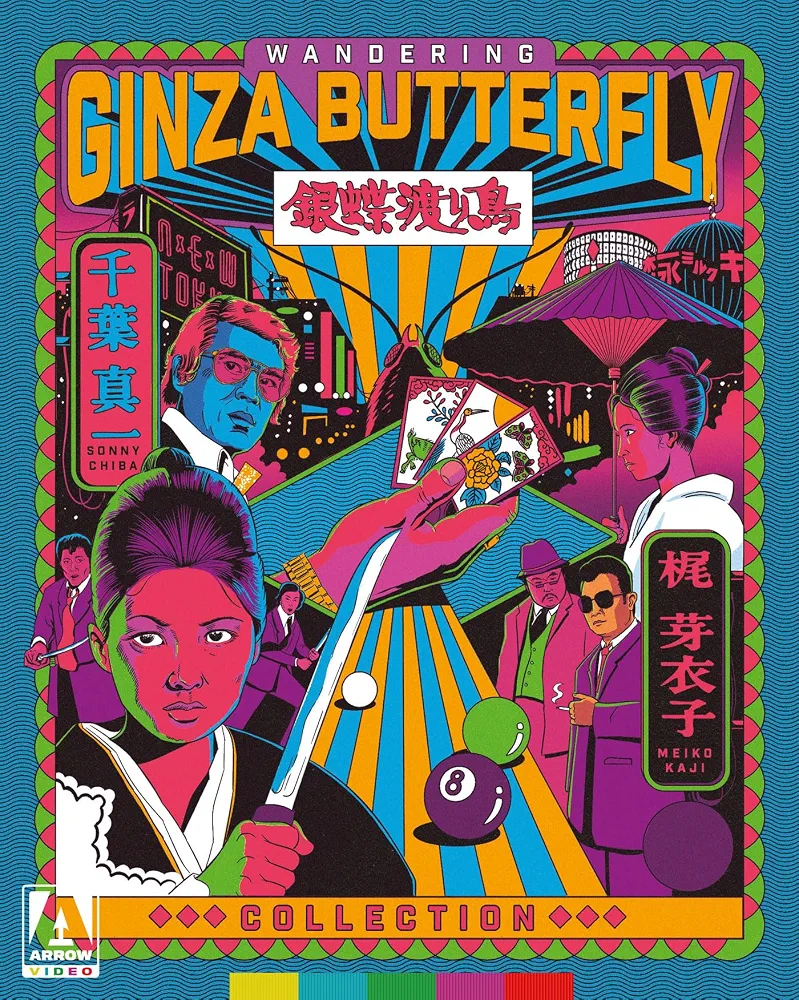
Meiko Kaji stands as one of Japan’s most revered and iconic actresses, her career spanning decades and encompassing a diverse array of genres and complex characters. While her filmography is extensive, she is most frequently celebrated for her indelible portrayals in two seminal series: the "Female Prisoner Scorpion" saga and the solitary avenger in "Lady Snowblood." These roles cemented her status as an international icon, embodying resilient women who defiantly challenged and ultimately subverted male-dominated narratives and entrenched patriarchal structures. A foundational performance that demonstrably laid the groundwork for these later, globally recognized characters was her nuanced portrayal of Nami Higuchi in Kazuhiko Yamaguchi’s 1972 feature, "Wandering Ginza Butterfly." This film, released shortly after her impactful stint in the "Stray Cat Rock" series—where she similarly led a formidable gang of young women confronting the yakuza, the police, and other adversaries—offered a potent blend of gritty drama and social commentary. Beyond its exploration of evolving gender roles and female agency, "Wandering Ginza Butterfly" also provided a keen observation of the nascent effects of Japan’s economic recession on its society, particularly on its youth and increasingly disenfranchised populations.
Meiko Kaji: An Enduring Icon of Japanese Cinema
Born Masako Ohta in 1947, Meiko Kaji embarked on her acting career in the mid-1960s, initially under the Nikkatsu studio system. Her early roles often cast her in youth-oriented dramas and action films, gradually building a reputation for her striking screen presence and enigmatic allure. It was during her tenure at Nikkatsu that she first gained significant recognition with the "Stray Cat Rock" series (1970-1971), a collection of five youth exploitation films that saw her leading a rebellious all-female biker gang. These films, characterized by their counter-culture aesthetics, rock music soundtracks, and themes of youthful defiance against societal norms, allowed Kaji to cultivate a distinctive persona of a tough, independent woman. This period marked a pivotal transition in Japanese cinema, moving away from the golden age of studio-produced dramas towards more genre-driven, often transgressive, narratives aimed at a younger audience. Kaji’s ability to project both vulnerability and steely resolve made her a perfect fit for these roles, establishing her as a rising star capable of carrying a film.
Following the decline of Nikkatsu and its pivot towards the Roman Porno genre, Kaji transitioned to Toei Company, a studio known for its prolific output of yakuza films and action features. It was at Toei that she would achieve her most enduring fame. In 1972, she starred as Matsu, the titular character in the "Female Prisoner Scorpion" series. Her portrayal of a vengeful woman, unjustly imprisoned and brutalized, yet unyielding in her pursuit of justice, became a cinematic phenomenon. Kaji’s performance was characterized by minimal dialogue, relying instead on intense stares, subtle gestures, and an almost supernatural stoicism that made her a terrifying and compelling figure. This was swiftly followed by "Lady Snowblood" (1973) and its sequel (1974), where she embodied Yuki Kashima, a woman raised from birth to exact revenge on those who wronged her family. Both "Scorpion" and "Lady Snowblood" transcended their exploitation roots to become critically acclaimed works, celebrated for their stylized violence, stark visuals, and powerful female protagonists. Quentin Tarantino would later cite "Lady Snowblood" as a primary inspiration for his "Kill Bill" films, solidifying Kaji’s international legacy. "Wandering Ginza Butterfly," released between "Stray Cat Rock" and "Female Prisoner Scorpion," thus occupies a crucial position in Kaji’s filmography, bridging her earlier rebellious roles with the more iconic avenging figures that followed.
"Wandering Ginza Butterfly": A Narrative of Resilience and Atonement
"Wandering Ginza Butterfly" introduces audiences to Nami Higuchi (Meiko Kaji), a woman recently released from prison and returning to the familiar, neon-drenched streets of Tokyo’s Ginza district. Her return is not merely about re-establishing her life; it is deeply rooted in a desire for atonement. Nami seeks to financially support the family of the person she wronged, a tangible act of remorse that defines her character from the outset. This quest for redemption sets her apart from the purely vengeful personas of Scorpion or Lady Snowblood, adding layers of moral complexity to her actions.
Upon her return, Nami finds a degree of solace and assistance through Ryuji (Ryo Ikebe), a seasoned regular at her uncle’s billiard hall. Ryuji, a figure embodying the stoic wisdom often found in supporting roles of this era, helps Nami secure employment as a hostess at the Broncho Club. The club is managed by Kayo (Akiko Koyama), a proprietor initially wary of Nami’s past and her presence. Kayo, however, faces a more immediate and existential threat: the encroaching influence of the Owada clan. This powerful yakuza syndicate is systematically attempting to consolidate control over Ginza, pressuring independent businesses, including Kayo’s club, to sell out under duress. This narrative thread immediately grounds the film in the socio-economic realities of the time, painting Ginza as a battleground between individual resilience and organized predatory capitalism.
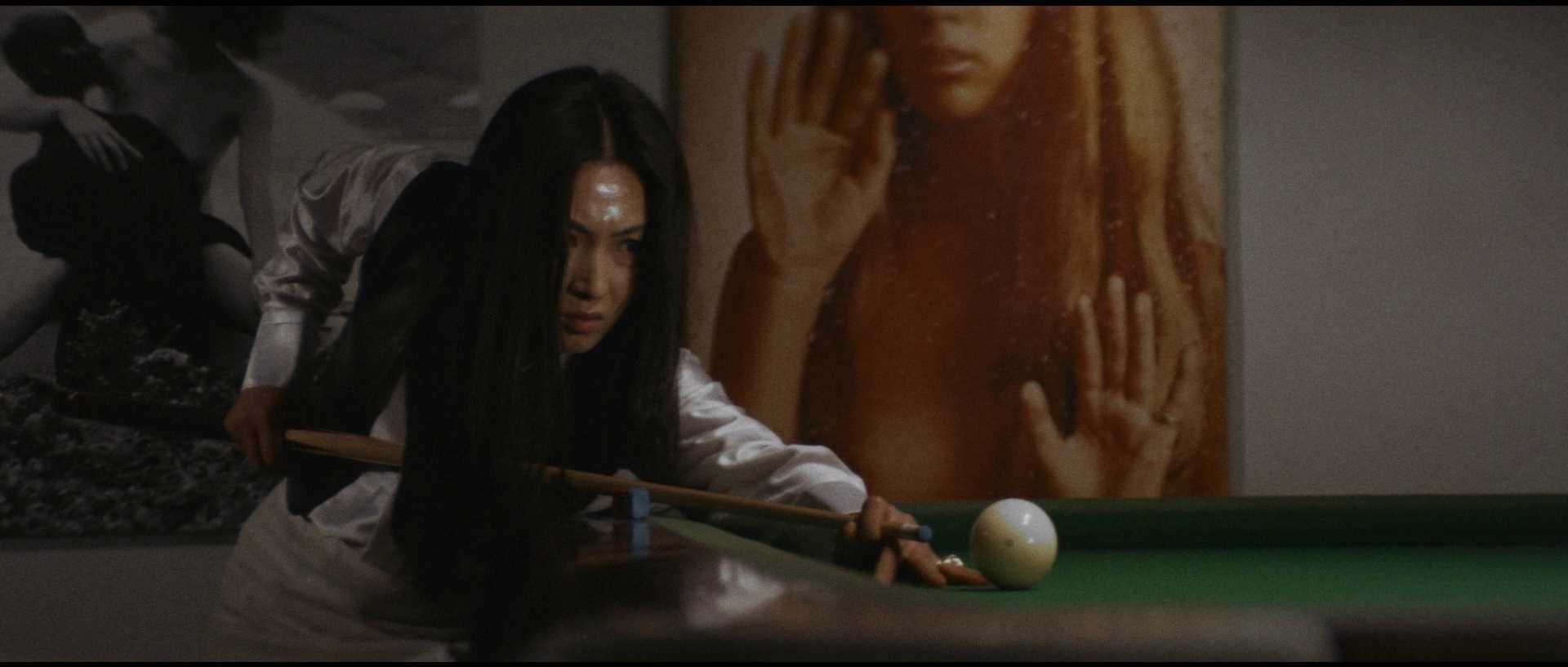
As Nami settles into her new life, her innate charisma and sharp wit quickly establish her as the Broncho Club’s most popular hostess. She becomes a de facto protector and confidante for the other women working there, ensuring their well-being and even deftly handling difficult customers and outstanding debts. This role as a community anchor, supporting her fellow women, is a recurring theme in Kaji’s films and further develops Nami’s compassionate yet firm character. The Owada clan’s pressure, however, intensifies, culminating in their brazen blackmail of Kayo, coercing her to sell the club under outrageously exploitative terms. It is at this critical juncture that Nami, driven by loyalty and a fierce sense of justice for the woman who offered her a second chance, takes decisive action. Rather than resorting to overt violence, she challenges the gang leader to a high-stakes duel at the billiard table—a brilliant narrative device that elevates the conflict beyond mere fisticuffs, showcasing Nami’s intelligence and strategic prowess. This scene, steeped in dramatic tension, becomes a symbolic confrontation between the old ways of brute force and the emerging strength of a protagonist who uses her mind as her primary weapon.
Ginza in Flux: A Social and Economic Microcosm
Kazuhiko Yamaguchi’s "Wandering Ginza Butterfly" is not merely an entertaining thriller; it functions as a compelling sociological study of a community grappling with profound economic and social transformation. Ginza, historically Tokyo’s premier shopping, entertainment, and cultural district, served as a beacon of modernity and prosperity. However, the film captures Ginza at a critical juncture, reflecting the broader anxieties gripping Japan in the early 1970s. The full ramifications of Japan’s economic recession, exacerbated by the 1973 oil crisis, were still unfolding, but their preliminary consequences were acutely visible in Ginza. The film subtly depicts declining customer numbers, struggling independent business owners facing bankruptcy, and the predatory opportunism of criminal organizations like the Owada clan, eager to exploit the vulnerability of these businesses.
Yamaguchi imbues Ginza with a sense of nostalgic affection, portraying it as a refuge for society’s outsiders and disenfranchised, despite the pervasive crime and exploitation that surrounds them. For characters like Nami and Ryuji, who are both implicitly presented as orphans or individuals without strong familial ties, Ginza represents a surrogate home, a place where they have found a sense of belonging amidst the urban sprawl. Nami’s gaze upon Ginza is complex, tinged with both a longing for a bygone era and the comfort of returning to a familiar, albeit changing, landscape. This dual perspective shapes the film’s tone, celebrating the district’s unique identity while lamenting its perceived inevitable disappearance under the relentless march of modernization and corporate/criminal consolidation. The film suggests that Nami’s audacious plan to outwit the gangster, securing both his money and his stake in the nightclub, is more than just a personal victory; it is a final, desperate act of resistance—a practical joke played on the forces threatening to erase Ginza’s soul. This move subtly echoes the spirit of characters like Paul Newman’s "Fast Eddie" Felson in "The Hustler" (1961), an acknowledged source of inspiration, where wit and skill transcend brute force. Yamaguchi, while romanticizing certain aspects of this underworld, conveys a genuine empathy for the outsiders who have shaped Ginza’s distinct identity over generations.
Kazuhiko Yamaguchi’s Vision and the Genre Landscape
Director Kazuhiko Yamaguchi was a prolific filmmaker within the Toei studio system during the 1970s, often associated with exploitation cinema, including yakuza films and "pinky violence." His directorial style in "Wandering Ginza Butterfly" exemplifies his ability to merge genre conventions with thoughtful social commentary and strong character development. While the film embraces elements of the action-thriller and crime drama, Yamaguchi ensures that its core narrative is anchored in the struggles of its characters and the socio-economic backdrop.
The early 1970s marked a period of significant flux for the Japanese film industry. The traditional studio system, which had dominated for decades, was in decline, giving way to more independent productions and a proliferation of genre films designed to attract specific audiences. Yakuza films were immensely popular, often glorifying the lives of gangsters while simultaneously exploring themes of honor, loyalty, and betrayal. "Wandering Ginza Butterfly" exists within this broader landscape but distinguishes itself by centering a female protagonist who navigates this male-dominated world on her own terms. It subtly critiques the patriarchal structures of the yakuza and the corporate world through Nami’s actions.
Yamaguchi’s direction balances the stylized aesthetics common in 1970s exploitation cinema—such as dynamic camera work, vibrant color palettes, and a palpable urban atmosphere—with a grounded realism in its portrayal of Ginza’s inhabitants. The film’s pacing is deliberate, allowing for character development and thematic exploration, rather than simply rushing from one action sequence to the next. The influence of Western films, particularly crime dramas and noirs, is discernible in the film’s structure and character archetypes, yet Yamaguchi firmly roots the story in a distinctly Japanese context. His approach elevates "Wandering Ginza Butterfly" beyond a simple genre piece, allowing it to function as both an engaging thriller and a poignant character study.
Kaji’s Performance: Crafting the Archetype
As with many features starring Meiko Kaji, "Wandering Ginza Butterfly" relies heavily on her undeniable charisma and commanding screen presence. Any minor structural or narrative shortcomings in the story are consistently overshadowed by the sheer magnetism and subtlety of her performance. Kaji possesses a remarkable ability to communicate complex emotional states through restrained gestures, precise body language, and remarkably expressive facial expressions, often with minimal dialogue. This economy of expression became a hallmark of her acting style and a key component of her iconic status.
In "Wandering Ginza Butterfly," Kaji imbues Nami with profound emotional depth, transforming a character who could easily have been a one-dimensional tough girl into a figure of quiet resilience and moral conviction. Her portrayal of Nami’s attempts to atone for her past, particularly through her financial support of her victim’s widow, showcases a rarely seen vulnerability and a deep-seated sense of responsibility. Simultaneously, Kaji masterfully conveys Nami’s quiet defiance of the gangsters, demonstrating intelligence and strategic thinking over brute force. This nuanced balance is crucial; while Nami may lack the biting, overt social criticism that defines her counterpart in the "Female Prisoner Scorpion" series, Kaji effortlessly balances dramatic intensity with quieter, deeply human moments of introspection and empathy.
Nami Higuchi clearly serves as a blueprint for Kaji’s later, more famous characters. The core elements of a strong, independent woman challenging patriarchal norms, surviving in a harsh world, and driven by a personal code of justice are all present. Nami’s compassion and determination to navigate a world dominated by men and capital resonate strongly with the themes explored in "Lady Snowblood" and "Female Prisoner Scorpion." Kaji’s performance in "Wandering Ginza Butterfly" is a testament to her unique talent for crafting characters who are both formidable and deeply relatable, laying the foundation for an enduring cinematic legacy that continues to inspire and captivate audiences worldwide.
Legacy and Critical Reassessment
While "Wandering Ginza Butterfly" may not have achieved the immediate global recognition of "Female Prisoner Scorpion" or "Lady Snowblood" upon its initial release, its significance has grown steadily over time. Within Japan, it contributed to the evolving landscape of female-led action and crime films, showcasing a different facet of female empowerment than the outright revenge narratives. Its initial critical reception would have likely positioned it as a solid genre film, appreciated for Kaji’s performance and its engaging plot. However, its enduring cult status and subsequent rediscovery by international audiences, particularly those interested in Japanese exploitation cinema and strong female protagonists, have led to a critical reassessment of its place in cinematic history.
The film’s exploration of economic hardship, urban decay, and the struggle for individual autonomy against powerful, impersonal forces remains relevant today. The themes of gentrification, the decline of local businesses, and the rise of corporate or criminal consolidation resonate in contemporary urban landscapes globally. Furthermore, Nami’s character continues to be a compelling figure in discussions of gender roles in cinema. She embodies a proto-feminist sensibility, challenging the notion that female strength must always manifest as physical aggression. Instead, Nami’s power derives from her intellect, her moral compass, and her unwavering loyalty to those she cares for. This makes her a multifaceted and enduring figure who contributed significantly to the archetype of the "strong female lead" in Japanese cinema. "Wandering Ginza Butterfly" is a powerful reminder of Meiko Kaji’s extraordinary range and the profound impact she had on shaping the cinematic representation of female agency.
In conclusion, "Wandering Ginza Butterfly" is a compelling blend of drama and thriller set against the vibrant, yet rapidly changing, backdrop of Tokyo’s Ginza district. While the story occasionally follows familiar genre conventions, Kazuhiko Yamaguchi’s thoughtful direction and Meiko Kaji’s magnetic performance elevate the feature. Kaji imbues Nami with an emotional depth and quiet strength that would become the defining characteristics of many of the actress’s most iconic roles, solidifying the film’s status as a pivotal work in her illustrious career and a significant contribution to 1970s Japanese cinema. It stands as a testament to the power of resilience, atonement, and the enduring spirit of individuals against overwhelming odds.