The Canadian cinematic landscape is experiencing a transformative era, marked by critically acclaimed theatrical releases that have captivated audiences both domestically and internationally. Notable films screening at the 2025 Toronto International Film Festival—such as Sophy Romvari’s Blue Heron, Chandler Levack’s Mile End Kicks, and Matt Johnson’s Nirvanna the Band, the Show, the Movie—have demonstrated that filmmakers operating with limited resources and assured creative visions can achieve profound cultural resonance. These works have collectively challenged traditional perceptions of national cinema, proving that stories rooted in regional identities can possess universal appeal. Adding to this vital wave of homegrown storytelling is Sean Menard’s documentary feature Run Terry Run, a 108-minute exploration of one of Canada’s most enduring modern figures, Terry Fox, and his legendary 1980 Marathon of Hope.
The documentary arrives at a time when contemporary Canadian filmmakers are actively redefining how history and identity are represented on screen. Featuring a cast of key historical figures including Terry Fox, Darrell Fox, Doug Alward, Leslie Scrivener, Darryl Sittler, and Bill Vigars, Menard’s film offers an intimate, behind-the-scenes perspective on a 143-day odyssey that permanently altered the cultural consciousness of a nation. Rather than presenting a sanitized hagiography, Run Terry Run examines the physical toll, the psychological endurance, and the journalistic friction that characterized the cross-country run, providing a comprehensive retrospective on a historic national endeavor.
Historical Context and the Genesis of the Marathon of Hope
The origins of the Marathon of Hope are deeply intertwined with personal tragedy and systemic observation. In November 1976, twenty-one-year-old Terry Fox was involved in a car accident that led to the discovery of osteosarcoma, a malignant bone cancer. The diagnosis necessitated the amputation of his right leg six inches above the knee in March 1977, followed by sixteen months of grueling chemotherapy treatments at the British Columbia Cancer Control Agency.
During his time as a patient, Fox witnessed firsthand the physical and emotional devastation suffered by fellow cancer patients, many of whom were children. He was deeply struck by the stark disparity between the profound suffering caused by the disease and the minimal financial resources allocated to cancer research at the time. Motivated by a desire to effect change, Fox quietly trained for over a year, running more than 3,000 miles in preparation for an unprecedented cross-country trek. His objective was unequivocal: to run across Canada from the Atlantic Ocean to the Pacific Ocean, raising one dollar for every Canadian citizen—totaling an initial goal of $22 million—to fund cancer research.
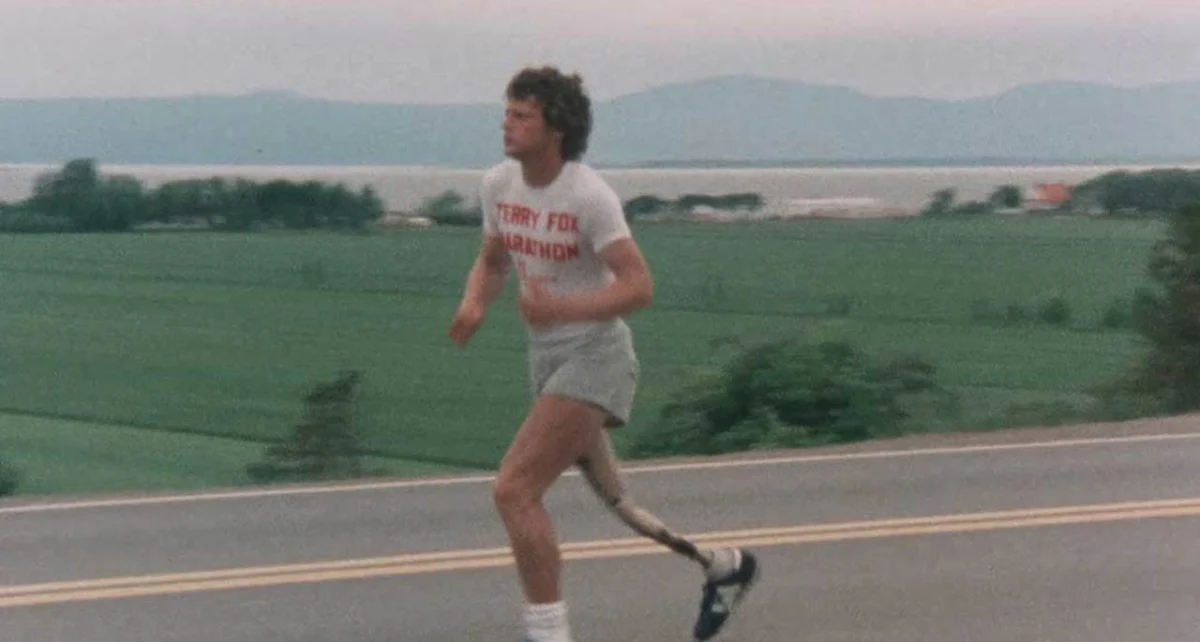
On April 12, 1980, Fox dipped his artificial right leg into the Atlantic Ocean at St. John’s, Newfoundland and Labrador, officially launching the Marathon of Hope. Accompanied only by his close friend and former high school basketball teammate Doug Alward, who drove a support camper van that served as their mobile living quarters, Fox embarked on a grueling daily routine. He maintained a pace of approximately 26 miles per day—a full marathon distance—running thousands of consecutive strides on a prosthetic limb that frequently caused severe blistering, bone bruising, and bleeding.
Chronology and the Evolution of Public Awareness
In its initial weeks, the Marathon of Hope generated remarkably little public attention. Major media outlets largely ignored the endeavor, viewing it as a localized human-interest anomaly rather than a national news event. However, the trajectory of the run shifted due to the perceptive reporting of Leslie Scrivener, a journalist for the Toronto Star. Scrivener became the first major reporter to cover Fox’s journey extensively, initiating a modest newspaper column titled Running with Terry.
Run Terry Run utilizes Scrivener’s original audio recordings as a foundational narrative framework. This journalistic perspective grounds the documentary, allowing contemporary audiences to experience the unfolding legacy of the marathon through the eyes of someone who documented it in real time. As Scrivener’s dispatches gained traction, public perception shifted dramatically. Letters, hand-drawn cards, and financial donations began flooding into collection points along the route, transforming a solitary athletic endeavor into a national phenomenon.
As the marathon progressed through the Atlantic provinces and into Quebec and Ontario, the crowds swelling at the roadside grew exponentially. Civic leaders, local sports heroes—such as National Hockey League star Darryl Sittler—and ordinary citizens began rallying to support Fox. By the summer of 1980, the Marathon of Hope had captured the political and social attention of a country navigating significant internal tensions, including the turbulent lead-up to the May 1980 Quebec sovereignty referendum, where Fox’s unifying presence offered a rare symbol of national cohesion.
Journalistic Friction and the Media Landscape
A compelling dimension of Menard’s documentary is its unvarnished examination of the relationship between Fox’s team and the media. While initial coverage was sparse, the later stages of the run attracted aggressive tabloid reporting and gossip-driven journalism. As the physical demands of the marathon intensified, reporters stationed at the support camper van occasionally sought sensational angles or personal friction among the small support team.
The film highlights the arrival of Bill Vigars, who stepped in as a publicist to manage media relations and protect Fox from invasive or trivializing inquiries. Vigars’ intervention helped redirect public discourse away from manufactured controversies and back toward the core objectives of the campaign: cancer research funding and patient advocacy. Despite the inherent frustrations and exhaustion documented during this period, Run Terry Run acknowledges the resilience required by Fox and his companions—including his brother, Darrell Fox, who later joined the support team—to maintain their focus amid intense public scrutiny.
Archival Integration and Structural Analysis
Director Sean Menard constructs much of the visual narrative using meticulously restored archival footage, largely sourced from filmmaker John Simpson. This historical material provides an unmediated look at Fox’s daily routine, capturing the excruciating physical strain, the changing weather conditions across diverse Canadian landscapes, and the candid interactions between Fox and the citizens who greeted him at every checkpoint.
While the documentary succeeds in conveying Fox’s unwavering determination, critics have noted certain structural limitations. The film occasionally relies on a repetitive episodic framework—depicting Fox arriving at a new town, addressing an assembled crowd, and moving onward—which can occasionally diminish the narrative momentum. However, this repetition also reflects the relentless, grinding nature of the marathon itself, where each day demanded the exact same physical and mental sacrifice as the one before it.
Crucially, the documentary avoids corporate branding and hollow hero worship, choosing instead to emphasize Fox’s personal autonomy and refusal to commercialize his cause. Fox consistently rejected lucrative endorsement offers, maintaining that the integrity of the Marathon of Hope depended entirely on its grassroots mission to help others.
Broader Impact and Implications for Canadian Identity
Terry Fox was forced to cut his marathon short on September 1, 1980, outside of Thunder Bay, Ontario, after medical tests revealed that the cancer had spread to his lungs. He had run 5,373 kilometers over 143 days. He passed away on June 28, 1981, at the age of 22, but not before witnessing the total funds raised by the Marathon of Hope surpass his initial $22 million goal, reaching over $24 million by the time his run concluded. To date, the Terry Fox Foundation has raised more than $850 million for cancer research worldwide, cementing his status as an enduring international symbol of perseverance.
Run Terry Run positions Fox not as an untouchable myth, but as a deeply human figure driven by empathy, stubborn resolve, and an uncompromising vision of collective responsibility. By juxtaposing Fox’s journey with the broader evolution of Canadian documentary filmmaking, Menard’s film suggests that national identity is not a static monolith, but an ongoing process shaped by diverse voices, shared struggles, and the courage to face an uncertain road ahead. In an era where cultural narratives are increasingly fragmented, Run Terry Run reaffirms the enduring power of a single individual’s commitment to the greater good.