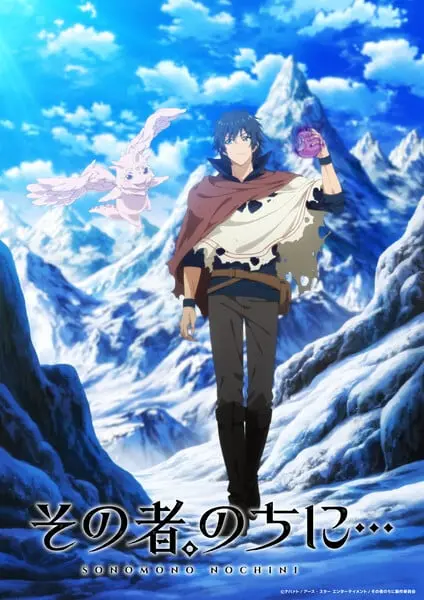
The official website for the light novel series Sono Mono. Nochi ni… (The One. Later On…) confirmed on Sunday that a television anime adaptation is currently in production and scheduled for a 2027 premiere. The announcement, which arrived alongside a teaser visual and an initial look at the primary cast and production staff, signals a significant expansion for Nahato’s fantasy franchise, which first captured the attention of readers over a decade ago.
The project is set to be animated by Studio Jumondo, with a seasoned creative team at the helm. Kōichi Ōhata, known for his directorial work on projects such as Burst Angel and Ikki Tousen: Dragon Destiny, will serve as the production’s chief director. He is joined by Seung Deok Kim, who brings experience from high-profile series including Black Clover and Ace of Diamond Act II, to direct the series. The production will also feature music by Pony Canyon, further underscoring the scale of the adaptation.
Chronology and Origin of the Franchise
The journey of Sono Mono. Nochi ni… began in September 2015 when author Nahato published the inaugural chapters of the story on the Shōsetsuka ni Narō website, a popular platform for web-to-print light novels. The narrative resonated with readers, leading to a swift conclusion in August 2016. Earth Star Entertainment recognized the potential of the series, moving to publish it in physical format. Featuring illustrations by Kazutomo Miya, the main novel series spanned 12 volumes, supplemented by an additional spin-off volume that helped flesh out the world-building of the setting.
The franchise’s reach grew significantly in August 2018 with the launch of a manga adaptation, illustrated by Shinichirō Nariie. This adaptation, which has currently reached six published volumes as of November 2022, serves as the primary gateway for many international fans. The significance of this expansion is marked by Titan Manga’s recent acquisition and English-language release of the title, which has helped solidify its presence in the Western market.

Narrative Premise and Character Profiles
The story follows the protagonist, Wazu, a young man whose trajectory is defined by a singular, life-altering moment of rejection. After being cast out of the hero’s party—a classic trope in fantasy literature that explores themes of meritocracy and personal growth—Wazu is forced to leave his home.
The narrative shifts from his initial state of relative weakness to a period of intense, solitary training in the mountains. This two-year interval serves as the catalyst for his transformation. Upon returning to society, Wazu discovers that the world has not remained static in his absence. The central conflict arises when he finds his childhood friend, Aria, engaged to the very hero who had previously mocked his inadequacy. This setup provides the emotional core of the series, as Wazu must navigate feelings of betrayal, the complexity of new relationships, and the challenge of finding his place in a social hierarchy that no longer recognizes him as the "weak, ordinary boy" he once was.
The voice cast for the upcoming anime has been confirmed to feature Kent Itō, who will provide the voice for Wazu and perform the opening theme song. Joining him is Yui Ogura, cast as the character Mear. Both performers bring significant experience to the production, reflecting the studio’s commitment to securing established talent for this high-profile project.
Production and Technical Overview
The announcement highlights a collaborative effort between seasoned industry veterans. In addition to his role as chief director, Kōichi Ōhata is overseeing the series scripts alongside Hisashi Morimiya, whose past credits include Queen’s Blade: Rebellion and The Warrior Princess and the Barbaric King. The character design is being handled by a team that includes the aforementioned directors and Choi Yeon-soo.
The choice of Studio Jumondo to spearhead the animation suggests a focus on atmospheric storytelling, consistent with the studio’s previous work. By securing Pony Canyon for music production, the project aims to ensure a high-fidelity auditory experience, a critical component for fantasy series that rely heavily on world-building and emotional resonance. The 2027 release window provides the production committee with a generous timeframe to ensure quality, an increasing trend in the industry as studios move away from rushed production schedules in favor of more polished, long-term development cycles.

Analysis of the "Rejection Fantasy" Genre
The adaptation of Sono Mono. Nochi ni… arrives at a time when the "rejection" or "power-up" subgenre of isekai and fantasy light novels is experiencing a saturation point. In these narratives, the protagonist often faces an initial setback—frequently involving being dismissed from a party or suffering a betrayal—that acts as the engine for their subsequent evolution.
The enduring popularity of Nahato’s work can be attributed to its balance of character-driven drama and traditional fantasy adventure. While many series in this category lean heavily into power fantasies, Sono Mono. Nochi ni… is noted for its focus on the psychological fallout of abandonment and the protagonist’s attempt to redefine his identity outside of his former allegiances. By moving from a web-novel roots to a physical book series, and now a televised anime, the franchise serves as a case study for the lifecycle of modern Japanese media, where digital origins frequently serve as a testing ground for broader commercial viability.
Broader Implications and Industry Outlook
The announcement of a 2027 premiere for such a well-established property is indicative of the current state of the anime industry, where production committees are increasingly looking toward established mid-tier light novel series to fill out their long-term schedules. The success of the manga adaptation in English-speaking territories, facilitated by publishers like Titan Manga, likely played a role in the decision to greenlight an anime.
Furthermore, the involvement of voice talent who are also musical performers, such as Kent Itō, highlights the trend of "cross-media integration," where the marketing of an anime is tied directly to the musical success of its theme songs. This strategy is designed to maximize engagement across multiple platforms—streaming services, social media, and digital storefronts—long before the first episode airs.
Conclusion and Future Updates
As the project enters its primary production phase, fans and industry analysts alike will be watching for further casting announcements and potential promotional materials. The teaser visual, released in tandem with the announcement, provides a glimpse into the art direction, which appears to emphasize the series’ focus on high-fantasy environments and character-centric storytelling.

With the release date set for 2027, the production committee has ample time to build anticipation. For followers of the light novel and manga, the transition to the screen represents the culmination of a decade of development. Whether the adaptation will adhere strictly to the source material or introduce new elements to the narrative remains to be seen, but the core foundation of Wazu’s journey remains a compelling draw for audiences eager for stories of redemption and self-discovery.
The official websites for both the anime and the source material will serve as the primary hubs for future updates. As more details regarding the episode count, streaming distribution, and international broadcast rights become available, the industry will gain a clearer picture of how Sono Mono. Nochi ni… will fit into the competitive landscape of the late 2020s anime market. For now, the confirmation of the project stands as a testament to the lasting appeal of Nahato’s original vision and the ongoing trend of revitalizing cult-classic fantasy literature for a new generation of viewers.