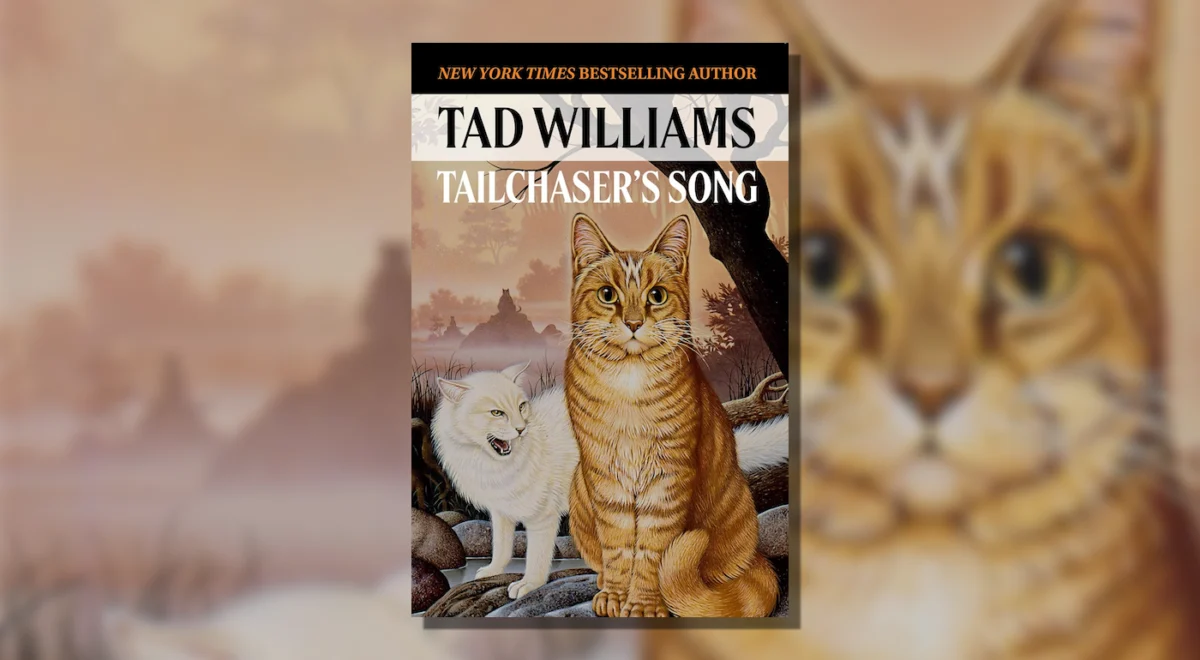
More than three decades before the debut of Erin Hunter’s wildly popular Warrior Cats series, Tad Williams offered readers a profound exploration of animal sentience and societal structure in his 1985 novel, Tailchaser’s Song. This seminal work, featuring an orange tabby named Fritti Tailchaser, predates many of the tropes that would come to define the talking-animal fantasy genre, presenting a world entirely from the perspective of cats. Fritti’s journey from a pampered housecat to a reluctant hero who ventures into the unknown echoes archetypal fantasy quests, drawing inspiration from ancient folklore, beast fables, and the epic world-building of authors like J.R.R. Tolkien.
Williams’s creation is not merely a collection of anthropomorphized felines; it is a meticulously constructed universe where cats are the apex species, their society, mythology, and language forming the bedrock of existence. The very fabric of their reality is woven with feline deities and a cosmic order designed for their dominion. Humans, referred to by the cats as M’an – a term that translates to "out of sunshine" – are relegated to a subordinate and almost unnatural status, perceived as a consequence of some cosmic transgression.
A Cat-Centric Cosmos and the Ambivalence of M’an
The narrative of Tailchaser’s Song is firmly rooted in a cat-centric worldview. The gods are cats, the land was fashioned for them, and their existence is considered the natural order. Humans, or M’an, are viewed with a mixture of dependence and disdain. While cats benefit from the services provided by humans, such as the provision of food and shelter, their relationship is marked by a deep-seated ambivalence. The story reveals that humans, in their obliviousness to the cats’ true place in the universe, often fail to meet their needs or desires. The ultimate indignity, as perceived by the feline characters, is a cat being forced to "drink from a bowl," a stark symbol of their subservience to the M’an who have seemingly forgotten their intended role. This detail underscores the novel’s exploration of power dynamics and the subversion of natural hierarchies.
The Art of Language: Invention and Expression
A hallmark of Tad Williams’s writing, evident from his earliest works, is his profound love for language itself, particularly his talent for linguistic invention. Much like Tolkien before him, Williams crafts distinct languages and dialects for the various species populating his world. While a common tongue facilitates interspecies communication, each species possesses its own linguistic nuances, accents, and unique languages.
Williams emphasizes that communication in Tailchaser’s Song transcends mere vocalization. It is an intricate synthesis of sound, gesture, facial expression, and intention, a holistic bodily expression. When cats communicate, they engage their entire beings, making their "speech" more akin to a song, a concept central to the novel’s title. This connection between song and dance further enriches their expressive repertoire, transforming every interaction into a performance of meaning.
The novel is replete with stories, poems, and songs, which serve as vehicles for transmitting history, mythology, and legend. These narratives, ranging from the solemn to the humorous, provide readers with a deep understanding of the cats’ cultural heritage and their perception of the world. Language, therefore, is not just a tool for communication; it is fundamental to their identity and their very existence.
The Significance of Names: Heart, Face, and Tail
Central to the linguistic tapestry of Tailchaser’s Song is the concept of names, each carrying profound significance within feline society.
- Heart Names: Bestowed by a mother upon her kitten at birth, the heart name is the most intimate designation. It is shared only with those closest to the cat, and the act of divulging one’s heart name signifies a deep bond of trust and vulnerability.
- Face Names: Awarded when a young cat first attends the grand "Meeting of all the cats," face names are public appellations. These names are compound descriptive terms, reflecting how the elders perceive the cat’s character or history. Examples include Pouncequick, Fencesitter, Roofshadow, and Hushpad. Fritti Tailchaser’s face name is somewhat ironic, as he is accused of seeking his "tail name" before truly understanding himself. Other face names, like Eatbugs the mad and Scratchnail the evil Clawguard chieftain, hint at the characters’ roles and personalities. The name Tangaloor Firefoot of the Firstborn is particularly noteworthy, as it is often cited as a potential inspiration for elements within Erin Hunter’s Warrior Cats series.
- Tail Names: The tail name is the most enigmatic. Every cat is born with one, a deeply personal designation that must be discovered through introspection or a personal quest. This name is never shared with another being and remains known only to the individual cat. While Fritti’s journey is ostensibly about finding his vanished love, it can be interpreted as a subconscious quest for self-discovery, potentially leading him towards his own elusive tail name.
Fritti’s Perilous Quest: From Summer’s End to Winter’s Depths
Fritti Tailchaser’s quest begins as a desperate search for his beloved, Hushpad, and possibly his mother and siblings. This personal odyssey propels him across the vast and varied landscape of his world, from the familiar woods and wilds to the wondrously unsettling City of Cats. The narrative spans from late summer into the harsh grip of winter, taking him from the surface world to the "hell of cats" below. The journey is a crucible, presenting exhilarating moments alongside a harrowing final third that confronts Fritti with profound and terrifying evil. While Fritti may not explicitly discover his tail name, his experiences forge a deep understanding of his own identity and the values that truly matter to him.
The Feline Mind: Cognition and Familiar Quirks
Williams’s cats are depicted with a level of cognition comparable to humans, possessing color vision and a reduced need for sleep compared to their real-world counterparts. However, they retain certain feline traits, such as a propensity for distraction and occasional forgetfulness, requiring them to be "forcibly reminded" of their tasks. This blend of enhanced intelligence and familiar animalistic behaviors lends a unique charm and relatability to the characters.
A Note on Genetics and Gender Representation
A curious observation for those familiar with real-world feline genetics arises from the novel’s portrayal of tortoiseshell cats. In Tailchaser’s Song, all tortoiseshell characters are depicted as male. This contrasts sharply with reality, where the genetic makeup for tortoiseshell coloration (requiring two X chromosomes to express both black and red pigments) makes male tortoiseshells exceedingly rare, typically XXY and sterile. The novel makes no mention of this rarity or genetic anomaly, which, alongside the broader gender representation, warrants further examination.
The book exhibits a predominantly male-dominated cast. Female cats, referred to as "felas," often occupy secondary roles, functioning primarily as non-player characters. Villains, hunters, and warriors are overwhelmingly male. Fritti’s mother is "fridged" – removed from the narrative early on – and his romantic interest, Hushpad, while possessing moments of insight, also disappears. Her reluctance to visit Fritti when he is gravely ill suggests a conditional affection, prioritizing his health and vitality over his vulnerability.
Even Sunback, the Queen of the Cats, is portrayed as detached and somewhat negligent, engaging in self-grooming during audiences and, most damningly from a cat’s perspective, eating from a bowl. She is depicted as a figurehead, manipulated by the males around her, particularly her consort.
The most prominent female character with significant agency is Roofshadow. Her backstory, marked by the loss of her family, fits the "Strong Female Character" archetype. She joins Fritti’s quest as a loyal companion and occasional rescuer, exhibiting prowess in hunting and fighting akin to the male characters. However, her social connections are limited; her closest bond is with the kitten Pouncequick, who reminds her of her lost brother, and she has no female friends.
Comparing this to Erin Hunter’s Warrior Cats series, published in 2003, highlights the evolution of perception and representation in the genre. Hunter’s series offers a more balanced gender distribution, with female cats playing more substantial and agency-driven roles. In Hunter’s world, the exceptional tortoiseshell leaders or seers might be female or males whose genetic uniqueness sets them apart.
Enduring Legacy and Themes of Decency
Despite these observations regarding gender representation, Tailchaser’s Song remains a profoundly impactful work. The characters, including Fritti and his companions, are vividly drawn and memorable. The novel masterfully navigates dark and harrowing themes, balanced by moments of genuine brightness and hope. Fritti embodies the archetypal hero who consistently acts with pure, unadulterated decency, even when it brings him pain and inconvenience. While others may excel as seers, singers, or poets, Fritti’s inherent goodness serves as a catalyst for change in his world. His journey underscores the enduring power of empathy and the quiet strength found in unwavering moral integrity. The novel’s intricate world-building, sophisticated language, and exploration of complex themes solidify its status as a landmark achievement in feline fantasy literature.