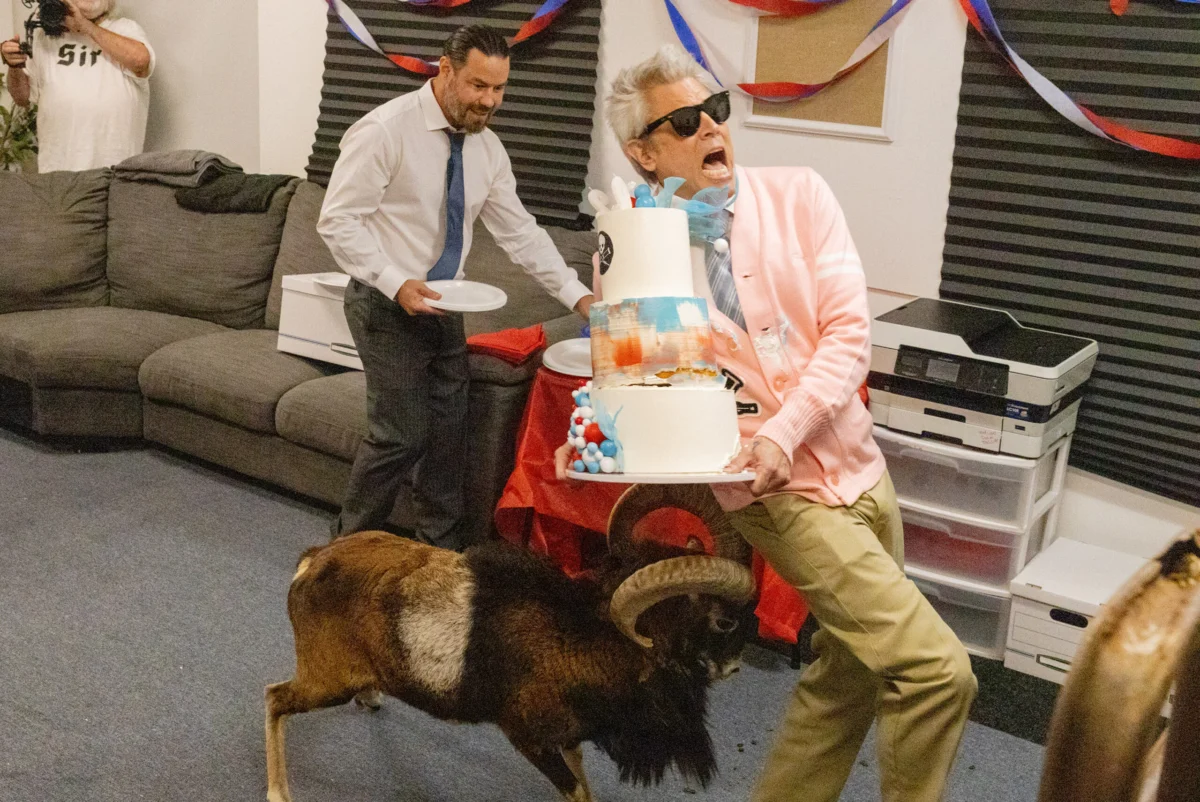
As the Jackass franchise prepares to unveil what some believe could be its ultimate chapter, Jackass: Best and Last (2026), a palpable sense of reflection and unexpected wistfulness has settled over its creators and cast. Director Jeff Tremaine, the steady hand behind the camera and the orchestrator of two decades of brilliantly sophomoric stunts, shared his own emotional journey as he revisited the extensive archives of footage, tracing the unlikely trajectory of a cultural phenomenon that was "not built to run long-distance." His insights offer a rare glimpse into the evolution of a series often dismissed as mere lowbrow entertainment, revealing the artistic eye and strategic vision that underpinned its enduring success.
Tremaine, whose unassuming demeanor and vintage Smiths T-shirt belie the image of a conventional auteur, articulated his feelings during an interview last Thursday. "I really felt it in the edit bay when we started opening up the old footage and looking back on how long we’ve been doing this," Tremaine recounted. "Seeing all these guys as babies, that hit me a little bit. We thought that we would get one episode on TV—if we did—and it would just get shut down. We weren’t built to run long-distance, but somehow we did." This sentiment underscores the improbable longevity of Jackass, a series that defied expectations from its inception, transforming from a fringe skateboarding video project into a multi-million dollar global franchise.
The Genesis of a Gutter-Punk Empire
The origins of Jackass are rooted in the anarchic spirit of the late 1990s skateboarding subculture. Jeff Tremaine, alongside co-creators Johnny Knoxville and Spike Jonze, cultivated the distinct sensibility and aesthetic that would define the franchise. Tremaine’s journey began not with aspirations of directing blockbuster films, but at Big Brother magazine, a publication notorious for its irreverent humor and outrageous content. "When I got the job at Big Brother, which was a skateboarding magazine, that was the top for me: ‘I’m the boss, I get to lay out this magazine, I get to choose exactly what it looks like.’ That was the pinnacle for me, career-wise," Tremaine explained.
It was within this environment that Tremaine honed his unique skill for identifying and curating "outrageous personalities," a talent that would prove foundational for Jackass. He recalls a pivotal moment: "When Knoxville shot himself [with a handgun for a Big Brother video], that footage was really the moment where I felt this was bigger than the little skateboard video we were making. It was Knoxville’s ability to engage you. I also had Steve-O and Wee Man and [Chris] Pontius—these guys who are funny as hell. I was like, ‘Oh shit, this is maybe a TV show.’" This realization marked the crucial transition from print and video segments to the burgeoning world of television, setting the stage for an unprecedented cultural impact.
The Jackass television series premiered on MTV in 2000, immediately captivating a generation with its raw, uncensored stunts and pranks. Despite its initial run being relatively brief, concluding in 2002, its success propelled the crew onto the silver screen. Jackass: The Movie (2002) grossed nearly $80 million worldwide, solidifying the franchise’s commercial viability and fan base. Subsequent films, Jackass Number Two (2006) and Jackass 3D (2010), continued to expand its reach, with Jackass 3D becoming the highest-grossing entry at over $171 million globally. Even spin-offs like Jackass Presents: Bad Grandpa (2013) demonstrated the brand’s enduring appeal, garnering over $150 million. The most recent theatrical release, Jackass Forever (2022), proved the franchise’s staying power, earning $80 million despite a global pandemic.
The Art of Orchestrated Chaos: Directing the Madness
Despite Tremaine’s undergraduate degree in fine arts and his lifelong passion for painting and drawing, he has rarely been recognized by journalists as a filmmaker in the traditional sense, often grouped with the "knuckleheads" he directs. Yet, his artistic sensibility has profoundly shaped the Jackass aesthetic, crafting surprisingly touching and endearing moments from seemingly coarse material. He has spearheaded a comedy series that, remarkably, manages to condemn homophobia while celebrating genuine male friendships—themes often overlooked amidst the chaos.
The logistical evolution of Jackass production mirrors its growth in popularity and scale. From its humble beginnings, where Tremaine himself would drive the single van transporting the entire cast and minimal crew, to the elaborate, multi-camera setups of modern studio productions, the challenge of maintaining spontaneity has been constant. "We used to all fit in one van. The cameraman, the sound guy and the cast—and I’m driving the van… for a Paramount movie!" Tremaine recalled, highlighting the stark contrast with later productions. "Every movie, it has just kept growing and growing, to the point where I’m like, ‘We have all these fucking people. I don’t even know what everyone’s doing.’"
The increasing scale brought with it the necessity of permits and greater oversight, fundamentally altering the freewheeling, guerrilla-style filmmaking that characterized the early days. Tremaine reminisced about the impulsive nature of stunts like kidnapping Brad Pitt for a segment: "Within five minutes, we were in the van heading to Pink’s. I love that so much and I miss those days, because now we are a slow-moving, deliberate machine that is hard to control." However, Tremaine views these restrictions not as limitations, but as catalysts for creativity. "I like operating with some restrictions—I think that forces me to be more creative," he noted, demonstrating an adaptability essential for navigating the complex landscape of major film production.
Navigating the Studio and the MPAA
A significant aspect of Tremaine’s directorial role has involved constant negotiation with studios and ratings boards, particularly the Motion Picture Association of America (MPAA). These battles often centered on the franchise’s signature elements, such as nudity and extreme stunts. He recounted a specific struggle during the production of Jackass 3D concerning a lengthy slow-motion shot of Chris Pontius’s penis hitting a ping-pong ball. The MPAA’s strict guidelines regarding male full-frontal nudity led to absurd compromises. "They were like, ‘No, this is too long,’ so I sped it up to the point where it stopped being magical," Tremaine explained. "Paramount came back: ‘No, it’s got to be shorter.’ I’m like, ‘Tell me the number,’ and they’re like, ‘You can have ten seconds of penis exposed.’ So we ended up putting a black bar over it, and then the black bar slides away and the dick hits the [ping-pong ball]—the funny part—and then the black bar comes back in and covers it. That was okay with them. [Laughs.]" Such anecdotes underscore the often-ludicrous challenges of translating Jackass‘s raw humor into a commercially viable, rated product.
While Tremaine meticulously crafts the scenarios, he emphasizes that the cast’s performances are largely unscripted. "I don’t tell anyone what to say—it is their real personalities," he affirmed. His directing style is more akin to curating reactions and positioning the right personalities for maximum comedic effect. "I know Chris Pontius is going to say something funny, so I always have him right next to the action, and I have a camera ready. I have no idea what he’s going to say, but I know if this bit isn’t as funny as it’s supposed to go, if you go to Chris, it’s going to turn a C into an A." This keen understanding of his cast’s individual strengths and dynamics is crucial to the Jackass formula.
The inherent dangers of Jackass stunts necessitate difficult decisions. Tremaine recounted the challenging moment during Jackass Forever when he had to inform Johnny Knoxville that his first attempt at "The Magic Trick"—being hit by a bull—wasn’t sufficient for the final cut, despite Knoxville breaking two ribs. "It was really hard for me to tell him we didn’t have it on that first hit. He wanted to hear that we got it… He knew he had to go again, but he needed to hear it—I’m the one who has to tell him that." This interaction highlights the intense pressure and the unique bond between director and performer in a franchise where "getting it right is getting it wrong." Tremaine, alongside Knoxville, serves as the ultimate arbiter of stunt ideas, often pushing through concepts he initially doubts, such as "The High Five" or "The Bear" stunt with Ehren McGhehey, which ultimately become fan favorites.
The Unexpected Embrace of High Art
Perhaps one of the most surprising developments in the Jackass saga has been its critical reappraisal. Initially dismissed as puerile and crude, the franchise, particularly from Jackass 3D onwards, began to garner serious critical attention, culminating in Jackass 3D‘s premiere at the Museum of Modern Art (MoMA). This shift in perception, where "lowbrow slapstick" was suddenly being discussed as "high art," was met with a mix of amusement and discomfort by Tremaine. "I thought it was hilarious," he admitted. "I’ve always struggled with intellectualizing what we do. To me, it is just so surface-level: ‘This is what we do and it’s stupid. We’re magnifying stupid.’ That’s all it is to me."
Tremaine finds himself in a unique position, observing intellectual analyses of his work, sometimes nodding in agreement, other times laughing at what he perceives as overthinking. "I love reading a good intellectualized breakdown of what we do, and they’re right some of the time—and sometimes they’re just pulling shit out. I’m like, ‘That’s great that they think that,’ but sometimes they are dead-on. They’re much more psychologically in tune than I am with what’s happening."
The critical consensus around Jackass has indeed shifted dramatically. Early films often received mixed to negative reviews, with critics struggling to find merit in the apparent mayhem. However, Jackass 3D earned a respectable 79% approval rating on Rotten Tomatoes, and Jackass Forever achieved an impressive 86%, with critics praising its humor, heart, and the genuine camaraderie among the cast. This trajectory is almost unprecedented in film franchises, which typically see diminishing critical returns with each sequel. Tremaine, however, finds this newfound critical embrace somewhat unsettling. "We never got good reviews in the beginning—terrible reviews, always—and that fueled me. Not to try to get better reviews, but, ‘This is great, fuck you.’" The positive reception for Jackass Forever even prompted a moment of self-doubt: "I’m like, ‘This doesn’t feel right. Either we’ve been doing it too long and now the kids that we raised up are now the critics—or maybe we’re just not fucking punk anymore. Maybe we’ve lost it. Maybe now we’re mainstream—or maybe COVID just broke the world and we’re fucked.’ [laughs] And a little bit of all of that’s true, but it’s still ‘Fuck the world’ in our mindset—or mine, at least."
Beyond the Stunts: A Hidden Artistic Vision
Beyond the stunts and slapstick, Tremaine’s artistic leanings manifest in unexpected ways. Few are aware that he directed a remarkably elegant and stylish American Airlines safety PSA, a stark contrast to his Jackass work. "That made me laugh—how the fuck am I even being considered to make a safety video for American Airlines, the biggest airline in the world? ‘You know who we got to get to do our safety video? The Jackass guy!’" he exclaimed. This project allowed him to embrace "Safety first!" after a career defined by "Safety third," and ironically, it might be his most widely seen work.
The polished openings and closings of Jackass films, often infused with musicality, hint at Tremaine’s deep connection to music. "Music has always been in the foreground for me. It’s not a background element in my life—it is a foreground element in my development," he stated. His discovery of punk rock, much like skateboarding, forged a path to like-minded individuals and a vibrant counter-culture. For Jackass, music isn’t merely background noise; it’s a vital component, an homage, and an expression of the creators’ tastes.
Tremaine acknowledges the consistency of his creative voice, even if it hasn’t evolved as he might have personally wished. "I’m almost embarrassed that I found that voice early—and the voice didn’t change. [Laughs.] Goddamn it, I want it to evolve, but it just feels like the same fucking thing and it didn’t mature. I’m almost 60 years old, and I still like to draw dicks on things. It’s weird to me that that is still funny to me. I’m waiting to grow up." This self-deprecating humor underscores the unique paradox of Jeff Tremaine: a fine artist by training, an accidental director by career, and a perpetual prankster by disposition, who has, against all odds, guided a seemingly frivolous concept into an enduring and culturally significant franchise. As Jackass: Best and Last looms, it marks not just a potential conclusion, but a moment to reflect on the improbable journey of a series that redefined comedy and left an indelible mark on popular culture.