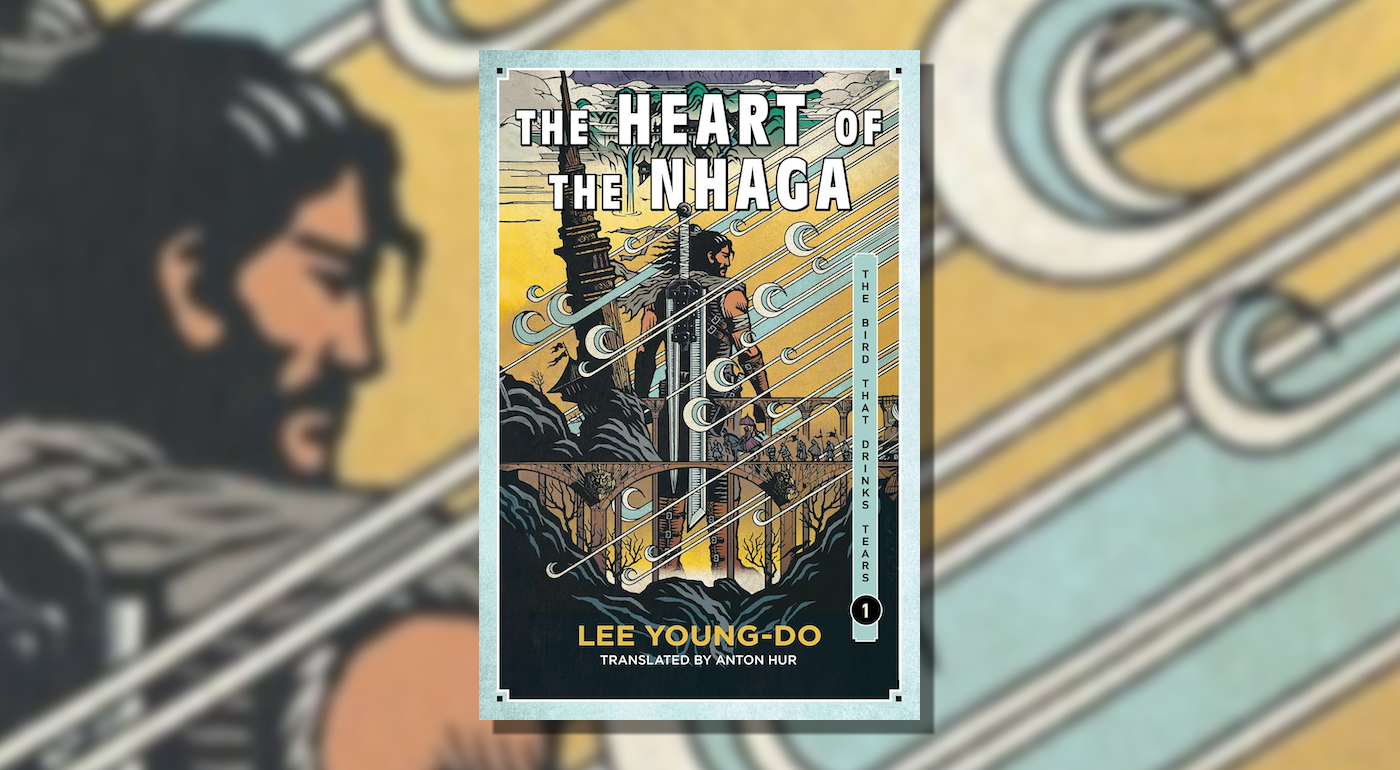
Harper Voyager is set to release Lee Young-do’s epic Korean fantasy novel, The Heart of the Nhaga, translated by Anton Hur, on June 2nd, offering readers a glimpse into a richly imagined world teetering on the brink of upheaval. The novel introduces a meticulously crafted cosmology divided by the formidable Line of Limit, a boundary separating distinct and ancient races, each with their own unique characteristics and histories.
A World Divided: Races and Realms
To the north of the Line of Limit reside the Tokkebi, a race of fire-wielding beings capable of manipulating flames for both combat and intricate illusions. Alongside them are the Rekon, colossal birdmen whose immense strength and warrior prowess are legendary. In stark contrast to the unified nature of these races, humanity to the north exists in a state of perpetual division. South of the Line of Limit dwell the Nhaga, a reptilian species renowned for their unique practice of relinquishing their hearts to achieve a form of immortality. For centuries, these disparate races have maintained a strict adherence to their geographical boundaries, a fragile peace dictated by the Line of Limit. However, the narrative heralds a significant shift, as a Nhaga is slated to traverse this long-standing barrier, signaling an unprecedented era of inter-racial interaction.
The Genesis of a Perilous Mission
The novel’s premise centers on an extraordinary mission: a trio, composed of one representative from each of the northern races, is dispatched to ensure the safe passage of a Nhaga envoy into the north. This seemingly straightforward escort duty is immediately complicated by the inherent nature and individual circumstances of the chosen operatives. The Tokkebi assigned to the mission is not a seasoned warrior but a scholar, ill-equipped for the rigors of an arduous journey. The Rekon, despite their formidable strength, harbors a crippling fear of water, a potentially insurmountable obstacle in varied terrains. The human contingent, meanwhile, carries a deep-seated prejudice, their culture dictating a hunting and consumption of Nhaga.
The already precarious situation escalates dramatically when the Nhaga they are tasked with escorting through the treacherous Kiboren forest is murdered. In a twist that unravels the initial plan, a replacement is sent, but this individual, unlike their predecessor, possesses a heart. This crucial difference renders them vulnerable to the myriad dangers that lie in wait during their perilous exodus. The newly formed quartet—a scholar Tokkebi, a hydro-phobic Rekon, a Nhaga with a heart, and a human with a complex relationship with their assigned charge—must rapidly forge an unlikely alliance. The success of their mission, and potentially the fate of their world, hinges on their ability to overcome centuries of ingrained distrust and prejudice. Furthermore, they must uncover the true purpose behind this clandestine operation, as the stakes are far greater than a simple escort.
Unveiling the Enigmatic Castle of Jumunuri
The narrative’s initial descent into this complex world begins within the labyrinthine walls of Jumunuri, the fortress of the Tokkebi. The construction of Jumunuri itself is a testament to the Tokkebi’s whimsical and often confounding nature. Legend holds that the castle was built with the aid of the "five daughters of the night": Chaos, Seduction, Imprisonment, Concealment, and Dreams. Chaos orchestrated the castle’s interior, while Seduction sculpted its exterior. Imprisonment engineered an intricate network of dead ends, mazes, and traps, and Concealment wove a tapestry of secret passages, hidden doors, and passwords. The role of Dreams, the fifth daughter, remains enigmatic, as her desire to uncover and discover contrasted with the night’s inclination towards concealment, aligning her more with the nature of day, yet she was visible only under the cloak of night.
The castle’s architectural design defies conventional logic. Its lord is the sole entity privy to the precise count of its floors, rooms, corridors, and stairs. Visitors and frequent inhabitants learn to navigate its peculiar pathways through a series of esoteric rules: reaching the fourth floor necessitates a journey to the seventh first; a turn of three corners invariably leads to the great hall; and specific turns from the eastern tower deposit one in the lord’s library. The nature of this landing spot is subject to the whims of each lord, ranging from a soft cushion to a bed of iron nails, or even the precarious placement of lit candles—a distinctly Tokkebi touch, intended to elicit a playful singed posterior. The veracity of the nail bed, however, remains a subject of speculation, hinting at a darker, more extreme side to Tokkebi amusement.
A Message from the Shadows: The Rescue Mission is Revealed
Amidst this peculiar setting, Sabin Hasu’un, the head of Jumunuri’s sentries, observes his lord, Bao Moridol, the eleventh lord of the castle, engaged in an unusual task: carrying a pail of what appears to be beetle feces. Sabin, tasked with delivering a critical letter, resigns himself to a potentially unpleasant olfactory experience, navigating the castle’s disorienting corridors. He follows the established protocol, turning twice, only to find himself landing on his posterior in the library, as per the castle’s eccentric design. To his surprise, the landing spot is empty.
Upon reaching the lord’s writing table, Sabin addresses Bao, who is holding a spade and appears to be contemplating the pail. Sabin attempts a lighthearted inquiry about the contents of the pail, suggesting it might be intended for the castle’s dim flora. Bao, however, impatiently demands Sabin state his business. Sabin, seizing an opportunity to prolong his lord’s potential distraction and perhaps glean more information, engages him in a philosophical discussion about sunlight and manure, subtly hinting at the castle’s perpetual gloom. Bao, eager to attend to whatever new inspiration the pail has sparked, urges him to get to the point.

Sabin then reveals the true purpose of his visit: a message from a group known as the Kims, delivered by a beetle. The Kims, identified as monks who practice self-shaving, have requested the dispatch of a Tokkebi. The reason for this request is a clandestine rescue mission, one that will venture below the Line of Limit. The specific objective of this mission is shrouded in secrecy, with the Kims refusing to divulge details, a characteristic attributed to their inherent tendency towards concealment.
The "Three Handles One" Doctrine and the Enigmatic Kagan Draca
Bao, intrigued, inquires about the other members of this mission. Sabin reveals that the Kims are adhering to an ancient adage: "Three handles one." This implies a tripartite composition for the mission, and indeed, a human and a Rekon are also slated to participate. The offer for the Tokkebi’s participation is a substantial two hundred pieces of gold, an amount that Bao finds surprisingly compelling.
Sabin, however, expresses profound skepticism regarding the mission’s prospects, predicting a swift and brutal demise for the assembled group in the unforgiving Kiboren jungle. He attributes this grim outlook to a general lack of knowledge about the region and the Nhaga. Bao, however, posits that the human member of the mission, a Kim, possesses the requisite knowledge. He identifies this individual as Kagan Draca, a legendary wrestler known for his past victory against a phalanx of Tokkebi champions.
The conversation then takes a dark and disturbing turn as Bao reveals Kagan’s chilling reputation: he hunts and consumes Nhaga. Sabin is visibly disturbed, questioning Kagan’s sanity. Bao explains that Kagan harbors an intense hatred for the Nhaga, stemming from a devastating personal tragedy where the Nhaga "swallowed everything that was precious and meaningful" to him, leaving him with only his "worthless body." This profound loss has driven him to exact a brutal and visceral revenge. Bao shares a letter from Kagan, written approximately six years prior, which details his relentless pursuit and consumption of Nhaga, drawing a parallel to the traditions of the tiger hunters of Kitaljer. The letter reveals Kagan’s self-identification as a "son that survived," driven by an all-consuming need for vengeance. His actions are not merely a matter of survival but a deeply ingrained, almost ritualistic, response to his immense grief and loss.
The Shadow of Tragedy and the Price of Revenge
The insignia on Kagan’s letter, a black lion and a dragon, is identified by Bao as the symbol of the Kitaljer hunters, representing "Kagan" and "draca" respectively in their language, both of whom were tragically killed by the Nhaga. This revelation underscores the depth of Kagan’s personal vendetta. Sabin, grappling with the horrifying implications of Kagan’s actions, questions what could have driven such extreme behavior. Bao confirms that a "terrible thing" occurred, but like Kagan’s true name, the details are withheld without his consent, indicating a profound and traumatic event.
Despite Sabin’s unease about Kagan’s potentially unhinged state, Bao insists that Kagan is, paradoxically, the safest individual to accompany the mission into the Kiboren. He argues that Kagan’s rage is singularly directed at the Nhaga, leaving him incapable of anger towards any other race. Bao believes that for anyone not a Nhaga, Kagan may be the most reliable protector, precisely because his capacity for rage is so narrowly focused.
The Unforeseen Appointment
The discussion circles back to the mission’s composition, with Bao agreeing to send a Tokkebi, fulfilling the "Three handles one" dictum. When Sabin inquires about who will be chosen, Bao, with a characteristic Tokkebi blend of pragmatism and caprice, declares that since no Tokkebi possesses the specific qualifications for such a perilous undertaking, all are equally eligible. Therefore, he will send whichever Tokkebi happens to enter the room next.
This fateful decision is soon put to the test. Shortly after, a Tokkebi named Byong Srabble, the lord’s valet, enters the room in a state of agitation, mistaking Sabin for someone attempting to usurp his duties. Bao, with a decisive grin, informs Byong that his presence is not for usurpation but for dispatch on a rescue mission. Byong, bewildered, learns he is to venture into a place untouched by mortals for centuries to rescue someone.
The excerpt concludes with this unexpected assignment, leaving the reader to ponder the intricate web of prophecies, personal vendettas, and the precarious balance of power that defines this epic fantasy world. The fate of the mission, and potentially the world, now rests on the shoulders of an unlikely quartet, each burdened by their own histories and prejudices, embarking on a journey into the unknown. The release of The Heart of the Nhaga promises to immerse readers in a narrative rich with complex characters, ancient lore, and the profound consequences of a world on the precipice of change.