The Genesis of Disorientation: A Plot Unraveled
The narrative of "You Become a Star, Too" embarks on a complex and intentionally abstruse journey, commencing with an almost surreal opening sequence. A nuclear family, whose identities are quickly established as conduits for the film’s escalating strangeness, experiences an improbable stroke of luck: winning the lottery. The connection between this sudden windfall and the subsequent events remains largely ambiguous, a narrative thread introduced only to be loosely reattached to the family’s relocation to a new residence—a home that swiftly reveals itself to be potentially haunted. Initial viewer expectations for a social critique, perhaps examining the psychological impact of sudden wealth or the pressures of aspirational living, are quickly subverted. Such concerns, much like the spectral entities that populate the film, merely hover intermittently at the periphery, never solidifying into a stable thematic anchor.
What begins as a seemingly conventional premise for a haunted house story rapidly metastasizes into an intricate web of possession, theatrical performance, and fragmented supernatural investigation. The film eschews linear progression, instead accumulating a diverse cast of figures and subplots that materialize and vanish with an almost arbitrary rhythm. Audiences are introduced to a nightclub singer who seduces the father, portrayed by the prominent actor Shin Seong-il, a pop star whose vacation takes a doomed turn, and the enigmatic spirit of a dead poet who rages about the underworld before disappearing from the narrative altogether. These disparate elements are further complicated by the emergence of a spiritual society dedicated to investigating paranormal phenomena, and eventually, a seemingly unrelated murder investigation spearheaded by a remarkably detached police officer. Each thread is introduced with a sense of urgent potential, only to be either abruptly dropped or intertwined in ways that defy conventional causality, creating a deliberate sense of narrative fragmentation that keeps the audience in a perpetual state of unease and intellectual engagement.
An Unstable Register: The Collision of Genres and Tones
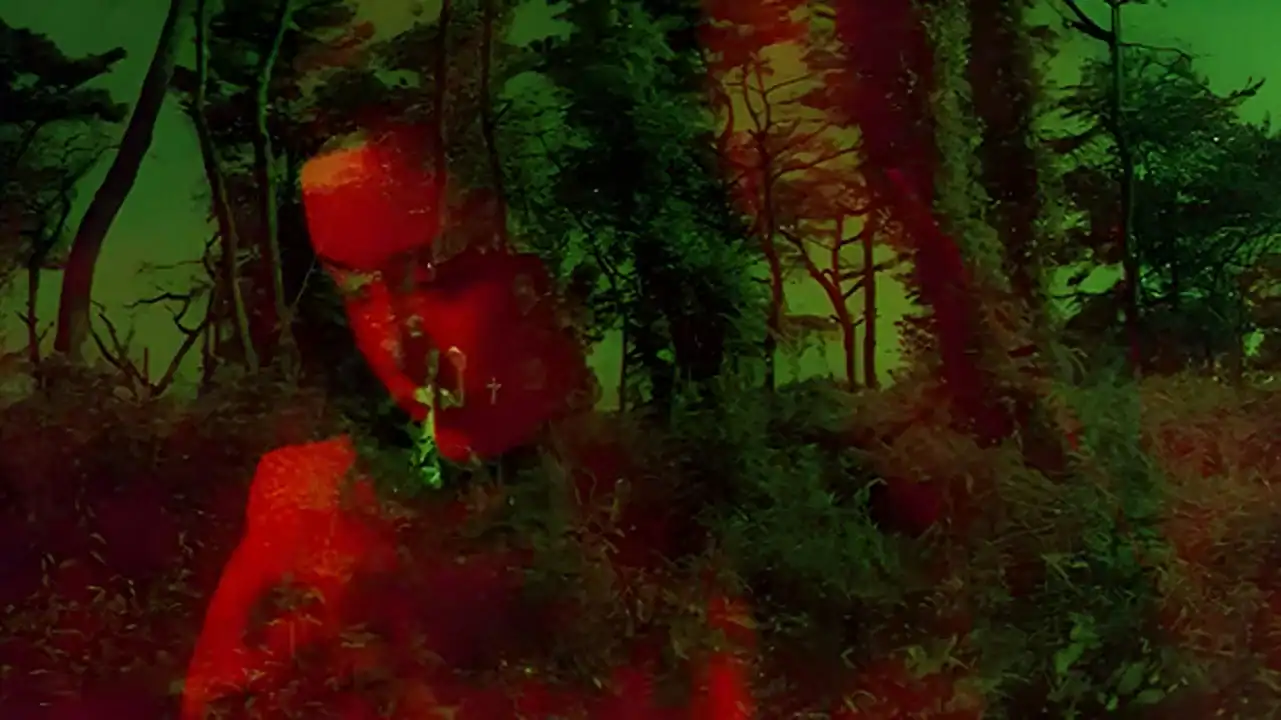
The most distinguishing characteristic of "You Become a Star, Too" is its unwavering refusal to stabilize its own narrative and tonal identity. This instability is not accidental but appears to be a deliberate design choice, creating a disorienting cinematic experience. The film lurches from one narrative thread to another without warning, its momentum dictated by an internal, inscrutable logic rather than conventional plot progression. Tonal shifts are equally abrupt and profound, collapsing the distinct emotional registers of horror, saccharine melodrama, and poignant lyricism into a single, volatile continuum. Scenes depicting intense possession or sudden bursts of violence are jarringly juxtaposed with lengthy, at times wearisome, melodramatic sequences, or with breathtaking, abstract visions of the afterlife that critics have noted would not feel out of place within Stanley Kubrick’s seminal science fiction epic, "2001: A Space Odyssey." This relentless oscillation between disparate genres and moods results in a film whose visual style and narrative identity feel intentionally precarious, actively resisting any consistent logic of continuity or genre classification. The effect is one of continuous surprise and a constant re-evaluation of the cinematic language being employed, challenging viewers to abandon pre-conceived notions of narrative structure.
Lee Jang-ho and the "Visual Age": A New Dawn for Korean Cinema
To fully appreciate the radical nature of "You Become a Star, Too," it is essential to contextualize it within the tumultuous landscape of 1970s South Korean cinema. This decade was characterized by severe government censorship under the authoritarian rule of President Park Chung-hee, who sought to control artistic expression through restrictive policies and a highly regulated film industry. Despite these constraints, or perhaps in direct response to them, a powerful movement emerged known as the "Visual Age" (영상시대, Yeongsang Sidae). This collective of visionary filmmakers, including Lee Jang-ho, Ha Gil-jong, and Kim Ho-seon, sought to revitalize Korean cinema by consciously breaking away from the established traditions of the "studio system" era.
Influenced heavily by the "New Waves" of French and American cinema—movements characterized by their rejection of classical Hollywood narrative and embrace of experimental techniques, auteur theory, and social realism—the Visual Age filmmakers aimed to cultivate a more explicitly modernist art cinema. They championed stylistic innovation, complex psychological narratives, and often, thinly veiled social critiques embedded within genre frameworks. Lee Jang-ho, a pivotal figure of this movement, quickly established himself as one of the most respected directors of the 1970s and 1980s, known for his audacious experimental works and his courageous engagement with pressing social issues, often pushing the boundaries of what was permissible under the strict censorship regime.
"You Become a Star, Too," released in 1975, stands as a prime example of the Visual Age’s ethos. Seen through this historical lens, the film transcends mere incoherence, revealing itself instead as a deliberate and sophisticated attempt to push the commercial horror framework to its absolute breaking point. It masterfully combines elements of melodrama, horror, and experimental form in ways that actively strain against traditional narrative coherence, transforming a genre vehicle into a platform for artistic rebellion. The aesthetic choices—saturated colors that often feel hyperreal, wild and unconventional camera angles that disorient the viewer, and abrupt, often jarring shifts in sound design—all contribute to a disorienting aesthetic that resolutely refuses narrative or stylistic stabilization. This was not simply a film; it was a manifesto, a declaration of independence from the cinematic norms of its time.
Artistic Innovation and Formal Experimentation: The Film’s Core Strength
The film’s inherent instability becomes its most compelling attribute when viewed as a conscious artistic strategy. Rather than being a flaw, the constant disruption of narrative flow and genre expectations serves to highlight the modernist impulses at its core. Particularly successful in this regard are the dream sequences. Each time the primary narrative threatens to settle into a conventional rhythm, these meticulously crafted sequences burst forth, shattering any sense of stability. They open up an unregulated, almost primordial space where image and sound are liberated from the strictures of narrative obligation, allowing for pure cinematic expression. The dreamscapes are often abstract, visually arresting, and emotionally resonant, providing glimpses into the characters’ subconscious fears and desires without the need for literal explanation.
Similarly, the film’s depiction of the afterlife functions not as a plot device for resolution but as a zone of formal license. Here, the supernatural elements become an explicit excuse for radical experimentation, rather than serving as a means to advance the story or provide conventional answers. The afterlife is portrayed with a hallucinatory quality, drawing comparisons to the transcendental sequences in "2001: A Space Odyssey" for its abstract visual grandeur and its exploration of consciousness beyond corporeal existence. This approach allows Lee Jang-ho to explore themes of existence, memory, and the unknown through purely cinematic means, pushing the boundaries of visual storytelling.
The film’s overt stylistic flourishes are equally noteworthy. The use of saturated colors, for instance, is not merely decorative; it intensifies the film’s emotional landscape, making the mundane feel uncanny and the supernatural intensely vivid. The wild camera angles, often extreme low or high angles, Dutch tilts, or dizzying tracking shots, distort perspective and contribute to the pervasive sense of unease and disorientation. These techniques serve to heighten the psychological tension and plunge the audience deeper into the film’s subjective and often chaotic world. Furthermore, the abrupt shifts in sound design—from moments of jarring silence to sudden bursts of discordant music or distorted ambient noise—underscore the film’s commitment to sensory overload and its deliberate disruption of comfortable viewing experiences. This meticulous manipulation of sound and image creates a truly immersive yet unsettling atmosphere that remains distinctive.
Legacy and Re-evaluation: A Lingering Presence
"You Become a Star, Too" maintains an enduring sense of the bizarre and the offbeat throughout its runtime, imbuing it with a distinctive and indelible identity. While certain elements of its formal approach, particularly its musical score, undeniably scream "1970s," marking it as a product of its time, the film’s core appeal lies precisely in its refusal to settle into conventional patterns. It is a work that actively resists easy categorization, continuously challenging viewer expectations and cinematic norms.
The current screening as part of "Korean Cinema’s Celluloid Fever: The 1970s" underscores the film’s enduring relevance and its growing recognition in international film circles. Such retrospectives are crucial for re-evaluating historical cinematic output, bringing to light works that may have been overlooked or misunderstood in their initial release. For "You Become a Star, Too," this re-evaluation confirms its status not just as a historical curiosity, but as a groundbreaking piece of experimental horror that anticipated many postmodern cinematic trends.
For a movie ostensibly about hauntings, its most profound and lasting "ghost" may very well be its own inherent instability. It is a cinematic work that resists coherence even as it continues to linger in the minds of those who encounter it, a testament to Lee Jang-ho’s audacious vision. Its influence can be subtly traced in later Korean genre-bending films and the country’s celebrated New Wave, which continued to push artistic boundaries in subsequent decades. "You Become a Star, Too" stands as a vital artifact of a dynamic period in Korean film history, a film that dared to be different, and in doing so, carved out a unique and enduring place for itself in the annals of experimental cinema. Its continued screening and analysis confirm its status as a significant cultural and artistic achievement, inviting new generations of viewers to grapple with its challenging and rewarding cinematic experience.