Asghar Farhadi, the acclaimed Iranian filmmaker renowned for his nuanced explorations of morality and human relationships, returns to the French language and cinematic landscape with his latest offering, a meticulously crafted meta-drama that delves into the intricate connections between voyeurism, creativity, and the blurring lines of reality. Building upon his established European sojourns with "The Past" (France) and "Everybody Knows" (Spain), Farhadi’s new film, though not explicitly titled in the provided text, continues to demonstrate his mastery in weaving complex narratives that echo the psychological depth of European auteurs like Michelangelo Antonioni and Michael Haneke, while simultaneously incorporating elements of suspense reminiscent of Alfred Hitchcock.
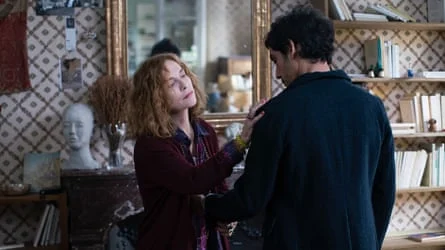
The film centers on Sylvie, portrayed by the formidable Isabelle Huppert, a once-celebrated writer now navigating a life of self-imposed isolation and creative stagnation. Residing in a cluttered Parisian apartment, Sylvie continues to churn out novels on her vintage Olivetti electric typewriter, a deliberate anachronism in an increasingly digital world. Her current literary endeavor draws inspiration from a peculiar source: her habit of observing her neighbors through a telescope. This act of private surveillance becomes the bedrock of her narrative, a reflection of a deeper thematic concern the film poses: the intrinsic link between the act of watching and the impulse to create. Does the writer, in their quest to bring characters to life, inevitably become a spy on the very beings they have conjured?
This central premise serves as a thematic echo of Krzysztof Kieślowski’s "A Short Film About Love," infused with the voyeuristic tension of Hitchcock’s "Rear Window." Farhadi, however, spins this familiar thread into a uniquely intricate and elaborate web, exploring the psychological ramifications of observation and its transformative power on both the observer and the observed. The narrative is a testament to Farhadi’s signature style, where seemingly ordinary circumstances unfurl into profound examinations of human frailty, deception, and the often-unseen currents that bind individuals together.
The Genesis of a Story: From Observation to Fiction
Sylvie’s latest novel is born from her clandestine observations of Nicolas (Vincent Cassel) and his colleagues, Nita (Virginie Efira) and Théo (Pierre Niney), who operate a sound effects production facility from their adjacent apartment. Within this space, the trio meticulously crafts lo-fi auditory landscapes – the crunch of footsteps, the rustle of undergrowth – that are essential for creating immersive cinematic realities, often while the visual content plays silently before them. Sylvie, despite her apparent aversion to modern technology, finds herself captivated by the intimacy of their collaborative process and their profession.

Her narrative also weaves in a deeply personal autobiographical thread. Sylvie imagines that her own father, from the very same apartment years prior, used a similar telescope to observe her mother’s lover, who resided in the neighboring dwelling. This imagined history imbues the present with a sense of inherited surveillance and unspoken secrets. The deceased occupant of the apartment, an elderly man who seemingly lived and died in solitude, becomes a spectral presence, his vacant dwelling now a potential stage for further clandestine observation.
Sylvie’s fascination with the lives of Nicolas, Nita, and Théo leads her to envision a steamy narrative for them, a tale of forbidden passion and murder à trois. This fictional drama, born from her voyeuristic impulse, is then presented to the audience as a parallel unfolding on screen, creating a meta-cinematic experience that questions the authorship of desire and the origins of fictional conflict.
Critical Reception and Thematic Resonance
The film’s reception has highlighted its intellectual rigor and the power of its performances, particularly from Huppert, Cassel, and Efira. However, some critics have noted a potential prolixity in its pacing, suggesting that the film’s deliberate unfolding, while building suspense, might test the patience of viewers accustomed to more immediate narrative gratification. The film’s runtime, exceeding two hours and twenty minutes, has been a point of discussion, with some drawing parallels to the perceived density of Georges Simenon’s literary works, a comparison that also appears within the film itself through a cameo by Catherine Deneuve as Sylvie’s agent. Deneuve’s character, unimpressed by Sylvie’s latest manuscript, dismisses it as being akin to Simenon, a critique that subtly underscores the film’s own thematic preoccupations with genre and literary merit.
Farhadi, known for his meticulous attention to detail and his ability to extract profound human truths from seemingly mundane situations, appears to be pushing the boundaries of his own cinematic language. The film’s exploration of the sound design, the creation of artificial realities through fabricated noises, serves as a potent metaphor for the act of storytelling itself. The “fake overdubs essential for creating reality” become a powerful statement on how we construct our understanding of the world, both through media and through personal narratives.
The Contamination of Fiction and Reality
The narrative takes a significant turn when Sylvie’s concerned niece hires Adam (Adam Bessa), an ex-convict seeking to go straight, to clean out Sylvie’s cluttered apartment. Adam, a man with a past that contrasts sharply with Sylvie’s intellectual pursuits, quickly becomes entangled in the writer’s world. His past brushes with the law are juxtaposed with his present encounter with Sylvie’s work. He impresses Sylvie’s niece with his decisive action in recovering her stolen bag on the Métro, demonstrating a grounded pragmatism that is absent in Sylvie’s more abstract contemplations.

Adam develops a dangerous obsession with Sylvie’s manuscript and the lives of the individuals who unwittingly inspired it. His fascination escalates when he manages to gain access to the manuscript and shares it with Nita. This act marks a critical juncture, where the fictional narrative begins to fatally contaminate the real lives of those depicted. The carefully constructed boundaries between Sylvie’s imagination and the lived experiences of her neighbors begin to dissolve, leading to unforeseen and potentially devastating consequences.
Broader Implications: The Ethics of Observation and Creation
Farhadi’s film prompts a profound reflection on the ethical dimensions of observation and the responsibility of the creator. In an era saturated with digital surveillance and the constant dissemination of personal information, the film’s exploration of voyeurism feels particularly resonant. It asks whether the act of observing, even with artistic intent, can ever be truly benign. The film suggests that the lines between observer and observed are not as clear-cut as they may seem, and that the act of creation, especially when fueled by the lives of others, carries inherent risks.
The narrative also touches upon the evolving nature of creative industries. The contrast between Sylvie’s analog methods and the digital sound design of Nicolas, Nita, and Théo highlights the generational and technological shifts that are reshaping artistic production. Yet, despite these differences, the film posits a fundamental human drive that unites them: the desire to craft narratives, to impose order on chaos, and to understand the complexities of human behavior.
The film’s conclusion, where fiction irrevocably bleeds into reality, serves as a cautionary tale about the power of stories and the unintended consequences of their dissemination. It underscores the idea that what we create, and how we create it, can have a tangible and profound impact on the world around us. Asghar Farhadi, through his masterful storytelling and his keen insight into human psychology, once again delivers a film that is not only thought-provoking but also deeply relevant to the contemporary human condition, urging audiences to consider the ethical implications of their own acts of observation and creation in an increasingly interconnected world. The film’s intricate structure and thematic depth invite multiple interpretations, solidifying its place as a significant contribution to contemporary cinema and a testament to Farhadi’s enduring artistic vision.