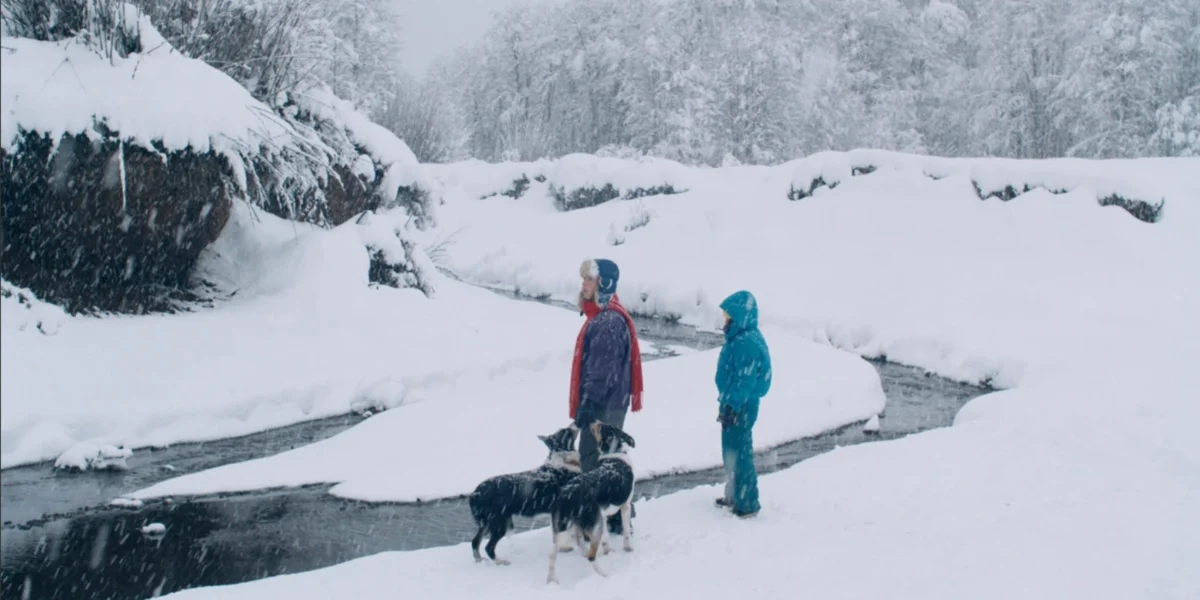
The Meltdown, titled El Deshielo in its original Spanish, represents a significant milestone in contemporary Latin American cinema, marking the sophomore directorial effort of Chilean filmmaker Manuela Martelli. Following its high-profile premiere at the Cannes Film Festival in the Un Certain Regard section, the film has garnered attention for its atmospheric tension and its exploration of Chile’s complex sociopolitical transition during the early 1990s. Set against the backdrop of the Andes Mountains in 1992, the production serves as both a gripping crime drama and a metaphorical deconstruction of a nation attempting to reconcile with a dark, authoritarian past while presenting a modernized facade to the international community.
The narrative centers on nine-year-old Inés, portrayed by newcomer Maya O’Rourke, who resides at a remote ski resort managed by her grandparents. The plot is set in motion when a German ski team arrives for training, leading to a friendship between Inés and 15-year-old Hanna (Maia Rae Domagala). The disappearance of Hanna following an evening outing triggers a sequence of events that forces Inés to navigate an adult world defined by evasion, patriarchal authority, and unresolved historical trauma.
Historical Context and the 1992 Universal Expo
To understand the thematic depth of The Meltdown, one must examine the specific historical moment in which it is situated. In 1992, Chile was only two years into its transition to democracy following the 17-year military dictatorship of Augusto Pinochet. The government of President Patricio Aylwin was focused on "rebranding" the nation, seeking to distance Chile from its reputation for human rights abuses and economic isolation.
A primary symbol of this effort, which features prominently in the film’s background, was Chile’s participation in the 1992 Universal Expo in Seville, Spain. To showcase its progress and its unique geography, the Chilean government commissioned the transport of a massive Antarctic iceberg to the Spanish pavilion. This 60-ton block of ice was intended to symbolize a "new," cool, and efficient Chile. In the film, Inés’s parents are away in Seville assisting with this exhibit, leaving her in the care of her grandparents. This narrative choice serves as a poignant irony: while the state is busy displaying a literal "meltdown" of ancient ice in Europe to signal a fresh start, the characters in the Andes are confronted with the "thawing" of buried secrets and the persistence of old-world prejudices.
Narrative Chronology and Plot Development
The film’s 108-minute runtime is structured as a slow-burn procedural seen through the eyes of a child. The chronology of the film can be divided into three distinct acts that mirror the psychological development of the protagonist.
The Arrival and the Bond
The first act establishes the isolation of the Andean resort. Inés is depicted as a bilingual, highly observant child who acts as a bridge between the Spanish-speaking staff and the international guests. Her life is solitary until the arrival of the German ski team. The friendship between Inés and Hanna is built on a shared sense of being outsiders—Hanna as the only girl on an aggressive male team, and Inés as the only child in a world of adults.
The Disappearance and the Search
The inciting incident occurs when Hanna vanishes after a night out with Inés’s older cousin. The second act shifts the tone from a coming-of-age story to a tense mystery. The arrival of Hanna’s mother, Lina (Saskia Rosendahl), introduces a new dynamic. Lina refuses to accept the dismissive explanations provided by local authorities and the resort management. Inés becomes Lina’s translator and silent observer, witnessing the incompetence and potential complicity of the men tasked with the investigation.
The Revelation and Deconstruction
The final act focuses on the "meltdown" of the social order within the resort. As the search continues, Inés begins to perceive the "dubious aspects" of the adults around her. The film avoids traditional thriller tropes, opting instead for a realistic portrayal of how power structures protect their own. The resolution of the mystery is less about a tidy "whodunit" ending and more about Inés’s loss of innocence regarding the moral failures of her community and family.
Technical Execution and Production Design
The Meltdown is distinguished by its high production values and a specific aesthetic that emphasizes the unforgiving nature of the Chilean winter. The technical team, many of whom worked with Martelli on her previous film Chile ’76, utilized the landscape as a primary character.
Cinematography and Visual Language
Cinematographer Benjamin Echazarreta captures the Andes with a palette of stark whites and deep, shadowy greens. The use of wide shots emphasizes the insignificance of the human characters against the vastness of the mountains, while tight, claustrophobic interior shots within the wood-paneled chalet heighten the sense of domestic tension. The visual language suggests that while the snow covers the ground, it cannot indefinitely hide the truth.
Soundscape and Score
The auditory experience of the film is integral to its suspense. Sound designer Javier Umpierrez created a hypnotic environment where the whistling wind and the crunch of snow underfoot become rhythmic elements of the storytelling. This is complemented by Maria Portugal’s score, which utilizes dissonant strings and brass to create an "ominous whimsy." The music does not tell the audience how to feel but rather reinforces the unsettling perspective of a child who senses danger without fully understanding its source.
Performance Analysis and Casting
The success of the film relies heavily on the performance of Maya O’Rourke. Carrying a feature film at such a young age is a rare feat, and O’Rourke has been praised for her ability to convey complex emotions through observation rather than dialogue. Her performance captures the "petite shoulders" carrying the weight of adult secrets.
Saskia Rosendahl provides a powerful counterpoint as Lina. Known for her work in international cinema, Rosendahl brings a "feminine frustration" to the screen that challenges the apathetic male characters. The supporting cast, including Paulina Urrutia and Mauricio Pesutic, represent the older generation of Chileans who are often depicted as being more interested in maintaining the status quo than in seeking justice.
Thematic Implications and Social Commentary
Martelli’s work frequently explores the intersection of the personal and the political. In The Meltdown, several key themes emerge that resonate with contemporary global issues:
- The Failure of the Patriarchy: The film deconstructs the "dodgy" behavior of the male characters—from the ski instructor to the police detectives. Their inability or unwillingness to find Hanna suggests a broader critique of systems that prioritize institutional reputation over individual safety.
- Generational Trauma: Inés serves as an emblem of the post-dictatorship generation. While her parents’ generation is focused on the future (the Seville Expo), Inés is left to deal with the immediate, cold reality of her surroundings. The "haunting sense of unrest" in the film mirrors the national psyche of Chile in the 1990s.
- Colonialism and Language: The interaction between the German visitors and the Chilean hosts touches upon the long history of European influence in Southern Chile. Inés’s role as a translator highlights the power dynamics inherent in communication and the ways in which information is filtered or suppressed.
Official Responses and Critical Reception
While official statements from the production companies emphasize the film’s artistic merits, the critical reception has focused on Martelli’s growth as a director. Critics have noted that while the film is a "slow burn" that may test the patience of viewers looking for a standard crime thriller, its "glacial pace" is a deliberate stylistic choice.
Industry analysts suggest that The Meltdown solidifies Martelli’s position in the "New Chilean Cinema," a movement that includes directors like Pablo Larraín and Sebastián Lelio. This movement is characterized by a sophisticated visual style and a persistent engagement with Chile’s historical memory. The film’s inclusion in the Un Certain Regard section at Cannes—a category dedicated to "original and different" works—further validates its unique approach to genre material.
Broader Impact on the Film Industry
The Meltdown contributes to a growing body of work that utilizes the "child’s eye view" to explore national trauma. By placing the viewer on the same level as Inés, Martelli forces the audience to experience the "incomplete perception" and vulnerability of childhood. This narrative strategy is particularly effective in stories about political transitions, where the truth is often obscured by those in power.
Furthermore, the film highlights the viability of international co-productions in Latin America. By bringing together Chilean, German, and potentially other European resources, the production was able to achieve a level of technical craftsmanship that rivals major studio releases while maintaining an independent, auteur-driven spirit.
As The Meltdown moves from the festival circuit to international distribution, it stands as a testament to the power of atmospheric storytelling. It reminds audiences that the "meltdown" of old systems is rarely a clean process; rather, it is a messy, chilling, and often silent transition where the youngest members of society are often the most astute witnesses to the truth.