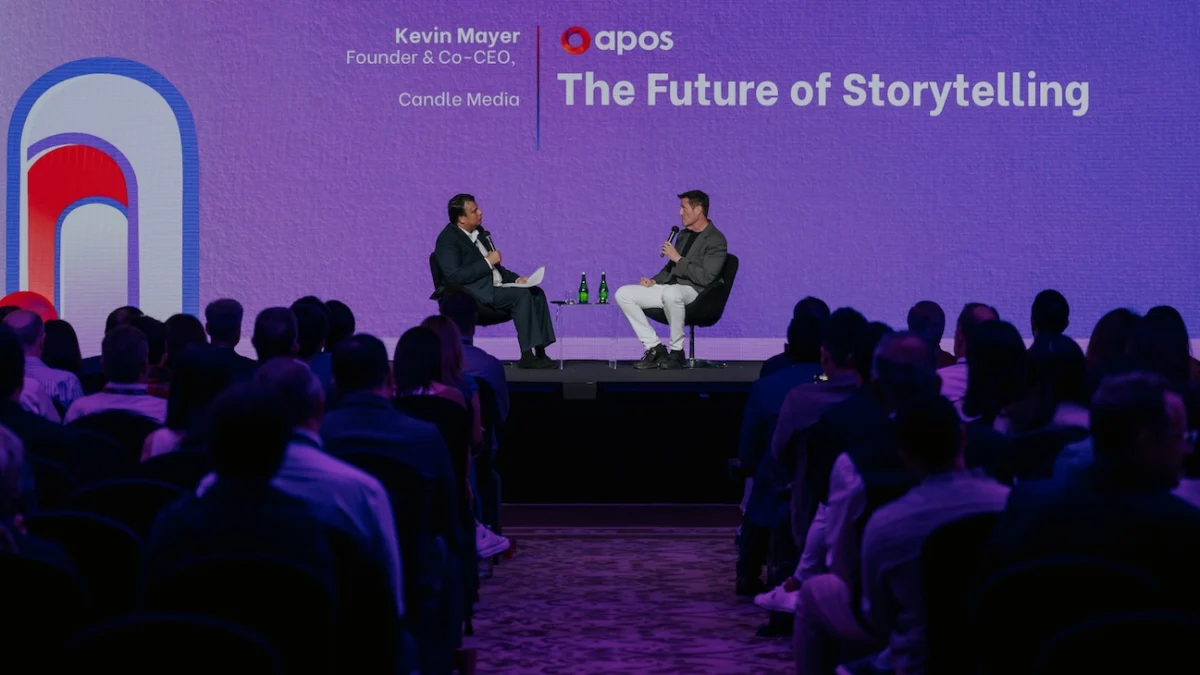
The marquee annual gathering of the Asia-Pacific media and entertainment business, APOS, gets underway this week in Bali, Indonesia, as organizers frame the 2026 edition around a singular, pointed concept: a total industry reset. Managed by the research and advisory firm Media Partners Asia (MPA), the summit convenes the most influential power brokers in the region—ranging from global streaming giants and Indian conglomerates to Chinese technology platforms and a burgeoning wave of artificial intelligence and microdrama upstarts. The central premise of the three-day event is that the traditional silos of television, theatrical releases, premium streaming, and social video are rapidly collapsing into a unified market, forcing a complete rewrite of the conventional rules governing monetization, production, and consumer engagement.
According to the latest data released by Media Partners Asia, the screen entertainment economy in the Asia-Pacific region is currently valued at approximately $180 billion. The firm’s projections indicate a steady upward trajectory, with the market expected to exceed $200 billion by 2031. This growth, however, is not evenly distributed. Online video has already overtaken linear television in terms of reach and revenue across the majority of the region, and analysts suggest that nearly all future growth will be driven by digital platforms. This shift represents a fundamental change in the hierarchy of the entertainment world. MPA’s valuations suggest that the world’s most valuable entertainment entities are now ByteDance and YouTube, each boasting valuations exceeding $500 billion—figures that are roughly double those of traditional Hollywood major studios. Vivek Couto, Chief Executive of MPA, noted that the industry is witnessing a massive migration where advertiser capital is strictly following consumer attention, which is increasingly focused on platforms built for engagement rather than legacy prestige.
A Chronology of Disruption: From Expansion to Maturity
The evolution of the Asian media landscape can be traced through the history of the APOS summit itself. A decade ago, the event served as the launchpad for Netflix’s aggressive expansion into the region, with then-CEO Reed Hastings detailing a vision of a borderless streaming world. In the intervening years, the industry moved through a period of frantic "streaming wars," characterized by high customer acquisition costs and massive content spending. By 2026, however, the landscape has shifted into a mature phase. Premium streaming is no longer the disruptive upstart but a foundational pillar of the industry, now facing its own set of challenges from "attention-based" platforms like TikTok and YouTube.
The current era is defined by a transition from pure subscriber growth to sustainable profitability. Over the last three years, the region has seen significant consolidation, most notably in India, and a pivot toward ad-supported tiers (AVOD) as a primary revenue driver. The 2026 summit serves as a historical marker for this "Great Reset," where the focus has moved away from simply building platforms to optimizing the economics of those platforms through AI integration and diversified content formats.
The Future of Premium Streaming and the $10 Billion Milestone
One of the primary focuses of APOS 2026 is the trajectory of the premium streaming market, which includes heavyweights such as Netflix, Amazon Prime Video, Disney+, and HBO Max. MPA forecasts that this sector alone will be worth $10 billion annually in the Asia-Pacific region by the end of 2026. Despite this impressive figure, the sector faces a daunting competitive environment. While premium platforms have doubled in size over the past few years, social video platforms like YouTube and TikTok have grown at four times that rate.
To address this "war for attention," regional leaders—including Netflix’s Minyoung Kim, Amazon’s Gaurav Gandhi, Disney’s Tony Zameczkowski, and Warner Bros. Discovery’s James Gibbons—are expected to present a united front on several key strategic pivots. Industry insiders suggest that the next phase of growth will rely on five core pillars:
- Live Sports and Events: Securing high-value rights, such as cricket in India or soccer in Southeast Asia, to drive consistent engagement.
- Ad-Supported Tiers: Expanding lower-cost subscription options to capture price-sensitive markets.
- Unscripted Efficiency: Increasing the production of reality and variety programming, which offers lower production costs compared to scripted dramas.
- Short-Form Experimentation: Testing premium content in vertical or bite-sized formats to compete with social media consumption habits.
- Aggressive Bundling: Forming partnerships with telecommunications providers and rival streamers to reduce churn and simplify the consumer experience.
The Rise of Local Champions: The JioStar Factor
While global platforms dominate headlines, the 2026 summit highlights the emergence of "local champions" that are achieving global-scale economics within their home markets. The most prominent example is JioStar, the Indian media titan controlled by Reliance, in which Disney maintains a 37 percent stake. JioStar represents a unique hybrid model that distinguishes it from Western peers. Rather than merely competing with Netflix for subscribers, JioStar is positioning itself as a direct competitor to YouTube, aiming to capture the massive advertising spend associated with India’s digital transformation.
Kevin Vaz, CEO of Entertainment at JioStar, and Ishan Chatterjee, who oversees sports and live experiences, are set to detail the company’s "AI-native" strategy. The goal is to run a high-volume ad engine alongside a premium subscription business within a single ecosystem. This model, if successful, provides a blueprint for how local players can achieve sustainable margins by leveraging massive population scales and deep integration into the local commerce layer—specifically through live events like the Indian Premier League (IPL). The broader implication for the region is clear: a consolidated local player can potentially outperform global majors by owning the entire value chain of attention, data, and commerce.
The Microdrama Phenomenon and the Path to Profitability
Perhaps the most disruptive trend discussed at APOS 2026 is the explosive rise of vertical microdramas. These are short, swipeable, cliffhanger-heavy serials designed specifically for mobile consumption. In just four years, this has grown into a multi-billion-dollar industry. Outside of mainland China, the microdrama market is valued at approximately $3.5 billion for 2026, with platforms like ReelShort and DramaBox controlling over half of the market share.
Joey Jia, founder and CEO of Crazy Maple Studio (the parent company of ReelShort), will address the "unit economics" of this boom. While these platforms have successfully captured consumer mind-share, many are currently operating at a loss due to high marketing and user acquisition costs. The challenge for the next 24 months is converting this viral reach into stable profitability. Industry analysts are watching closely to see if microdrama platforms can transition from a "pay-per-episode" model to more stable revenue streams, such as telco-integrated subscriptions or licensing deals with traditional broadcasters looking to refresh their digital offerings.
Fandom as a Moat: Anime and K-Content
In an era of mass-market fragmentation, APOS 2026 highlights the power of specialized fandoms. Sony’s Crunchyroll has become a case study in how a niche platform can achieve global success by building a "360-degree" business around a specific culture. Crunchyroll President Rahul Purini is expected to announce further global expansions, emphasizing that streaming is merely the core of a wider ecosystem that includes theatrical releases, merchandise, music, and live fan conventions.
Similarly, the continued dominance of K-content remains a central theme. Brian Nam of DIVE Studios will argue that K-pop and K-drama are uniquely suited for the current "attention economy" because they foster deep emotional connections that transcend language barriers. These specialized platforms serve as a reminder to the industry that focus, rather than broad aggregation, can provide a significant competitive advantage against larger, more generalized streamers.
AI and the Repricing of the Entertainment P&L
The most pervasive theme of the 2026 summit is the transformative role of Artificial Intelligence. In markets like China and India, AI adoption in media production is occurring at a faster pace than in the West. For investors and executives, the primary question is whether AI can trigger a "total repricing" of the entertainment profit and loss statement.
Vivek Couto suggests that AI has the potential to cause marketing and localization costs to collapse while simultaneously tightening production cycles. The summit will feature demonstrations from AI-video leaders such as Kuaishou’s Kling and ByteDance’s Seedance, alongside startups like Utopai Studios. A headline session featuring motion-capture pioneer Andy Serkis and Google’s Jon Zepp will explore the ethical and creative boundaries of this technology. The objective is to determine if AI can be used to augment human craft rather than replace it, ultimately allowing for high-quality storytelling at a fraction of the traditional cost.
Broader Impact and Industry Implications
The discussions at APOS 2026 suggest that the Asia-Pacific region is no longer just a growth market for Western ideas; it is now the primary laboratory for the future of global entertainment. The "Reset" being discussed in Bali reflects a world where the distinction between a "tech company" and a "media company" has effectively vanished.
The implications are far-reaching. For traditional Hollywood, the rise of $500 billion tech giants like ByteDance signifies a shift in the center of gravity toward the East and toward mobile-first platforms. For consumers, the collapse of these silos means a more integrated, though perhaps more fragmented, viewing experience where content is shorter, more personalized, and more interactive. As the summit concludes, the prevailing sentiment is that while the rules of the game have been rewritten, the opportunities within a $200 billion digital-first economy are greater than ever—provided players can navigate the volatile intersection of technology and human attention.