On May 22, 1993, a modest assembly of computer scientists, academic researchers, and digital pioneers gathered within a select few technology laboratories across the United States to witness a milestone in telecommunications history: the public broadcast of a feature-length motion picture entirely over the internet.
The transmission featured David Blair’s 1991 experimental art film, Wax, or the Discovery of Television Among the Bees. While the streaming of high-definition video content is now a ubiquitous, instantaneous global utility, the execution of this broadcast three decades ago required a complex and fragile chain of emerging network infrastructure. This event marked a foundational convergence point between traditional cinema and packet-switched data networks, foreshadowing the modern digital distribution landscape.
Technological Architecture of the 1993 Broadcast
Executing a video transmission across computer networks in the early 1990s presented profound technical hurdles. At the time, personal computers were transitioning from enterprise novelties into standard domestic hardware, but the public infrastructure of the World Wide Web was still in its infancy. Graphical web browsers were newly introduced, electronic mail was largely confined to academic and institutional spheres, and consumer broadband access did not exist. Public awareness of the screening relied instead on specialized mailing lists, Usenet forums, and word-of-mouth dissemination within technical communities.
The logistical framework required to deliver the film was an intricate feat of early engineering. A VHS cassette containing the film was loaded into a playback machine in New York. This VCR was physically connected to a Silicon Graphics workstation, which interfaced directly with a T1 telecommunication line—capable of delivering a data transmission rate of 1.544 megabits per second—linked to the Multicast Backbone, commonly known as the MBone.
The MBone was an experimental sub-infrastructure of the internet designed to test IP multicast routing, enabling the transmission of data packets from a single source to multiple designated receivers simultaneously. Despite this advanced architecture, severe bandwidth constraints dictated the quality of the stream. The resulting broadcast was delivered at a rate of merely two frames per second, a stark contrast to the native 24 frames per second of the original analog format. Furthermore, the video feed had to be converted from full color into monochrome, and the accompanying audio stream suffered from frequent, prolonged dropouts.
In reporting on the event, The New York Times felt compelled to explicitly define the underlying medium for its readership, describing the internet as "the global computer network that connects millions of scientists and academic researchers and hitherto has been a medium for swapping research notes and an occasional still image."
Chronology of Production and Distribution
The path of Wax, or the Discovery of Television Among the Bees to this digital milestone began years prior to its network transmission. Director David Blair initially conceived the project in 1981, developing the concept from a short, non-verbal experimental graphic and glitch art piece assembled while he was employed at a commercial video duplication facility. Lacking access to professional cameras or editing suites at the time, Blair utilized industrial duplication equipment to layer visual anomalies.
Over the subsequent decade, Blair expanded the three-and-a-half-minute graphic exercise into an 85-minute feature film. Production was supported by various arts grants and partial funding from ZDF, a German public television broadcaster. The completed film officially premiered in 1991, finding initial distribution through European television broadcasts, specialized arthouse cinemas, and avant-garde art galleries.
By 1993, the film had achieved minor cult status within experimental film circles, drawing literary comparisons to the labyrinthine fiction of Jorge Luis Borges and Thomas Pynchon, as well as the multimedia installation techniques of artist Nam June Paik. Its selection for the inaugural internet broadcast was orchestrated by digital media researchers seeking to test the limits of the MBone infrastructure by streaming a full-length narrative work rather than short video clips.
Narrative Content and Artistic Form
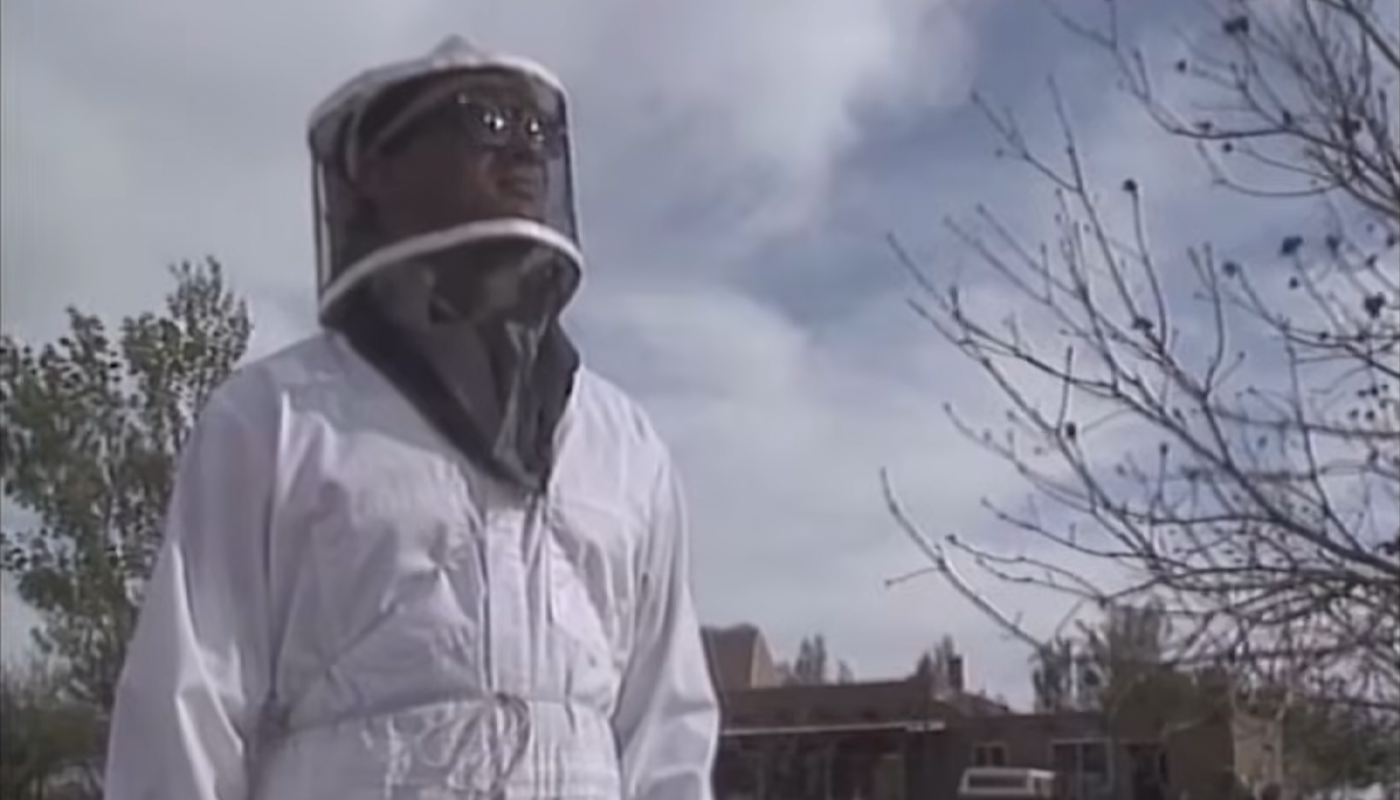
Wax diverges sharply from traditional cinematic storytelling, employing a nonlinear narrative structure that merges documentary-style framing with science fiction and historical commentary. The film’s plot centers initially on James "Hive" Maker—portrayed in a cameo appearance by author William S. Burroughs—a nineteenth-century spiritualist and beekeeper who attempts to photograph the dead, alongside his half-sister Ella and bee breeder Zoltan.
The narrative subsequently transitions generations forward to James’s grandson, Jacob Maker, played by Blair himself. Jacob is depicted as a defense contractor residing in Alamogordo, New Mexico, where he designs weapons simulation systems for the United States government by day while tending to an anomalous strain of Mesopotamian bees. The plot escalates when the bees drill into Jacob’s skull, installing a biological television system that grants him the ability to traverse space and time, ultimately drawing commentary on the Persian Gulf War, the American military-industrial complex, and the collective memory of historical conflicts.
Critics and scholars have noted that interpreting the film through a strict narrative lens often yields frustration. Rather than following a standard causal arc, the production operates as a digital collage, integrating purpose-recorded footage, archival stock imagery, and early computer-generated visual effects underscored by Blair’s deadpan, monotonic narration.
Industry Implications and Legacy
The experimental broadcast of Wax, or the Discovery of Television Among the Bees holds enduring significance not for its commercial reach, which remained strictly confined to avant-garde circles, but for its status as a technological proof-of-concept. By demonstrating that moving images could be compressed, packetized, and transmitted across wide-area networks to distributed nodes, the May 1993 event anticipated the seismic shifts that would redefine the entertainment and technology sectors over the ensuing decades.
The transition from physical media distribution—such as celluloid prints and magnetic tape—to digital streaming revolutionized consumer access to media. While the technical parameters of the 1993 broadcast—operating at two frames per second with intermittent audio—seem primitive by contemporary standards of ultra-high-definition streaming, the event established an operational baseline for video-over-IP technology.
Ultimately, the choice of an uncompromising, deeply idiosyncratic art film for this technological debut ensured that the internet’s cinematic origins remained rooted in the exploratory spirit of independent creators rather than mainstream commercial interests. As network infrastructure evolved to support robust, high-bandwidth multimedia streaming, the foundation laid by Blair and the network engineers of the MBone remained a critical stepping stone in the evolution of global digital culture.