
The sweltering heatwave gripping London serves as a stark reminder for Rupert Everett of summers past, particularly that of 1976, when a seventeen-year-old Everett basked in the sun, his future an unwritten canvas. Now, at 67, the actor and writer reflects on the profound shifts in his perspective, admitting, "When you were young, hot weather was nice. But when you’re chubby like me now, it’s not so nice." His publicist’s gentle rebuttal, "You’re not chubby," is met with Everett’s characteristic breathy, blue-blooded drawl, "I am chubby." This exchange, however, is merely a fleeting prelude to a deeper exploration of a life lived at the sharp edges of fame, personal turmoil, and eventual self-acceptance.
A Hollywood Year and the Specter of Typecasting
Everett’s career trajectory offers a fascinating study in the challenges and triumphs of navigating the entertainment industry as a distinct individual. His "Hollywood year," as he wryly terms it, began in 1997 with his memorable role as Julia Roberts’ gay confidante in My Best Friend’s Wedding. This period saw him become a sought-after accessory for leading ladies, a charismatic, camp best friend. The lucrative work, however, came at the cost of typecasting. Everett found himself boxed in by a triple threat of societal perceptions: his homosexuality, his aristocratic background, and his imposing height of 6ft 4in. "If you have to lean down to do a kissing scene, you look like a freak," he observes, highlighting the practical and psychological hurdles to being cast as a conventional leading man.

This struggle for diverse roles echoes a broader historical context of Hollywood’s often rigid casting practices, particularly for actors who deviated from the heteronormative, conventionally masculine ideal. Everett’s early success in the 1984 Julian Mitchell play Another Country, set in a private school steeped in themes of bullying, bigotry, and buggery, foreshadowed the societal scrutiny that would follow. His portrayal of the horny, anarchic rebel Guy Bennett, based on the real-life spy Guy Burgess, resonated with audiences because it mirrored his own rebellious spirit and his upbringing within a privileged yet seemingly stifling environment. The son of a British army major and a successful stockbroker, Everett attended the Catholic private school Ampleforth before being expelled from the Royal Central School of Speech and Drama for insubordination, a testament to his early non-conformist streak.
The Kamikaze Memoirs: Unflinching Honesty and Public Reckoning
The public gained a far more intimate, and often shocking, understanding of Everett’s life through his two brilliantly written, "kamikaze" memoirs: Red Carpets and Other Banana Skins (2006) and Vanished Years (2012). These autobiographical works pulled back the curtain on a life marked by hedonism, addiction, and a seemingly self-destructive impulse. Everett laid bare his experiences with heroin and cocaine, his dalliances with sex work during lean periods, and a relentless pursuit of pleasure that often came at the expense of relationships and opportunities.
His unflinching honesty extended to his A-list peers. He recounted anecdotes about Madonna and Julia Roberts, describing the former as having "power cuts" under stress, and the latter as "beautiful and tinged with madness." These candid, often barbed, observations, while offering vivid vignettes, also carried consequences. Madonna, for instance, reportedly ceased speaking to him for a considerable period after the publication of his first memoir. Everett’s writing style, characterized by its sharp wit and observational acuity, positioned him as a modern-day Hedda Hopper, a provocateur unafraid to expose the gilded cages of celebrity.

His self-critique was equally brutal, with labels like "a terrible monster," "impossible," and "a cunt" punctuating his reflections. This profound self-awareness, coupled with the societal pressures of his identity and career, forms the crux of his current struggle to reconcile his past self with his present. "I simply cannot begin to understand the man I used to be," he confesses. When asked to describe that younger self, his response is a stark litany: "Brash. Pushy. Disingenuous. Lethal."
A History of Disruption: The Performer and the Provocateur
Everett’s disruptive tendencies were not confined to his personal life; they permeated his early career. He readily admits to behaving "incredibly badly" during the staging of Another Country, a behavior he struggles to comprehend now. His antics included dressing as a rabbi and sitting in the audience during scenes he wasn’t in, and orchestrating elaborate pranks, such as introducing sugar lumps that turned into flies in a tea party scene, causing an actor to scream mid-performance. The playwright, Julian Mitchell, bore witness to this chaos.
This pattern of disruption continued throughout his theatrical career. In a production of Noël Coward’s The Vortex, a disgruntled audience member’s complaint about his quiet delivery led to a rather unconventional apology: a cutting of his pubic hair sent as compensation. While such incidents might seem audacious, Everett now expresses profound regret for his lack of respect for the audience, often performing while under the influence of drugs and wishing himself elsewhere.
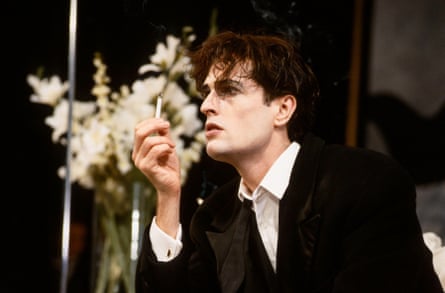
He articulates this early attitude as "the weird remains of a punk upper-class attitude," characterized by a dismissive, "Fuck everything" ethos. He differentiates this from working-class punk by noting its association with heroin, a drug more commonly linked to the upper echelons of society, and a more passive form of self-destruction. This "upper-class version of punk," he muses, was akin to "setting yourself on fire with a cigarette."
Evolving Identity: From "Freak" to "Country Blob"
At 67, Everett cuts a striking figure, his once "butter-cutting" cheekbones softened by time, but his presence undiminished. He acknowledges the physical changes, stating he is now "in perfect shape" for character roles, a stark contrast to his youthful physique. His past pursuit of a "bodybuilder buff" physique in Hollywood, he reveals, was undertaken without the necessary discipline, leading to current "musculoskeletal" ailments.
His current lifestyle prioritizes simpler pleasures: walking his labrador and appreciating nature. This shift in focus is profound, marking a departure from the relentless hedonism of his youth. The "fear of missing out" (Fomo), a driving force in his earlier life, has been replaced by a newfound contentment. "I always felt I was missing out on some mythical life that was taking place somewhere else. That was my problem," he reflects.

This feeling of being an outsider, a "freak," as he describes his younger self, stemmed partly from his physical transformation. From a diminutive 5ft at 15, he shot up to 6ft 4in by 18, feeling like a "human stick insect." To compensate for his perceived skeletal frame, he resorted to wearing custom-made bodysuits, complete with false calves and shoulders, a secret he kept from directors.
Navigating the AIDS Epidemic and Personal Loss
Everett’s formative years coincided with the devastating AIDS epidemic, a period of profound fear and uncertainty for the gay community. He recounts the pervasive sense of siege, the casual discrimination, and the constant anxiety of contracting the virus. "For a long time you couldn’t really test for HIV. So you didn’t know if you had it or not, and that was an added weird pressure for someone who had just become famous, because it was a very difficult time to be gay." His painful decision to abandon a boyfriend diagnosed with HIV underscores the terror of the era.
This personal experience, coupled with the loss of numerous friends to addiction, alcohol, and AIDS, has deeply shaped his perspective. He once aspired to a "live-fast-die-young" ethos, even idolizing James Dean’s tragic trajectory. Yet, paradoxically, it was his privileged background, with its underlying "middle-class work ethic," that ultimately acted as a protective buffer, preventing him from succumbing to the abyss.

Relationships: A Tapestry of Love, Lust, and Lessons
Everett’s romantic life has been as complex and captivating as his career. He recounts a history of relationships with both women and men, including significant affairs with Susan Sarandon, Béatrice Dalle, and Paula Yates. His six-year relationship with Yates, while she was married to Bob Geldof, highlights a period of intense drama and passion. He describes Yates as "adorable and beautiful," bonded by their shared "sense of drama."
His reflections on heterosexuality offer a poignant insight into the allure of societal acceptance. Experiencing life as a seemingly conventional couple with Yates allowed him a glimpse into a world of "normalcy" and "belonging," a sensation he found both appealing and ultimately confining. He likens it to a "wolf who wanted to get back out on to the heath," a desire for the untamed freedom of his own path.
The concept of "wholes" versus "holes" in relationships emerges as a recurring theme. Everett admits to a past disingenuousness in relationships, driven by a desire for "more" and a relentless pursuit of the "next thing." His confession, "No one was ever enough," speaks to a deep-seated insecurity masked by a veneer of confidence. His current long-term relationship with Brazilian accountant Henrique, with whom he has been for 16 years and married for two, signifies a profound shift towards commitment and mutual understanding. "As soon as you live with someone, that’s the end of that – otherwise you’d split up after five minutes. You have to make allowances, give territory."

The Artist’s Evolution: From Chaos to Discipline
The "lack of success," Everett argues, can be a powerful catalyst for an actor’s reinvention. His career, punctuated by notable successes like The Happy Prince (which he directed, produced, and starred in), and the Shrek franchise, has also seen its share of flops, most notably The Next Best Thing, which reportedly strained his friendship with Madonna. He confirms they have since reconciled, but prefers not to "reopen old wounds."
The periods of unemployment, however, were fertile ground for his literary endeavors. His memoirs, novels, and short stories are testaments to his prolific output, often born from rejected screenplay ideas. The Happy Prince, a deeply personal project about the final years of Oscar Wilde, is considered his finest achievement, lauded for its surprising discipline, a trait he now attributes to his own maturation. "I think that’s what I’ve become. Someone who is quite disciplined."
This discipline, he laments, arrived late. "I definitely regret that, because I had it in me somewhere. But I was too busy thinking about silly things." Sex, he admits, was a primary distraction. His burgeoning second film project, centered on his teenage self in Paris, promises a return to exploring these formative years.

A Mature Perspective: Finding Contentment in the Mundane
Everett’s present-day outlook is marked by a surprising contentment, a far cry from the restless energy of his youth. His "little #MeToo movement" involved a realization that most men, despite his lifelong fascination, ultimately felt "dull." The thrill of the chase has waned, replaced by an appreciation for simpler pleasures. "I’m interested in dust particles and things like that," he chuckles, indicating a profound shift in his focus. "I could quite happily sit just watching spring."
He describes himself as a "country blob," embracing a quiet existence of walking his dog and writing. This transformation, he believes, is intrinsically linked to caring for his aging mother in her final years. This period of familial responsibility provided a crucial grounding, allowing him to "reassess his early adulthood and the type of person he has evolved into." The "rationing, blitz-mentality folk" of his mother’s generation instilled in him a latent discipline he hadn’t recognized.
His political leanings have also evolved, from a socialist outlook to a "pro-Europe conservative with a small c." He now finds himself admiring the stoicism of the generation he once rejected. This sense of being "dragged back on the tide to the beaches of one’s youth" has led him to embrace the values of his parents, a profound reconciliation with his past.

Legacy and Reflection: The Enduring Rupert Everett
The actor’s past as a rent boy, a detail he sheepishly requests be omitted from discussions due to his mother’s distress, remains an indelible part of his narrative. It underscores a life lived on the margins, a constant negotiation between societal expectations and personal desires. Yet, even this facet of his life, when viewed through the lens of his current perspective, reveals a journey of self-discovery.
At 67, Rupert Everett is not just an actor but a testament to the power of reinvention. The rebellious youth who flirted with self-destruction has, through a process of unflinching self-examination and a profound re-evaluation of his priorities, found a measure of peace and purpose. His current engagements, including roles in Rivals, Madfabulous, and an upcoming Harold Pinter play, signify a renewed commitment to his craft, imbued with the discipline and respect he now accords to his work and his audience. The enigma of Rupert Everett, once defined by his defiance and hedonism, is slowly giving way to the wisdom of an artist who has finally come home to himself.