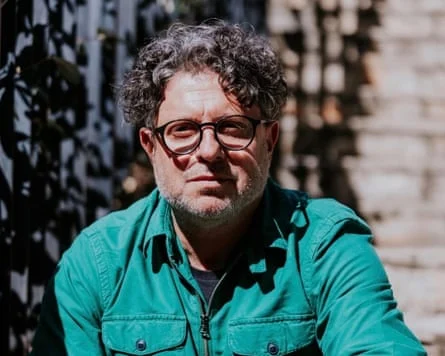
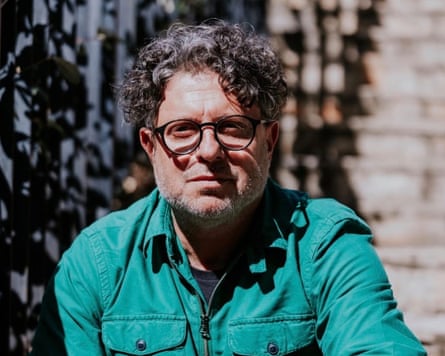
In the ever-evolving landscape of documentary filmmaking, British director Marc Isaacs has consistently carved a niche for himself with his unique, often droll, and always humanistic portrayals of ordinary life in Britain. His latest cinematic offering, "Synthetic Sincerity," takes this approach to a meta-level, presenting a narrative that blurs the lines between reality and artifice, and critically, between human and artificial intelligence. The film’s premise, revealed by Isaacs himself, is that a leading AI research laboratory has recently licensed his entire body of work – a quarter-century of meticulous observation spanning films like "Lift," a poignant look at a London tower block’s inhabitants, and "The Curious World of Frinton-on-Sea," a gentle exploration of a retirement town.
This audacious concept, however, is where Isaacs’s signature subversiveness truly shines. "Well, we made up the University of Southern England," admits the 59-year-old filmmaker during a recent conversation at Etles, a Uyghur restaurant in London. This revelation, shared with his longtime collaborator and the film’s writer, Adam Ganz, immediately reframes the entire narrative of "Synthetic Sincerity." The "AI research laboratory" and its supposed interest in Isaacs’s oeuvre are, in fact, the central fabrication of the film.
The Genesis of a Fictitious AI Lab
The idea of a fictitious university, as Ganz explains, was a strategic choice to circumvent the need for extensive permissions and approvals that would be required for a real-world research institution. This creative decision allowed Isaacs and Ganz to explore the complex themes of AI, authenticity, and the human condition without the constraints of bureaucratic hurdles. While Isaacs acknowledges that he has "heard about people who have" had their work licensed for AI development, he confirms that the specific scenario depicted in his film is a construct.
This departure from conventional documentary filmmaking is not entirely new for Isaacs. His previous works, "The Filmmaker’s House" and "This Blessed Plot," also played with the boundaries of the genre. "The Filmmaker’s House" confined its action largely to Isaacs’s own home as it was visited by numerous guests over a single day. "This Blessed Plot" followed a Chinese student filming in rural Essex, ingeniously recasting individuals who had previously appeared as themselves in Isaacs’s earlier films, now portraying fictional characters, even a ghost. These films, while appearing to be documentaries, featured non-actors performing scripted scenarios, a technique that has a rich lineage in cinema, most notably in masterpieces like Abbas Kiarostami’s "Close-Up."
A Tradition of Blurring Lines
The "staged reality" or "docu-drama" genre, as it’s sometimes called, has seen varied interpretations. In the UK, it’s often associated with reality television staples like "Made in Chelsea" and "The Only Way Is Essex." However, it has also produced significant cinematic works. Michael Winterbottom’s 2002 refugee drama "In This World" and Jack Hazan’s 1973 film "A Bigger Splash," a compelling portrait of artist David Hockney, are often cited examples, though "A Bigger Splash" is frequently miscategorized as a pure documentary.
Isaacs, who counts acclaimed documentarian Louis Theroux among his admirers, has always challenged the notion of "pure" documentary. His 2014 film "Outsiders" featured casual conversations at a roadside fast-food van, with the participants secretly having been cast in advance. This tendency towards "meddling," as he puts it, has been a constant thread in his career. The increasing demand for sensationalist "docbusters" from television channels and streaming platforms in the early 2020s, he explained in 2021, served as a catalyst for him to "wake myself up" by delving into this hybrid form, a move that also reflected a perceived stagnation in the industry itself.
Critiquing the Contemporary Documentary Landscape
Both Isaacs and Ganz express a dim view of the current state of mainstream documentary filmmaking, with Isaacs describing it as "even worse" than before. He points to high-profile Netflix productions like "Beckham" as examples of a trend that prioritizes celebrity over substance. Ganz elaborates on this concern, stating, "British documentaries used to be the best way you’d know what other people were up to. Every week on the BBC or Channel 4 there’d be an extraordinary diversity of different lives. Now ordinary people are being erased. You’re not encouraged to learn about anyone who either isn’t a celebrity or isn’t like you." They both found Sofia Coppola’s recent film about Marc Jacobs, "Marc by Sofia," to be a particularly uninspired example, with Ganz likening it to "watching AI."
"Synthetic Sincerity": A Cinematic Experiment
"Synthetic Sincerity" itself is a nimble 70-minute film that tackles a surprisingly broad range of contemporary issues. Beyond its central premise of AI and authenticity, the film touches upon Israel’s bombing campaign against Lebanon, the plight of the Uyghur people, and the increasing presence of pro-China censorship within UK universities. These weighty topics are navigated with Isaacs’s characteristic wit, humanity, and a delicate touch.
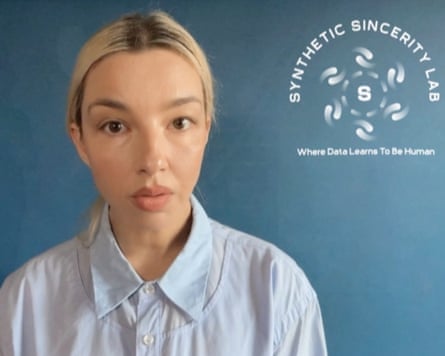
A particularly effective element of the film is the dynamic between Isaacs, appearing on screen for the first time in his own work, and a female AI avatar. This avatar, voiced by Romanian actor Ilinca Manolache, playfully flatters, provokes, and occasionally admonishes Isaacs. Manolache, who recently garnered attention for her role in Radu Jude’s "Do Not Expect Too Much From the End of the World," where she utilized an AI filter to portray a toxic influencer, is now a rising star with an upcoming role alongside Leonardo DiCaprio and Jennifer Lawrence in Martin Scorsese’s "What Happens at Night." For "Synthetic Sincerity," Isaacs filmed Manolache using Snapchat, then processed the footage through AI. This collaboration highlights a fascinating paradox: an actor enthusiastically embracing the very technology that could render her profession obsolete.
The Audience’s Perception and the Nature of Truth
Isaacs expresses surprise that some viewers haven’t grasped the film’s premise as a deliberate fabrication. He anticipated that cues, such as the avatar inviting him to "come to the place where I was made," would signal the artificiality. However, at a festival screening in Thessaloniki, one audience member approached him, expressing frustration: "OK, you’ve made your point. You’ve shown me you don’t believe in anything." This reaction, Isaacs notes, stems from the film’s ability to destabilize viewers’ perceptions of reality. He argues that this questioning of what is real is precisely the point, stating, "But right from the earliest documentaries, the idea of truth has always been complicated."
This thematic resonance between the film’s content and its form is a deliberate artistic choice. The anxieties surrounding AI and its potential for deception mirror the very questions viewers will grapple with as they watch "Synthetic Sincerity." To further underscore this point, Isaacs incorporates footage from an unbroadcast BBC documentary he made years ago about a purported Iraq war veteran who was later exposed as a fabricator. This inclusion serves as a powerful reminder that inauthenticity and "glitches" are not exclusive to artificial intelligence; human beings are equally capable of them.
Navigating the Future of Filmmaking
Despite the often-critical tone regarding the current documentary landscape, Isaacs and Ganz exhibit a surprisingly pragmatic outlook on the potential of AI in filmmaking. "Why not use it for fight sequences with hundreds of warriors?" Ganz posits. "You might as well. The real difficulty will be representing the world people live in."
Isaacs was keen to avoid a dystopian narrative. "We didn’t want to go down the road of doom and gloom," he states. He notes that audiences have responded positively to scenes where AI empowers individuals, such as giving Ablikim Rahman, the restaurant owner who appears in the film, a voice to express things he might not otherwise articulate. Isaacs is eagerly awaiting an "auteur" to create something truly extraordinary with AI, but believes this will only occur if AI is used to critically examine itself. He remains skeptical that AI will fundamentally alter the industry or birth a new cinematic movement like the French New Wave.
His own forays into using AI for creative purposes are, perhaps, more modest but reveal a practical engagement. While preparing for his next film, which will feature Ilinca Manolache and explore London’s Romanian community, Isaacs admits to running initial script ideas through ChatGPT for suggestions. "Some of what came back wasn’t bad," he remarks, before recounting Ganz’s blunt, yet characteristically honest, response to the AI-generated suggestions: "Fuck off." This anecdote encapsulates the ongoing, often humorous, negotiation between human creativity and artificial intelligence in the pursuit of compelling storytelling.