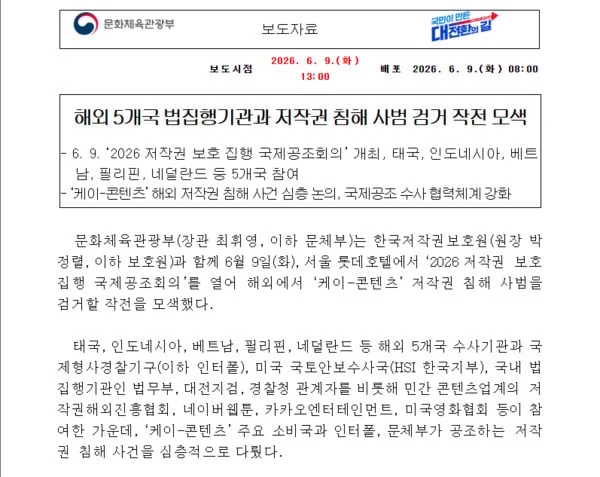
South Korea’s Ministry of Culture, Sports and Tourism (MCST) convened an international enforcement meeting on June 9 in Seoul to strengthen global cooperation against copyright infringement targeting K-content. The "2026 International Copyright Protection Enforcement Conference," held at Lotte Hotel Seoul, brought together law enforcement agencies from five countries – Thailand, Indonesia, Vietnam, the Philippines, and the Netherlands – along with Interpol, the U.S. Homeland Security Investigations (HSI) Korea office, and Korean authorities including the Ministry of Justice, prosecutors, and police. Private-sector participants included major content industry stakeholders such as Naver WEBTOON and Kakao Entertainment. The meeting focused on sharing enforcement strategies and coordinating joint operations to track and apprehend overseas copyright offenders. Discussions also covered ongoing international investigations under Interpol’s "Stop Online Piracy" (I-SOP) initiative, as well as public-private collaboration efforts. The ministry emphasized that cross-border copyright crimes require coordinated global responses, pledging to further strengthen its investigative network with international partners.
A Growing Threat to the Hallyu Wave
The convening of the "2026 International Copyright Protection Enforcement Conference" underscores the escalating global challenge posed by copyright infringement to the burgeoning South Korean entertainment industry, commonly referred to as the Hallyu wave. In recent years, K-pop, K-dramas, and webtoons have achieved unprecedented international popularity, generating billions of dollars in revenue and significantly contributing to South Korea’s cultural and economic influence. However, this success has concurrently attracted sophisticated criminal networks engaged in the illegal distribution and monetization of copyrighted material. The digital landscape, characterized by rapid content dissemination and the ease of accessing and sharing digital files, has created fertile ground for piracy. Unauthorized streaming sites, torrent networks, and social media platforms have become primary channels for the illicit distribution of K-content, leading to substantial financial losses for creators, producers, and the entire creative ecosystem.
The Genesis of a Global Alliance
The conference, held on June 9, 2026, at the prestigious Lotte Hotel Seoul, was the culmination of years of increasing concern and reactive measures by South Korean authorities and the content industry. The MCST, recognizing the transnational nature of online piracy, initiated proactive diplomatic and law enforcement engagement to build a robust international framework for combating these crimes. This particular conference built upon previous bilateral and multilateral discussions, aiming to formalize cooperative strategies and operational protocols. The selection of participating nations was strategic, focusing on countries with significant K-content consumption and those identified as common transit or origin points for infringing activities. The inclusion of Interpol and the U.S. HSI provided a crucial international law enforcement backbone, facilitating information sharing and coordinated investigations across borders.
Key Participants and Their Roles
The conference brought together a diverse group of stakeholders, each playing a vital role in the fight against piracy:
-
South Korean Authorities:
- Ministry of Culture, Sports and Tourism (MCST): As the host and organizer, the MCST spearheaded the initiative, outlining the strategic objectives and facilitating inter-agency cooperation. Their mandate includes policy development and cultural industry promotion, making them central to addressing the economic and cultural impact of piracy.
- Ministry of Justice, Prosecutors, and Police: These bodies provided the on-the-ground investigative and prosecutorial power. Their presence underscored the legal and enforcement dimensions of the conference, focusing on the practicalities of tracking, apprehending, and prosecuting offenders.
-
International Law Enforcement Agencies:

- Interpol: The International Criminal Police Organization offered a global platform for intelligence sharing and coordinated operations. Interpol’s "Stop Online Piracy" (I-SOP) initiative, specifically mentioned in discussions, is a testament to their commitment to tackling digital crime and intellectual property theft.
- U.S. Homeland Security Investigations (HSI) Korea Office: HSI is a critical player in international investigations, particularly those involving financial crimes and intellectual property theft that cross U.S. borders. Their participation highlighted the interconnectedness of global illicit economies.
- Law Enforcement Agencies from Thailand, Indonesia, Vietnam, the Philippines, and the Netherlands: These nations were selected for their active role in the K-content market, either as significant consumer bases or as locations where infringing activities are often detected. Their participation was crucial for developing region-specific strategies and fostering direct operational links.
-
Private Sector Content Industry:
- Naver WEBTOON: As a leading global platform for digital comics, Naver WEBTOON faces significant challenges from unauthorized scanning and distribution of its popular webtoons. Their input provided real-world examples of piracy and highlighted the need for robust legal protections for digital intellectual property.
- Kakao Entertainment: Similarly, Kakao Entertainment, a powerhouse in digital content creation and distribution, including webtoons, K-dramas, and music, shared its experiences and concerns. Their involvement emphasized the economic stakes involved and the impact of piracy on investment and future content development.
Strategic Objectives and Operational Frameworks
The conference’s agenda was meticulously designed to foster actionable outcomes. The primary objectives included:
- Sharing Enforcement Strategies: Participants exchanged best practices in investigating and prosecuting online copyright infringement. This involved discussing innovative investigative techniques, the use of digital forensics, and the legal frameworks in each participating country that could be leveraged for cross-border enforcement.
- Coordinating Joint Operations: The discussions moved beyond mere information sharing to the planning of synchronized operations. This could involve joint task forces, coordinated raids on pirate servers, and the sharing of intelligence to disrupt the entire supply chain of pirated content, from uploaders to distributors.
- Tracking and Apprehending Overseas Offenders: A significant focus was placed on developing methodologies for identifying and locating individuals and organizations responsible for copyright infringement operating outside their domestic jurisdictions. This often involves complex international legal assistance requests and the tracing of digital footprints across multiple countries.
- Leveraging Interpol’s I-SOP Initiative: The "Stop Online Piracy" initiative by Interpol serves as a critical framework for international collaboration. Discussions likely revolved around how to maximize the effectiveness of I-SOP by providing timely and actionable intelligence, and by aligning national enforcement efforts with Interpol’s global objectives. The I-SOP initiative aims to combat intellectual property crime by facilitating information exchange, promoting best practices, and supporting joint operational actions.
- Enhancing Public-Private Collaboration: The active participation of private content companies like Naver WEBTOON and Kakao Entertainment was a key feature. The MCST recognized that effective anti-piracy efforts require a symbiotic relationship between government enforcement agencies and the rights holders who are directly impacted. This collaboration allows for the sharing of proprietary data on infringing activities, the development of technical solutions for content protection, and the joint advocacy for stronger copyright laws.
Supporting Data and the Economic Impact of Piracy
While specific figures were not detailed in the initial announcement, the context of the conference implies a significant economic motivation behind these efforts. The global digital content market, valued in the hundreds of billions of dollars annually, is increasingly vulnerable to piracy. South Korea’s cultural export market, driven by Hallyu, is estimated to contribute tens of billions of dollars to its GDP. Studies by organizations like the OECD have consistently shown that intellectual property theft, including online piracy, results in substantial revenue losses for legitimate businesses, reduced investment in new content creation, and job losses within the creative industries. For instance, a report by the Korean Copyright Protection Agency (KCOPA) in 2023 indicated a significant increase in the illegal distribution of K-content, with estimates of billions of dollars in lost revenue annually. The MCST’s proactive stance suggests a strategic understanding that protecting intellectual property is not just about preserving artistic integrity but also about safeguarding a vital economic engine for South Korea.
Official Statements and Future Commitments
The MCST’s statement following the conference, emphasizing the need for "coordinated global responses" and pledging to "further strengthen its investigative network with international partners," signals a long-term commitment. This indicates that the conference was not a one-off event but the beginning of an intensified and sustained effort. The ministry’s recognition of "cross-border copyright crimes" as requiring such a robust international approach highlights the evolving nature of digital piracy and the necessity for adaptive and collaborative enforcement.
Broader Implications and Future Outlook
The "2026 International Copyright Protection Enforcement Conference" signifies a critical juncture in the global fight against online piracy. By bringing together key international law enforcement bodies and industry leaders, South Korea is taking a leading role in establishing a more effective global network for intellectual property protection. The success of this initiative will have far-reaching implications:
- Safeguarding the Hallyu Wave: A more robust anti-piracy framework will help ensure the continued growth and profitability of the Korean entertainment industry, allowing creators to be fairly compensated and reinvest in producing high-quality content.
- Setting International Precedents: The collaborative strategies and operational models developed in this conference could serve as a blueprint for other countries facing similar challenges with their own cultural exports.
- Impact on Digital Platforms: The increased enforcement efforts will likely put pressure on digital platforms to implement stronger measures for content moderation and to cooperate more readily with rights holders and law enforcement.
- Economic Benefits: By curbing piracy, South Korea can expect to see increased foreign investment in its cultural industries and a more robust contribution of Hallyu to its national economy.
The ongoing nature of discussions under Interpol’s I-SOP initiative, coupled with the MCST’s commitment to expanding its investigative network, suggests that this is a dynamic and evolving effort. The battle against online piracy is complex and requires continuous adaptation to new technologies and criminal tactics. However, the concerted international effort initiated by South Korea marks a significant step forward in protecting the creative works that have captivated audiences worldwide and are central to the nation’s soft power and economic prosperity. The long-term effectiveness of these measures will depend on sustained political will, consistent inter-agency cooperation, and the ongoing adaptation of legal and technological tools to counter the persistent threat of digital copyright infringement.