As David Ellison moves into the final stages of a $111 billion megadeal to merge two of Hollywood’s most storied institutions—Paramount and Warner Bros. Discovery—the industry’s focus has shifted from the boardroom to the streets of Los Angeles. While the financial architects of the deal emphasize the necessity of scale in an era dominated by tech giants, a more somber narrative is emerging regarding the human cost of corporate consolidation. According to recent internal projections and a comprehensive report from the Los Angeles County Department of Economic Opportunity, the merger seeks to extract approximately $6 billion in "synergies," a figure that translates directly into the elimination of thousands of roles across the corporate, administrative, and technical sectors of both companies.
The proposed merger comes at a precarious moment for the entertainment capital of the world. Los Angeles County is currently grappling with a significant downturn in local film and television production, leaving soundstages underutilized and ancillary businesses—ranging from specialized catering firms to visual effects houses—struggling to remain solvent. The potential union of Paramount and Warner Bros. Discovery represents more than just a corporate marriage; it is a seismic event that threatens to further erode the economic bedrock of the region.
A Granular Look at Potential Job Losses
The most immediate concern for local officials and labor advocates is the sheer volume of overlapping roles that could be eliminated once the two companies are integrated. A June 18 report, authored by the Los Angeles County Department of Economic Opportunity and led by Director Kelly LoBianco, provides a stark assessment of the merger’s impact. The report identifies approximately 2,495 jobs in Greater Los Angeles County that are at high risk of elimination. Globally, that number swells to roughly 6,000 positions.

These risks are primarily concentrated in "shared functions," which include corporate leadership, information technology, real estate management, human resources, and legal departments. The logic of the merger relies on removing duplicative efforts; if two companies become one, they no longer require two separate payroll departments or two distinct global marketing hierarchies.
The report provides a detailed breakdown of the workforce distribution. Approximately 17 percent of Paramount’s total workforce is based in the Los Angeles area, largely centered around the iconic 65-acre Paramount lot on Melrose Avenue. For Warner Bros. Discovery, roughly 13 percent of its workforce resides in the region, spread across nearly 140 acres of studio and office space. The concentration of these workers in a single geographic market creates a "redundancy trap," where the local economy bears the brunt of the consolidation efforts.
The Promise of Increased Production vs. the Reality of Runaway Shoots
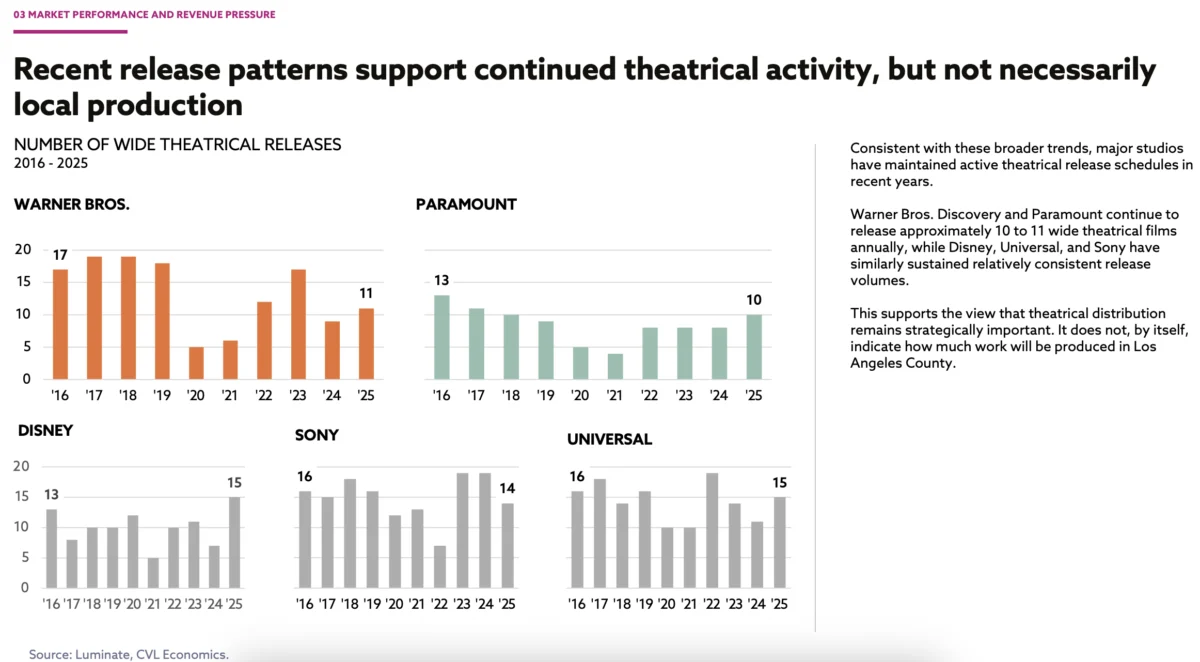
In defense of the merger, David Ellison and his team at Skydance have argued that a combined entity will be a more robust engine for content creation. During a May earnings call, Ellison pledged a commitment to theatrical releases, aiming for 30 films per year—a significant increase from the 15 films currently on the combined calendar for the current year. Furthermore, the new entity plans to produce upwards of 170 television shows annually, leaning heavily on "tentpole" franchises such as Harry Potter, Top Gun, Star Trek, Looney Tunes, Game of Thrones, and Yellowstone.
However, the Los Angeles County report casts doubt on whether this increased output will actually benefit the local workforce. The primary hurdle is the "global race for tax incentives," which has seen production move away from California to more tax-friendly locales. The report analyzed 19 upcoming theatrical releases from Paramount and Warner Bros. for 2025 and found a discouraging trend: only one film, One Battle After Another, was primarily filmed in California (specifically in Eureka).

The remaining 18 projects were distributed across a global map of production hubs, including Georgia, Louisiana, New York, Canada, the United Kingdom, Norway, France, and New Zealand. This data suggests that while the merger might lead to more content being produced, the actual labor—the "boots on the ground" in production—is increasingly likely to occur outside of California. This "runaway production" phenomenon means that even if Ellison fulfills his promise of a "stronger Hollywood," the economic benefits may be felt more in London or Atlanta than in Burbank or Hollywood.
Political Resistance and Social Backlash
The merger has not proceeded without significant friction from political and social spheres. In Sacramento, California Attorney General Rob Bonta is reportedly preparing a legal challenge to the merger, coordinating with multiple other states to investigate potential antitrust violations. This state-level scrutiny persists despite indications that the federal Justice Department under the current administration might be more inclined to greenlight the deal.
On the ground, the resistance has taken a more grassroots form. Activist groups have targeted Paramount’s Melrose Gate with mobile billboards, and a celebrity-led protest effort, spearheaded by Jane Fonda, has mobilized a base of industry workers who fear that further consolidation will lead to lower wages and fewer opportunities for creative professionals.
The sentiment among these groups is that the "status quo" of Hollywood is being dismantled not to improve the quality of art, but to satisfy the demands of Wall Street. Critics point to the previous merger of Discovery and WarnerMedia as a cautionary tale, where significant debt loads led to the cancellation of nearly finished projects (such as Batgirl) and massive layoffs that left the workforce demoralized.

Official Responses and Corporate Strategy
In response to the County’s findings, a spokesperson for Paramount framed the merger as a necessary survival tactic. The spokesperson argued that the current entertainment economy is "failing" Los Angeles due to declining linear television revenues and the overwhelming dominance of technology platforms like Netflix, Amazon, and Apple. From this perspective, the merger is not the cause of the industry’s woes, but a potential cure.
"A combined Paramount-WBD will have the scale and resources needed to compete more effectively in a rapidly evolving global media marketplace and invest in content, technology, and jobs," the spokesperson stated.
David Ellison has also sought to soothe the concerns of lawmakers. In a formal letter sent in March to Senator Adam Schiff and Representative Laura Friedman, Ellison pledged to preserve and potentially increase jobs, describing the Los Angeles workforce as the "most talented and well-trained" in the world. Ellison’s vision is one of "synergy through growth" rather than "synergy through contraction," though the $6 billion savings target remains a central pillar of the deal’s financial viability.
A Chronology of the Megadeal
To understand the current tension, one must look at the timeline of the deal’s progression:

- Late 2023 – Early 2024: Initial rumors of a merger between Paramount Global and Warner Bros. Discovery begin to circulate as Shari Redstone explores options for National Amusements, the controlling shareholder of Paramount.
- February 28, 2024: David Ellison sends a formal letter to California lawmakers, pledging his commitment to the local entertainment economy and promising job preservation.
- March 2024: Formal talks between Skydance and Paramount intensify, with Ellison’s group emerging as the frontrunner despite competing bids from Apollo Global Management and Sony Pictures.
- May 2024: During a high-stakes earnings call, Ellison outlines a franchise-focused strategy, committing to 30 theatrical films and 170 TV shows per year.
- June 18, 2024: The Los Angeles County Department of Economic Opportunity releases its "60-Day Report," identifying nearly 2,500 local jobs at risk and highlighting the lack of California-based production.
- August 2024 (Expected): The Department of Economic Opportunity is scheduled to deliver a "120-Day Report," which will provide a deeper analysis of the long-term effects on the broader production landscape and ancillary industries.
Broader Implications for the Entertainment Industry
The Paramount-Warner Bros. merger represents a pivotal moment in the history of American media. If successful, it will reduce the number of major "legacy" studios, further concentrating power in the hands of a few mega-corporations. For the workers of Los Angeles, the implications are twofold.
First, there is the issue of "monopsony" power—a market condition where there are many sellers (workers/creatives) but only a few buyers (studios). As studios merge, writers, directors, and craftspeople have fewer places to sell their work, which can lead to stagnant wages and less favorable contract terms. This was a central theme in the 2023 WGA and SAG-AFTRA strikes, and the current merger talk suggests that those tensions are far from resolved.
Second, the merger highlights the shifting geography of the industry. The fact that only one of nineteen major films is being shot in California is a "red alert" for local policymakers. It suggests that the state’s current tax credit program may be insufficient to compete with the aggressive incentives offered by other states and countries. If the combined Paramount-Warner Bros. entity continues this trend, the physical infrastructure of Hollywood—the historic lots and soundstages—may eventually become more valuable as real estate than as centers of production.
As the industry awaits the mid-August report from the County, the mood in Hollywood remains one of anxious anticipation. The merger may indeed create a company with the scale to survive the streaming wars, but for the 2,495 workers whose roles are currently categorized as "duplicative," the cost of that survival may be their livelihoods. The coming months will determine whether David Ellison’s promise of a "stronger Hollywood" includes the people who have spent decades building it, or if they will be the "synergies" sacrificed at the altar of corporate consolidation.