In an era where the specter of Rod Serling’s seminal anthology series, The Twilight Zone, continues to cast a long shadow over contemporary storytelling, director Kevin Hamedani’s latest offering, The Saviors, emerges as a potent, albeit familiar, exploration of societal anxieties and ingrained prejudices. The film, described as a sci-fi satire that draws parallels to both Serling’s probing narratives and the chilling paranoia of Arlington Road, delves into the volatile undercurrents of suspicion and xenophobia that permeate modern American culture. Hamedani, known for his willingness to confront uncomfortable truths, crafts a narrative that, while thematically robust, treads ground already explored by a recent wave of politically charged genre films.
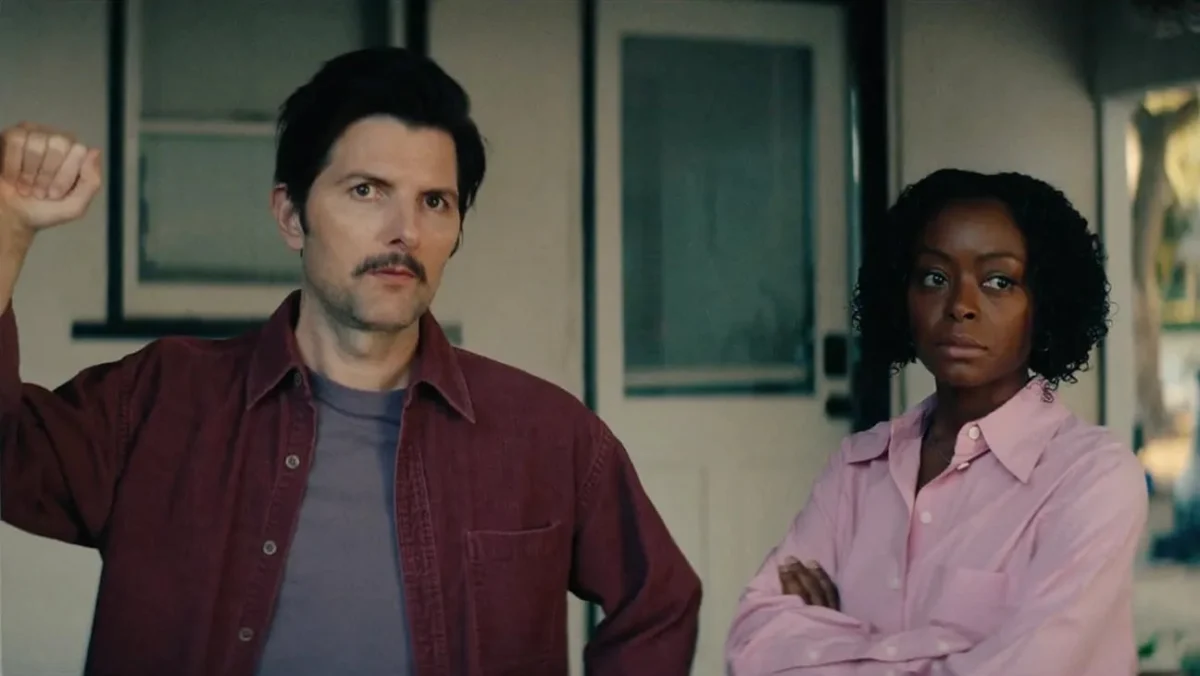
At the heart of The Saviors is the disintegrating marriage of Sean Harrison, portrayed by Adam Scott, and his wife Kim, brought to life by Danielle Deadwyler. Their personal lives are in disarray, mirroring the broader societal fractures the film aims to dissect. Facing financial strain and the prospect of separation, the couple decides to supplement their income by renting out their guest house via Airbnb. Their hopes for a seamless rental arrangement are quickly dashed with the arrival of Amir (Theo Rossi) and his sister Jahan (Nazanin Boniadi), tenants who, due to their Middle Eastern heritage, become the unwitting targets of Sean and Kim’s deeply ingrained, yet consciously suppressed, biases. The film adeptly captures the mainstreaming of prejudice, showcasing how subtle hostility and misguided jokes serve as a thin veneer over genuine apprehension.
The dynamic is further contextualized by the presence of Sean’s parents, played by Ron Perlman and Colleen Camp. Their characters serve as a sounding board for the film’s exploration of political polarization, spewing what the original review terms "Baby’s First Turning Point USA ideological nonsense." This serves to highlight the perceived ideological chasm between Sean’s ostensibly progressive politics and the conservative sentiments surrounding him. However, the narrative quickly pivots as Sean, despite his self-perception of superiority, succumbs to his own escalating paranoia. He becomes convinced that Amir and Jahan are orchestrating a plot to assassinate the President during an imminent visit, a conspiracy theory that propels the film into its more suspenseful and unsettling territory.
Hamedani and co-writer Travis Betz skillfully navigate the initial stages of the film, allowing Adam Scott to embody a character grappling with a desperate need to avoid appearing racist. Sean’s frantic attempts to articulate his suspicions, masked by a disingenuous concern for national security, are both darkly comedic and deeply revealing. He dons a metaphorical "tinfoil hat," pleading with his wife and sister, Cleo (Kate Berlant), a character described as a "cool conservative," to acknowledge his conviction that their Middle Eastern guests are terrorists. Rossi and Boniadi, in their roles as Amir and Jahan, deliver commendable performances, striking a delicate balance between outward politeness and an underlying enigmatic demeanor. Their characters challenge the audience, urging them to resist the prejudiced conclusions Sean is so readily embracing.
The film’s thematic depth is further amplified as Sean, and subsequently Kim, are plagued by disturbing apocalyptic visions. These dreams depict a war-torn world, a desolate wasteland reminiscent of the Fallout video game series, saturated in muted browns and grays. This shared psychological turmoil fuels their conviction that they are acting as agents for a greater good, a narrative that subtly reinforces their belief that their progressive politics render them immune to criticism. Their "othering" of Amir and Jahan is framed not as overt bigotry, but as a distinct form of apprehension, a more "enlightened" response, they believe, than that of the general populace.
The introduction of Greg Kinnear as a quirky private investigator marks a significant shift in the film’s genre elements, steering it towards a more procedural investigation. The narrative incorporates elements of stakeouts and clue-gathering, even introducing a potentially imperiled neighbor’s dog into the unfolding drama. This shift, occurring approximately 25 years after the September 11th attacks, imbues the film with a palpable resonance, directly addressing the enduring undercurrent of xenophobia that Hamedani argues remains a foundational element of American society. This pervasive prejudice, the film suggests, pollutes all aspects of life, even encroaching upon marginalized communities, yet paradoxically, it possesses the potential to forge unlikely bonds and unite disparate individuals. In Sean and Kim’s case, this shared paranoia may even serve as a catalyst for salvaging their fractured marriage.
However, despite its strong thematic underpinnings, The Saviors occasionally feels like an extension of a well-trodden path within the politically confrontational genre that has gained prominence in the post-2016 landscape. Films such as The Hunt, The Humans, The Oath, and Silent Night have explored similar thematic territory. This observation serves as both a strength and a weakness for The Saviors. While Hamedani, in collaboration with cinematographer Jon Keng, manages to craft moments of striking thematic imagery, the film’s trajectory, right up to its concluding twist, feels somewhat predictable.
The film’s primary challenge lies not in its ability to provoke thought, but in its reflection of pre-existing societal understandings. While reflection is a valid and often valuable function of art, The Saviors rarely ventures beyond what audiences are likely already aware of. Nevertheless, even films that primarily reflect can still be deemed worthy of praise. At its most effective, The Saviors succeeds in generating a profound sense of unease, creating a genuinely squirm-inducing and contemporary viewing experience. The question of its lasting legacy, however, remains open. Whether The Saviors will endure in the cultural consciousness, much like the unsettling inhabitants of Maple Street in the original Twilight Zone episode, or fade into a fleeting moment of contemporary relevance, is yet to be determined.
Background and Context
The release of The Saviors arrives at a time when discussions surrounding cultural identity, immigration, and national security continue to dominate public discourse. The film’s exploration of xenophobia is particularly relevant in the wake of heightened geopolitical tensions and periods of significant social upheaval. The legacy of 9/11 continues to inform American perspectives on national security and the perception of certain ethnic and religious groups. Director Kevin Hamedani’s decision to revisit these themes through the lens of a Twilight Zone-esque narrative suggests a deliberate attempt to tap into a shared cultural memory of societal paranoia and the dangers of unchecked fear.
The Twilight Zone, in its original run from 1959 to 1964, was lauded for its prescient social commentary, using science fiction and fantasy to explore themes of prejudice, conformity, and the human condition. Rod Serling’s creation consistently challenged audiences to confront their own biases and the societal forces that shape them. The Saviors attempts to echo this critical function, applying its allegorical framework to contemporary anxieties.
![Sci-Fi ‘The Saviors’ Aspires to ‘The Twilight Zone’ but Falls Somewhat Short [Review]](https://www.dreadcentral.com/wp-content/uploads/2026/06/Screenshot-2026-01-29-at-4.49.03-PM_1769737353085001akey-H-2026.jpg)
Chronology of Events within the Film
The narrative of The Saviors unfolds over a relatively short period, likely a few days to a week, focusing on the escalating paranoia of Sean and Kim.
- Initial Setup: Sean and Kim are facing marital and financial difficulties. They decide to list their guest house on Airbnb.
- Arrival of Guests: Amir and Jahan book the guest house, triggering Sean’s initial suspicion due to their ethnicity.
- Escalation of Paranoia: Sean’s distrust of Amir and Jahan grows, fueled by his own insecurities and a desire to appear vigilant. He begins to suspect them of harboring malicious intentions, specifically a plot to assassinate the President.
- Kim’s Involvement: Kim initially dismisses Sean’s theories but gradually becomes drawn into his paranoia, influenced by his fervent conviction and their shared anxieties.
- Introduction of External Investigator: A private investigator, played by Greg Kinnear, is brought in, adding a procedural element to the unfolding events.
- Culmination: The film builds towards a climactic confrontation or revelation, with the twist ending intended to reframe the audience’s understanding of the preceding events.
Supporting Data and Analysis
The film’s thematic concerns are supported by broader societal data regarding public perception and prejudice. Surveys and studies conducted by organizations such as the Pew Research Center have consistently highlighted evolving attitudes towards immigration and national security in the United States. For instance, post-9/11, there was a documented rise in suspicion towards individuals perceived as Middle Eastern or Muslim. The Saviors taps into this historical context, exploring how such ingrained biases can resurface and manifest even in seemingly progressive individuals.
The film’s critique of the "mainstreamification of prejudice" resonates with sociological analyses of how societal norms can subtly absorb and normalize discriminatory attitudes. The "othering" of minority groups, a central theme in The Saviors, is a well-documented psychological and sociological phenomenon, often employed to create in-group solidarity at the expense of out-groups. The film’s portrayal of Sean’s internal conflict—his desire not to be seen as prejudiced while simultaneously harboring prejudiced thoughts—is a nuanced depiction of cognitive dissonance, a psychological state where conflicting beliefs, ideas, or values are psychologically sustained by refusing to acknowledge or think about one of them.
Broader Impact and Implications
The Saviors contributes to a growing body of cinematic work that uses genre conventions to comment on contemporary political and social issues. The film’s exploration of xenophobia and the dangers of unchecked paranoia has significant implications for how audiences perceive their own biases and the societal forces that shape them. By presenting a narrative that challenges viewers to question their initial judgments, the film encourages introspection and a more critical examination of the information they consume.
The film’s thematic resonance with post-2016 cinema underscores a perceived shift in the American cultural landscape, where anxieties about political polarization, social justice, and national identity have become prominent. The success and thematic focus of films like The Hunt and The Oath suggest a public appetite for narratives that grapple with these complex issues, often through allegorical or satirical means. The Saviors fits within this trend, aiming to provoke dialogue and critical thinking about the enduring presence of prejudice in a supposedly evolved society. The potential for such films to foster empathy and understanding, or conversely, to reinforce existing divisions, remains a key aspect of their broader cultural impact.
Summary
The Saviors presents a thought-provoking, albeit somewhat familiar, exploration of contemporary societal anxieties through a Twilight Zone-inspired lens. While director Kevin Hamedani delivers a potent critique of xenophobia and ingrained prejudice, the film’s thematic territory has been recently revisited by numerous other genre offerings. Adam Scott and Danielle Deadwyler anchor the narrative with compelling performances as a couple whose personal struggles become entangled with escalating paranoia. The film’s strength lies in its unflinching portrayal of subtle biases and the psychological mechanisms that allow prejudice to persist, even in those who consider themselves enlightened. However, its predictable narrative arc and reliance on established tropes prevent it from achieving truly groundbreaking status. Despite its narrative shortcomings, The Saviors succeeds in generating significant discomfort and prompting introspection, offering a timely reflection of the anxieties that continue to shape the American cultural landscape. The film’s ultimate legacy will depend on its ability to transcend its contemporary relevance and resonate with audiences beyond the immediate socio-political context it so acutely captures.
Summary
The Saviors possesses ambitious political ideals; however, its Twilight Zone-lite genre antics lead to an uneven sci-fi outing.