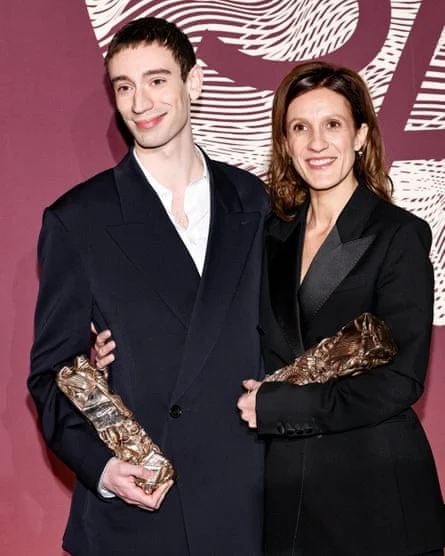
Just six months after the global entertainment community rallied to defend actor Paul Dano against a perceived slight from director Quentin Tarantino, a nuanced portrayal of vulnerability appears to be emerging as a significant asset in the acting landscape. What Tarantino dismissed as "weak sauce" may, in fact, be a potent ingredient for actors seeking to connect with audiences on a deeper level. This shift in perception arrives at an opportune moment for Théodore Pellerin, whose gangly frame and expressive large eyes imbue him with a captivating fragility in the new French character study, "Nino." The film presents Pellerin as a young Parisian grappling with a HPV-related cancer diagnosis, locked out of his apartment for a weekend, portraying him as gauche, hesitant, and emotionally guarded, yet utterly magnetic.
Pellerin delves into Nino’s predicament, dissecting his protagonist’s profound inability to communicate his inner turmoil to his loved ones with a remarkable, almost cellular, understanding. "His throat cancer isn’t insignificant," Pellerin explained during a recent Zoom interview from his home in Montréal, Canada. "It’s the part of the body that links the head to the body. There’s a dissociation from the body – a distancing of his emotions. And because it stems from a sexually transmitted disease, his sexuality, which is a strong life force, is also stunted. So his mission becomes to speak and to ejaculate." The urgency of the latter is paramount: Nino must freeze his sperm before his impending treatment renders him infertile. His subsequent odyssey through Paris is framed by the film as a Gen Z echo of French New Wave classics like Agnès Varda’s "Cléo de 5 à 7," a film also centered on a cancer diagnosis. However, "Nino" uniquely explores the modern challenge of finding a private space for self-soothing and procreative necessity in an urban environment.
Pellerin, despite his profound connection to Nino’s vulnerability, projects an air of composed self-assurance. Dressed in a plaid shirt with sleeves rolled up his forearms, his cropped brown hair and neat oval glasses lend him the brisk demeanor of a business student between classes. He is, in fact, in a period of transition between projects, awaiting the commencement of a new shoot in August after recently concluding his work on Tom Ford’s 18th-century drama, "Cry to Heaven." His professional trajectory has been accelerating rapidly, propelled not only by his performance in "Nino" but also by his compelling role in last year’s caustic psychological thriller "Lurker." In that film, he portrayed a parasocial Los Angeles hipster desperately seeking the approval of a pop star. While "Lurker" saw his vulnerability morph into a dangerous neediness, it consistently remained the core of Pellerin’s on-screen presence. Even in more assertive roles, such as a loose-cannon apprentice hoodlum in the 2018 Québécois crime film "Family First," or the pyramid-scheme proselytizer tutoring Kirsten Dunst in the 2019 television series "On Becoming a God in Central Florida," Pellerin consistently infuses his characters with a disarming innocence.
A Director’s Vision and an Actor’s Intuition
Pauline Loquès, the director and co-writer of "Nino," recognized a singular quality in Pellerin’s acting. "Théodore had this ability to give life to silences," Loquès stated. "They became charged with other dimensions – poetic, mysterious, or psychological." She expressed that Pellerin understood her character on a level that surpassed her own initial conception, a remarkable feat given the deeply personal nature of the project. The film was inspired by her profound grief and outrage following the death of a family member, identified only as "Romain," from cancer at the age of 37.

Pellerin offered a distinct interpretation of "Nino," suggesting it is fundamentally a film about parenthood. This perspective came as a revelation to Loquès, despite the film’s narrative featuring numerous parental or quasi-parental encounters, including a poignant scene with Mathieu Amalric offering aftershave, and the undeniable undercurrent of an accelerated biological clock. Loquès, 39, a former journalist embarking on her directorial debut, found Pellerin’s perspective invaluable. Pellerin, when asked about any perceived risks in joining a first-time director’s project, countered, "Plenty of big directors make really bad films. And if you write a magnificent screenplay, the film will be great – because you’re close to your subject, you’ve mastered it."
He further elaborated on his collaborative process, stating, "I never had the impression of having to force anything, or add a layer of fiction on top of what I was ‘living’ with the other actors." This immersive environment, he believes, contributed to the success of a pivotal masturbation scene in the film. The scene, fraught with potential for misinterpretation or awkwardness, was instead rendered as a touching moment of liberation, avoiding an unfortunate comic tone.
Navigating Intimate Scenes and Artistic Roots
Addressing the delicate nature of the masturbation scene, Pellerin acknowledged the director’s initial apprehension. "It was a bit stressful for Pauline because she didn’t want to sexualize a moment that was really important for the film," he recounted. "She was a bit uncomfortable talking to me about the scene. We just had to stick close to what we were really saying, and what it represented for the character and the film." Pellerin’s relative ease with such scenes might be attributed to his recent role as Jacques de Bascher, Karl Lagerfeld’s boyfriend, in a television series that included an orgy scene where he masturbated while wearing a t-shirt. "So Nino wasn’t really a big deal," he remarked.
Pellerin’s precocious immersion into the artistic world is deeply rooted in his family’s creative background. His mother, Marie, is a choreographer, and his father, Denis, is a painter. His artistic journey began early, attending a secondary school with a specialization in dramatic arts. By the age of 16, he had secured a leading role in the popular school drama "30 Vies," marking his debut in television. "I grew up in theatre dressing rooms, with the dancers from my mum’s troupe," Pellerin shared. "So the theatrical space was one I loved. It was playful, personal. Being an artist wasn’t necessarily what I always wanted to do when I was young – but it’s never been an impossibility from my perspective."
From Quebecois Cinema to Global Ambition
Speaking in French, with his native Québécois accent becoming more pronounced as the interview progressed, Pellerin quickly amassed credits in his native language. He portrayed a younger iteration of Vincent Cassel’s character in Xavier Dolan’s 2016 film "It’s Only the End of the World," and a notably irritating younger brother, possibly mentally unwell, in "Family First." However, Pellerin identified English-language roles as the primary pathway for career advancement. He dedicated himself to learning the language, which enabled him to star as a teenager grappling with his sexuality in the 2017 film "Never Steady, Never Still," opposite Shirley Henderson.
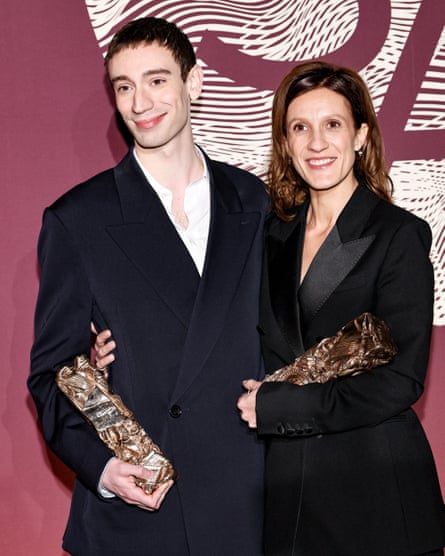
Pellerin has steadily built a presence on the periphery of Hollywood, including a brief appearance as one of Joaquin Phoenix’s fantasy sons in Ari Aster’s "Beau Is Afraid." His performance in "Lurker" garnered significant acclaim. His portrayal of an L.A. hipster, complete with a flawless American drawl, is indicative of his linguistic adaptability. This skill is likely to be evident again in his upcoming role as a castrato music professor, where he is expected to master a Received Pronunciation (RP) accent in "Cry to Heaven." Pellerin notes a distinct difference in performing in English-language roles: "There’s a bit more of an intellectual process to go through with English, because phrases are constructed in such a way that, for them to have the right sense, consciously or unconsciously, you have to hit the right accents. In French, you don’t have to worry about the rhythm. In English, it’s more pap-a-pap-a-pap-pap-pap." He punctuated this observation with a gestural illustration, his hand moving up and down an imaginary musical score like a conductor.
The Art of Slow Immersion and Character Resonance
Pellerin is now increasingly landing leading roles in both French and English productions, a testament to his growing reputation. He has previously spoken about his methodical approach to acting, describing himself as a "slow" processor of roles. Loquès elaborated on this aspect of his artistry: "He often says, ‘I’m not a great actor but I know how to read a script really well.’ That’s the difference between him and other actors – he’s very strong at doing research upstream. It’s a place of expansion for him. Then he tries to forget it all before coming on set."
The roles that have left a lasting impression on Pellerin are those that demanded a deep dive into character. With "Family First," he expressed concern about potentially remaining trapped in a sadistic mindset. Similarly, the environment of celebrity hangers-on and sycophants in "Lurker" took its toll. "It was a kind of cynicism. The feeling of rejection was very strong, because that’s what the character was going through in every scene," he recalled. Conversely, "Nino" was a character he found difficult to detach from. "It was more of a return to my life, to frivolity," he explained. "I wasn’t confronting mortality in the same way. I found it hard: it was like a loss of poetry in my life."
A Future Forged in Diverse Roles
Given Pellerin’s current trajectory, it seems inevitable that he will continue to explore a diverse range of characters. As our conversation neared its end, with an impending August shoot on the horizon, the question of him already inhabiting a new persona arose. However, Pellerin revealed his immediate focus: "Er, I’ve got my therapy session on Zoom now, so that’s what I’ll be doing with my psychologist." With a wry smile and a polite "merci," he concluded the interview. The ability to navigate such complex emotional landscapes, both on and off screen, underscores the profound and ongoing work of embracing vulnerability, a skill that appears to be defining Pellerin’s burgeoning career.