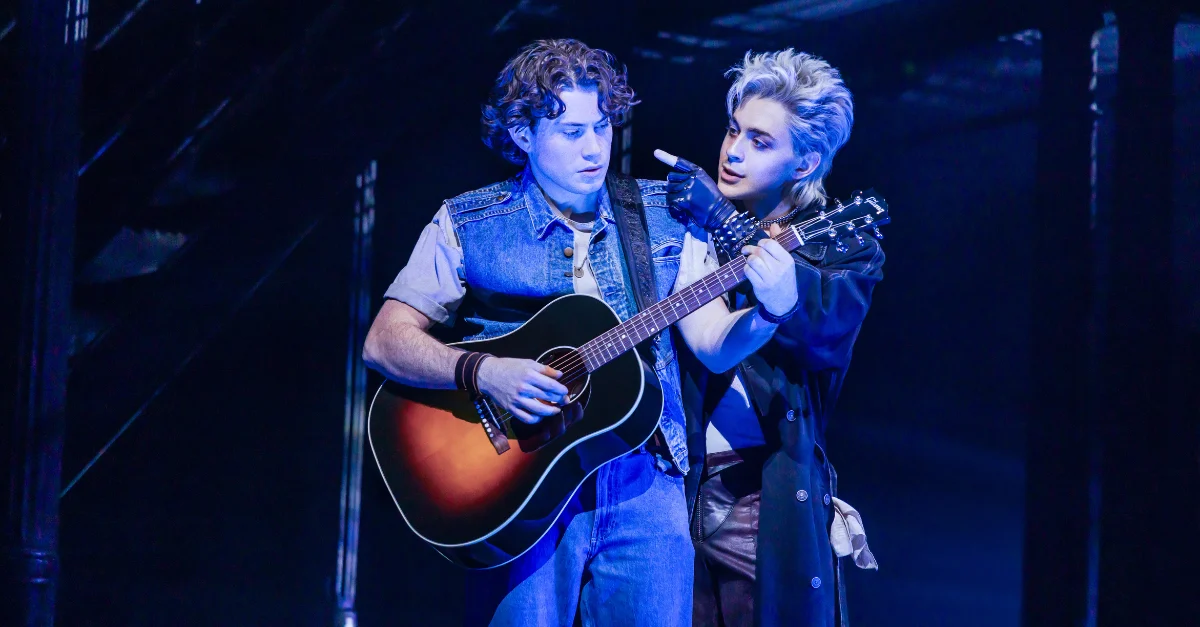
The iconic 1987 film "The Lost Boys" has been reimagined for the stage, transforming into a critically acclaimed Broadway musical that has not only captivated audiences but has also seemingly broken a long-standing theatrical jinx surrounding vampire-themed productions. "The Lost Boys: A New Musical," which opened at the Palace Theatre in New York City in April 2026, has defied expectations and earned significant accolades, including 12 Tony nominations and four wins, with Ali Louis Bourzgui taking home the award for Best Featured Actor in a Musical for his portrayal of David.
This ambitious adaptation, produced in part by actor Patrick Wilson, a noted horror enthusiast, and featuring musical contributions from rock legend Slash, has achieved what many deemed impossible: making singing vampires a bona fide Broadway success. The production’s triumph marks a significant moment for horror properties transitioning to the theatrical realm, challenging the "vampire curse" that has plagued previous attempts, such as "Dance of the Vampires," "Dracula the Musical," and "Lestat" in the early 2000s.
From Cult Classic to Stage Spectacle
"The Lost Boys" has long held a revered status among horror aficionados, appreciated for its multifaceted interpretations. For some, it’s a coming-of-age narrative exploring the integration of one’s darker impulses. For others, it serves as a poignant allegory for LGBTQ+ acceptance or a reflection of the anxieties surrounding the AIDS crisis of the 1980s. The film’s enduring appeal lies in its ability to resonate on multiple levels, solidifying its position as a property that fans believe should be approached with extreme care.
The decision to adapt such a beloved and culturally significant film into a musical was met with a mixture of anticipation and trepidation. While the involvement of Patrick Wilson, known for his roles in horror films like "The Conjuring" series, and the legendary guitarist Slash, a lifelong horror fan, provided a strong foundation of genre authenticity, the inherent risks of a musical adaptation remained. However, the final product has exceeded these cautious hopes, delivering a production that the original reviewer described as tear-jerkingly successful.
The musical has been lauded for its comprehensive execution, from its opening sequence, which faithfully recreates a chilling vampire kill, to its hard-rock soundtrack. The inclusion of original songs, such as the evocative "Murder Capital of the World," underscores the show’s commitment to a fresh yet familiar sonic landscape. Key elements from the film, including the dynamic presence of the Frog Brothers, the exhilarating motorcycle chase sequences, and the iconic bridge-fall scene, have been translated to the stage with remarkable fidelity and creative flair. Even the character of the "greasy sax guy" makes a memorable appearance, adding to the production’s nostalgic charm.
Redefining the Vampire Narrative on Stage
A particularly striking aspect of the musical’s reception has been the audience’s reaction. Unlike traditional theatergoers, the crowds at "The Lost Boys: A New Musical" have exhibited an energy more akin to a rock concert, demonstrating the production’s ability to forge a deep connection with its audience. This enthusiastic engagement speaks volumes about the show’s success in translating the visceral thrill of the film to a live theatrical experience.
Beyond its faithful recreation of beloved moments, the true triumph of "The Lost Boys: A New Musical" lies in its capacity to deepen the original narrative. The production honors the source material while ambitiously expanding upon its characters, mythology, and emotional core. This approach allows for a richer exploration of the themes that made the film a classic, offering new insights and perspectives for both long-time fans and newcomers alike.

The Broadway Vampire Curse: A Historical Perspective
The notion of a "vampire curse" on Broadway is not without precedent. Several high-profile musical adaptations of vampire lore have met with significant commercial and critical failures. "Dance of the Vampires," which opened in 2002 and starred Michael Crawford, is often cited as a prime example, struggling to connect with audiences despite its lavish production. Similarly, "Dracula the Musical" in 2001 and "Lestat" in 2006, based on Anne Rice’s novels, also failed to achieve lasting success, leading to a widespread perception that singing vampires were an inherently difficult proposition for the Broadway stage.
The challenges faced by these earlier productions stemmed from various factors, including misinterpretations of the genre’s appeal, attempts to shoehorn complex horror narratives into traditional musical theater structures, and a lack of cohesion between music, book, and staging. The inherent theatricality of vampire lore—its gothic atmosphere, dramatic transformations, and supernatural elements—seemed to elude successful adaptation, resulting in productions that often felt either too campy or too dramatically uneven.
"The Lost Boys: A New Musical," under the direction of Michael Arden, has demonstrably broken this mold. Arden, known for his innovative and visually striking theatrical work, has guided the production with a clear vision that balances the film’s inherent cool factor with the demands of musical theater. His direction, combined with the contributions of the creative team, has resulted in a show that is both a faithful homage and a groundbreaking theatrical achievement.
Crafting the Musical: Behind the Scenes
The monumental task of adapting "The Lost Boys" for the stage fell to Tony-nominated book writers David Hornsby and Chris Hoch. Their collaboration brought together distinct yet complementary skill sets. Hornsby, renowned for his sharp comedic writing on television shows like "It’s Always Sunny in Philadelphia" and "Mythic Quest," brought an acute sense of humor and character development. Hoch, a seasoned Broadway performer with credits in shows such as "Spamalot," "Shrek," and "Matilda," provided invaluable experience in the intricacies of musical theater.

Hornsby initially expressed reservations, acknowledging the daunting nature of the project. "Oh man, this is a big swing," he recalled, "It’s comedy, but it’s vampires, but it’s horror. I mean, that’s a lot." His initial exposure to the film was a unique, shared experience with Hoch, who had grown up with the movie. "I ended up watching it with Chris, except he was in New York and I was in LA," Hornsby recounted, "So I watched it with him on speakerphone talking over the whole movie."
Producer Patrick Wilson played a crucial role in ensuring the production maintained its horror integrity. His insistence that the scares needed to be genuinely effective pushed Hoch to delve deeply into the genre’s archives. "It was very important to him to get the horror right," Hoch stated, "I watched a lot more horror just to try to get on his wavelength." This commitment to authenticity led Hoch to study films like "The Exorcist III," which features one of cinema’s most renowned jump scares, a testament to the team’s dedication to capturing the essence of the horror genre. "Am I wrong that ‘The Exorcist III’ has the scariest single jump scare that I’ve seen?" Hoch mused, "I was shocked at how well that was done." By the end of this intensive study, Hoch admitted, "I definitely became a horror fan by the end of it."
The Heart of the Story: Family and Belonging
The creative team recognized that simply translating the film’s plot and aesthetics to the stage would not be enough. The challenge lay in finding the underlying human narrative that would resonate with audiences beyond the leather jackets and supernatural elements. For Hornsby and Hoch, this emotional anchor was the concept of family.
"We wanted something the audience could relate to that was outside of the scares," explained Hoch. "That was the real difficult part, and the real trick. So we hung the show on this idea of family." Hornsby further elaborated on this thematic focus, stating, "The vampires are a vehicle to get them to be a closer family unit. Let’s make a show about chosen family, and show all the various versions of a family."

This thematic framework—vampirism as a metaphor for chosen family, LGBTQ+ acceptance, brotherhood, seduction, and the universal need to belong—permeates the entire production. It provides a profound emotional depth that elevates the musical beyond a mere genre piece.
This thematic resonance is perhaps most powerfully manifested in Michael’s initiation sequence. The creators intentionally excised some of the film’s more overtly comedic or unsettling elements, such as the infamous worm-eating scene. In their place, they crafted a haunting a cappella performance where the vampires beckon Michael to join their ranks. This moment is described as beautiful, chilling, and deeply spiritual, exploring emotional territory that the original film only hinted at.
"The act of harmonizing means you have to be in tune with other people," Hornsby explained, drawing a parallel between the musical technique and the narrative’s core themes. "So when the story is about family, and we’re showing a brotherhood, people interlaced in harmonies are, in a sense, subconsciously saying, ‘We are one, and we want you to step in and join.’"
The Music: A Driving Force
The score for "The Lost Boys: A New Musical" was composed by Gabriel Mann, a member of the Los Angeles-based indie pop-rock trio The Rescues, alongside Kyler England and Adrianne "AG" Gonzalez. Known for their harmony-rich, cinematic songwriting, The Rescues brought a fresh perspective from outside the traditional musical-theater pipeline, having previously had their songs featured in popular television series such as "Grey’s Anatomy," "One Tree Hill," and "The Umbrella Academy."

Mann elaborated on the creative process, highlighting the central question that guided their musical compositions: "We really had to ask ourselves, what’s drawing Michael to David and his gang? There’s something otherworldly going on, beyond just wanting to belong to a group of cool guys. There’s probably some kind of power these vampires have. So we imagined this a cappella moment with ancient vibes, and it seemed to really work."
The musical’s approach to its score was unconventional, with the music often preceding the book. Director Michael Arden tasked The Rescues with creating a substantial body of work before the book writers were fully engaged. Mann recalled Arden’s directive: "Go away. Go make a bunch of stuff, and everybody leave them alone." This approach allowed the composers to establish the show’s sonic identity, with Hornsby and Hoch then tasked with reverse-engineering a narrative structure around these existing musical tentpoles. "For us, it was looking at what they have and trying to come up with a structure," Hornsby noted.
The involvement of Slash further infused the score with authentic rock energy and horror-rock credibility. Mann described working with the legendary guitarist as a surreal experience, emphasizing Slash’s deep connection to the material and his ability to bring both rock authority and genuine fan enthusiasm to the studio sessions. This synergy between Wilson’s commitment to horror and Slash’s musical contributions proved instrumental in shaping the show’s distinctive sound.
Theatrical Innovation: Flight and Spectacle
Beyond its musicality and thematic depth, the production also excels in its visual presentation. Director Michael Arden and scenic designer Dane Laffrey prioritized stagecraft that evoked beauty and emotional resonance, rather than relying solely on digital screens or overt spectacle. The show masterfully utilizes its three-story-high set to create stunning visual sequences of vampires in flight, transforming aerial choreography into a potent visual language of seduction, danger, and transcendence.

"The ethos of our show was to emphasize the beauty of the world," Hornsby stated. "As opposed to shocking them, let’s make these beautiful moments where we can make people feel. It’s letting people forget they’re in a seat so they can be carried away for a second." This artistic philosophy ensures that the spectacle serves the narrative and emotional arc of the story, rather than overwhelming it.
The Future of Horror on Stage
The success of "The Lost Boys: A New Musical" signifies a potential paradigm shift in how beloved horror properties are adapted for new mediums. While reboots and sequels in film often tread familiar ground, stage adaptations offer a unique opportunity to reinterpret and expand upon existing narratives in a live, immersive environment.
In recent years, Broadway has seen a growing number of successful horror-themed productions. "Beetlejuice the Musical" has found a dedicated following, and "Stranger Things: The First Shadow" has generated considerable buzz. The upcoming "Paranormal Activity: A New Story Live on Broadway" further indicates a burgeoning trend. These productions suggest that the stage is emerging as a fertile and promising new frontier for horror franchises, capable of attracting dedicated fan bases and reaching new audiences.
"The Lost Boys: A New Musical" is currently playing at the Palace Theatre in New York City. A North American tour is slated to launch in the spring of 2028, promising to bring this groundbreaking production to a wider audience. The show’s triumphant run not only celebrates the enduring legacy of "The Lost Boys" but also heralds a new era for horror in theatrical storytelling.