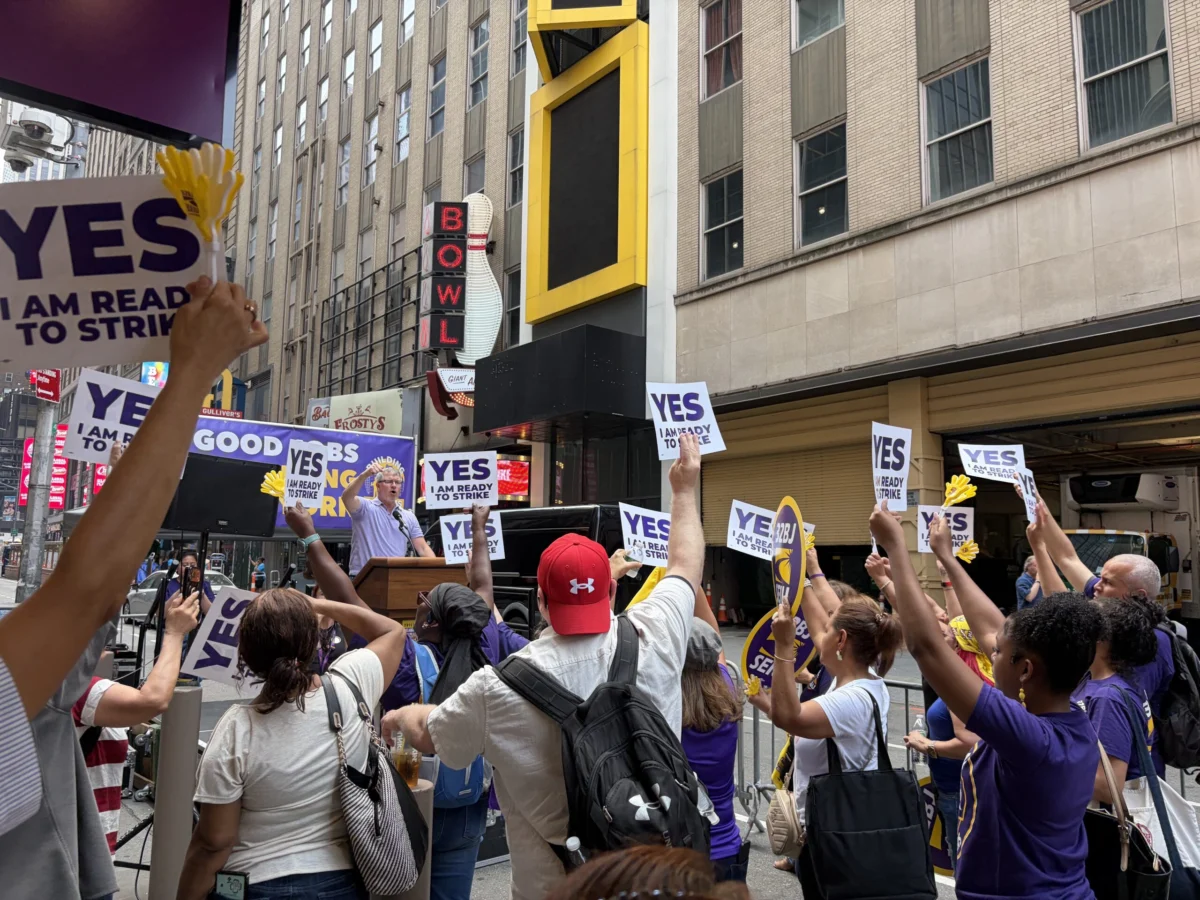
The landscape of labor relations on Broadway shifted significantly on Tuesday as more than 250 theater cleaners, represented by 32BJ of the Service Employees International Union (SEIU), voted overwhelmingly to authorize a strike. This decisive move marks the first time in nearly two decades that this specific workforce has moved toward a work stoppage, signaling a deepening rift between the essential workers who maintain the "Great White Way" and the powerful theater owners who control its iconic venues. The vote follows months of stalled negotiations with the Broadway League, the industry trade association representing major employers including the Shubert Organization, the Nederlander Organization, ATG Entertainment, and Circle in the Square.
While the strike authorization does not trigger an immediate walkout, it provides the union’s bargaining committee with the legal leverage to call for a strike if a satisfactory agreement is not reached in the coming days. The current contract has already expired, and despite ongoing discussions that began in early June, union leadership maintains that the two parties remain fundamentally at odds over core economic issues, most notably wage increases that reflect the skyrocketing cost of living in New York City.
A Historic Escalation in Labor Relations
The decision to authorize a strike is a rare occurrence for the Broadway cleaning crews, who last took such a step 18 years ago. The 32BJ SEIU is one of the largest property service workers unions in the United States, representing over 175,000 members, but the Broadway contingent occupies a unique and highly visible niche within the organization. These workers are responsible for the upkeep of the historic houses that host millions of tourists and theatergoers annually.
The tension currently manifesting on Broadway is part of a broader post-pandemic labor movement that has swept through the entertainment industry. In the last year alone, Broadway has seen similar brinkmanship from the musicians of Local 802 AFM and the performers and stage managers of Actors’ Equity Association. In both instances, strike authorizations were used as a "show of force" to break deadlocks in negotiations, eventually leading to new contracts just hours or days before scheduled walkouts. The cleaners are now following this blueprint, betting that the threat of dirty theaters and disrupted schedules will compel the Broadway League to meet their demands.
The Core Demands: Wages, Pensions, and Dignity
At the heart of the dispute is a package of economic and social demands that the union describes as essential for survival in an increasingly expensive urban environment. The 32BJ SEIU is seeking significant wage increases, improved pension benefits, robust healthcare coverage, and strengthened anti-discrimination measures. Additionally, the union is pushing for better working conditions, including guaranteed paid leave.
Denis Johnston, Executive Vice President of 32BJ SEIU, emphasized that the economic pressures on his members have reached a breaking point. Speaking at a rally held in front of the Shubert Organization offices on Tuesday, Johnston noted that the pandemic’s legacy continues to haunt the workforce. When theaters were shuttered for 18 months starting in March 2020, cleaners were among the first to lose their livelihoods. Upon the industry’s return, wage growth failed to keep pace with the subsequent surge in inflation.
"With the high cost of inflation in the city, the high cost of housing, our members are deeply, deeply struggling, like many other working people," Johnston stated. "We have to deliver a very strong wage settlement for our members."
The union’s position is bolstered by recent economic data from the New York City region. According to the Bureau of Labor Statistics, the Consumer Price Index for the New York-Newark-Jersey City area has seen persistent increases, particularly in the costs of housing and food. For workers earning hourly wages in the service sector, these inflationary pressures often outstrip standard annual raises, leading to a net decrease in purchasing power.
The Financial Context: Record Grosses vs. Stagnant Wages
The cleaners’ demands are set against a backdrop of significant financial recovery for the Broadway industry. According to data released by the Broadway League for the 2023-2024 season, the industry brought in a collective $1.54 billion in ticket sales, with attendance reaching 12.3 million. Projections for the 2025-2026 season suggest even higher gains, with some estimates placing ticket revenue near the $1.91 billion mark. This financial success has become a focal point for union members who feel they are being excluded from the industry’s prosperity.
At Tuesday’s rally, workers held signs and chanted "Share the wealth," a slogan that highlighted the disparity between the high cost of the Broadway experience for patrons and the compensation for those who facilitate it. Chris Repollet, a cleaner at the New Amsterdam Theater—currently home to the long-running hit Aladdin—spoke candidly about the disconnect.
"It’s us who have to pick up the $7 bottles of water and the $20 boxes of popcorn at every single show," Repollet said. "We see the success of the industry. That depends on us."
While Repollet’s theater is owned by Disney, he is covered under the same general contract terms currently being negotiated with the Broadway League, illustrating the far-reaching impact of these talks across the entire theatrical landscape.
The Reality of the Job: Essential Labor Behind the Scenes
The labor performed by Broadway cleaners is often invisible to the public, occurring in the late hours after the final curtain call or in the early mornings before the box office opens. However, the physical demands of the role are substantial. Martha Aristizabal, a 17-year veteran of the Ambassador Theater, where the musical Chicago is performed, described the grueling nature of the work.
Through a translator, Aristizabal explained that the job involves more than just sweeping floors. Cleaners are tasked with hauling heavy supplies, distributing thousands of Playbills, and meticulously cleaning seating areas that are often littered with food, beverage containers, and various stage effects. In recent years, many Broadway productions have incorporated immersive elements, such as confetti cannons or stage gravel, which frequently migrate into the audience seating, adding hours of intensive labor to the cleaning shift.
"It’s very important because we’re like the motor for Broadway to function," Aristizabal said. "Every show starts with the essential workers, which is us." She further noted that many cleaners must work well over 40 hours a week or seek second jobs just to afford basic necessities in New York City, a situation she described as unsustainable.
Timeline of Negotiations and the Path to a Strike
The current labor dispute has been brewing for months. The timeline below outlines the key milestones in the negotiation process:
- Early June 2024: Formal negotiations between 32BJ SEIU and the Broadway League begin. Initial proposals focus on wage adjustments and healthcare protections.
- Summer 2024: Several rounds of bargaining take place, but little progress is made on the core issue of salary increases. The existing contract expires, leading to workers operating under the terms of the old agreement.
- September 2024: The union intensifies its public outreach, drawing parallels between the cleaners’ struggle and the successful negotiations of the musicians’ and actors’ unions.
- Tuesday: Union members gather for a rally and officially vote to authorize a strike. The vote is nearly unanimous.
- Wednesday: A critical negotiating session is scheduled. Union leaders indicate that if no significant movement is made, they will begin preparing for a potential walkout.
The Broadway League, which represents the interests of theater owners and producers, has remained largely silent in the immediate aftermath of the vote. Historically, the League has argued that while grosses are high, the cost of producing and maintaining shows has also risen exponentially due to increased labor costs across all departments, higher insurance premiums, and the lingering debt from the pandemic shutdown.
Broader Impact and Industry Implications
If a strike were to occur, the implications for Broadway would be profound. While 250 workers may seem like a small fraction of the thousands employed in the theater district, their role is foundational to health and safety regulations. New York City building codes and health standards require public assembly spaces to meet specific cleanliness and maintenance criteria. Without a professional cleaning crew, theaters could potentially face fines or be forced to cancel performances if they cannot guarantee a sanitary environment for patrons.
Furthermore, a strike by 32BJ SEIU would likely garner the support of other Broadway unions. Members of the International Alliance of Theatrical Stage Employees (IATSE) and the American Federation of Musicians (AFM) have already shown solidarity by attending Tuesday’s rally. In the highly unionized environment of Broadway, a picket line by one guild is often respected by others, which could lead to a total shutdown of the industry’s 41 theaters.
The economic impact of such a shutdown would extend far beyond the box office. Broadway is a primary engine for New York City’s tourism economy, supporting hotels, restaurants, and transportation services. A prolonged strike during the lucrative fall season could result in millions of dollars in lost revenue for the city.
Conclusion: The Search for Respect
For the workers of 32BJ SEIU, the conflict is about more than just a paycheck; it is about the recognition of their contribution to the cultural fabric of New York. Chris Repollet summarized the sentiment of the bargaining committee by stating that "respect" is the ultimate goal of the negotiations.
"Everybody looks down on us, but we do it with pride because we care about the theaters. We care about the shows," Repollet said.
As the parties return to the bargaining table on Wednesday, the pressure is on the Broadway League to present an offer that satisfies a workforce that has clearly signaled its willingness to walk away from the job. With the eyes of the labor movement and the theater world watching, the next few days will determine whether the lights of Broadway continue to shine or if the "Great White Way" will go dark in a historic stand for workers’ rights.