The enduring legacy of the Evil Dead franchise is its remarkable adaptability, consistently reinventing itself across various cinematic genres. From its early days as a quintessential "teens in a haunted cabin" slasher to its evolution into slapstick comedy, medieval fantasy homage, and even a poignant exploration of addiction and recovery, the series has proven remarkably fertile ground for creative expression. Evil Dead Burn continues this tradition, presenting a chilling narrative that artfully blends the unsettling aesthetics of French extremity with a visceral examination of the suffocating complexities of marrying into a deeply troubled family. The film interrogates how inherited trauma and unresolved grief can manifest as a literal, flesh-ripping horror.
The narrative centers on Alice (Souheila Yacoub), the widow of restaurateur Will Price. Following Will’s untimely death in a car accident, Alice finds herself obligated to attend a funeral and memorial weekend at the Price family home. The estate has since been inherited by Will’s younger brother, Joe (Hunter Doohan). While Alice maintains a cordial relationship with Joe and his girlfriend, Thya (Luciane Buchanan), her interactions with Will’s parents, Susan (Tandi Wright) and Edgar (Erroll Shand), are strained and fraught with unspoken tension. Adding another layer of familial dysfunction is Will’s grandmother, Polly (Maude Davey), who, in her advanced dementia, lives in a perpetual state of recollection, mistaking Susan for her deceased sister, Bonnie. This intricate web of strained relationships forms the bedrock upon which the supernatural terror is built.
Susan, the matriarch, embodies a brittle, furious grief that transcends mere sadness. She has seemingly martyred herself to the needs of her family, declaring herself "nothing" without them, and implicitly expects Alice to assume a similar caretaker role, even in Will’s absence. Edgar, the patriarch, presents a gruff, intimidating facade, initially appearing as a paramilitary figure dispatched to eliminate any perceived threats. The grandmother, Polly, harbors an overt hatred and mistrust for everyone except her deceased grandson, Will. Both parents express palpable anger towards Joe, criticizing his perceived neglect of the family home and the stalled trajectory of his writing career. Thya, Joe’s girlfriend, experiences marginally better treatment than Alice, primarily because Susan and Edgar openly resent their son’s marriage to a "French girl." This animosity culminates in Susan’s decision to relegate Alice to a meager camp bed in the attic, a deliberate act to underscore her unwelcome status within the family.
The pre-demonical tension within the Price household is palpable. By the time the family gathers for a post-funeral lunch, the air is thick with mutual recriminations, insults, and passive-aggressive barbs. Alice’s suggestion that she might not wish to continue managing Will’s restaurant is met with immediate disapproval, signaling that the familial horror has already begun to manifest in its most human and psychological forms. This domestic dread serves as a potent precursor to the overt supernatural onslaught that is soon to follow.
The film’s sinister turn is initiated by the discovery of eerie Kandarian artifacts within the attic, hinting at the Price family’s long-standing, and apparently inherited, connection to the occult. It is revealed that a deceased patriarch was deeply involved in esoteric research, laying the groundwork for the malevolent forces that now threaten the living. The narrative skillfully establishes that demons have been systematically targeting this family, patiently infiltrating their lives with the ultimate goal of their complete destruction.
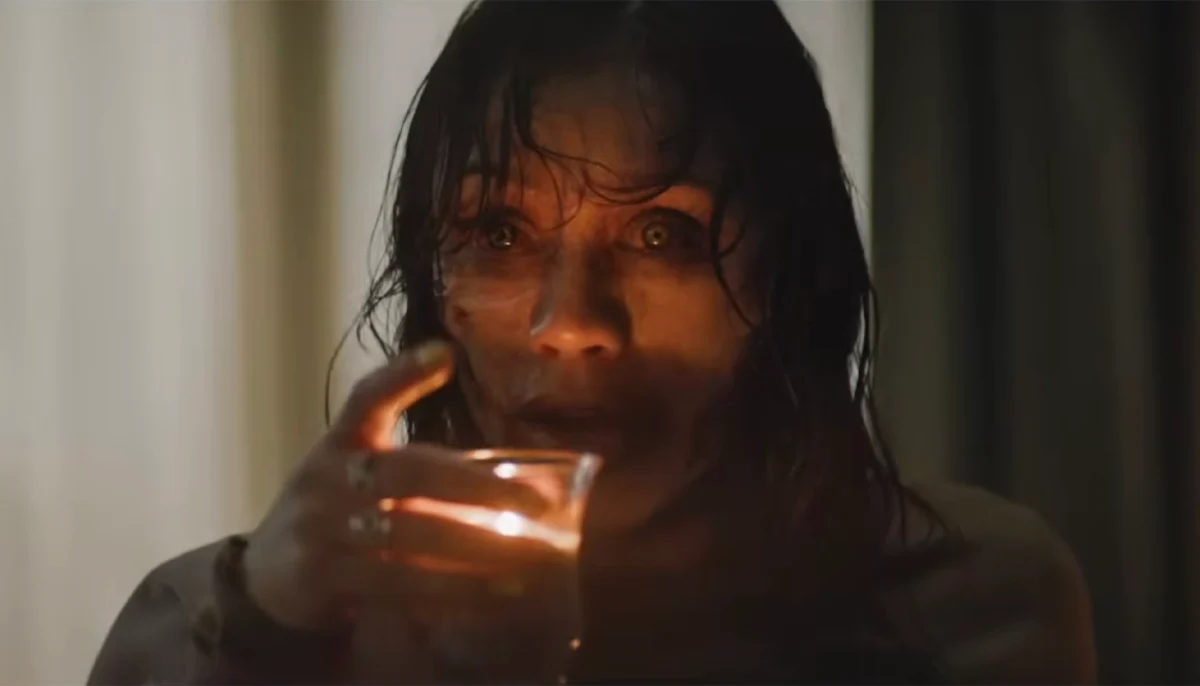
The trailer for Evil Dead Burn offers a tantalizing glimpse into the film’s escalating terror, showcasing a single, brutal scene from its midpoint. Once the demonic entities make their presence known, the film unleashes a relentless barrage of horror, offering viewers minimal respite. The violence and gore are depicted with an operatic, over-the-top intensity, depicting the physical dismemberment of human bodies in ways that defy biological possibility. For aficionados of extreme gore, the film promises a comprehensive exploration of bodily mutilation. However, Evil Dead Burn transcends mere splatter, offering significant depth through its compelling performances. While the entire cast delivers exceptional horror acting, Souheila Yacoub’s portrayal of Alice is particularly noteworthy. She navigates a complex emotional spectrum encompassing sorrow, regret, rage, numbness, and shock, authentically embodying the multifaceted grieving process while simultaneously confronting her antagonistic in-laws and facing down genuine demonic terror. Her performance is utterly convincing, carrying the weight of the film’s emotional core.
The dynamic between Alice and her mother-in-law, Susan, is especially rich. Tandi Wright delivers a masterful performance as Susan, her portrayal laced with wounded pride, accusatory glances, and long-suffering sighs. Even after the demonic invasion commences, Wright manages to imbue Susan with a chillingly effective passive-aggression, underscoring the deeply ingrained familial animosity.
Director Sébastien Vaniček, previously lauded for his critically acclaimed film Infested, which explored xenophobia in Parisian society through a terrifying spider invasion, once again demonstrates his skill in weaving social commentary into visceral horror. In Evil Dead Burn, Vaniček and co-screenwriter Florent Bernard do not directly equate the demons with grief, but rather integrate the narrative of an imploding family into the established Evil Dead mythos. The film subtly touches upon real-world familial struggles: an absentee father, a terminally ill sister, a mother succumbing to dementia, and the daughter burdened with caretaking responsibilities. These are inherently difficult situations, but when the absentee father’s absence is explained by his research into actual demons, the stakes are exponentially raised. By introducing the story at a point where familial trauma has already been passed down to the next generation, the filmmakers expertly capture the moment when resentment and anger are poised to boil over. The subsequent arrival of demons to feast on this festering negativity is an inspired use of supernatural horror to illuminate the darkest corners of human experience.
It is crucial to emphasize that Evil Dead Burn operates as a visceral "meat grinder," often punctuated by moments of stark, black humor. The film unflinchingly portrays a funeral scene for comedic effect, and no pet, exposed limb, or ear is safe from its relentless carnage. Nearly every sharp or heavy object within the house gains a profound, Chekhovian significance. If an open dishwasher served as a pivotal, gruesome element in Evil Dead Rise, then a similar ingenuity is applied to household items in Burn. Implements such as weed-whackers, power drills, serrated turkey carving knives, and, in one extended sequence, virtually the entire interior of a car, are employed with devastating effectiveness. Even seemingly innocuous items like fountain pens are repurposed as weapons multiple times. The film also features a surprising amount of supernaturally charged saliva, contributing to its uniquely grotesque aesthetic. A particularly memorable and protracted scene involves a disturbingly visceral, bloody kiss that lingers for what feels like an eternity, eliciting palpable discomfort from the audience.
The film navigates a fine line: the older members of the Price family are portrayed as so thoroughly unpleasant that their suffering becomes almost cathartic to watch. Yet, the genuine goodness of Alice, Joe, and Thya ensures the audience remains invested in their survival, a distinction that sets Evil Dead Burn apart from the more broadly comedic entries like Evil Dead 2 or Army of Darkness.
While Evil Dead Burn features an opening scene and a post-credits sequence that explicitly link it to Evil Dead Rise, establishing its place within the larger franchise continuity, it functions as a standalone narrative. A deeper understanding of the Evil Dead lore enhances the viewing experience, particularly a moment involving Alice and the Necronomicon that elicits genuine delight for franchise veterans. Nevertheless, the film is accessible and engaging for newcomers. Evil Dead Burn leans into the tragic undertones that characterized the 2013 reboot, aligning more closely with its somber tone than the campy escapades of Evil Dead Rise. Ultimately, the film’s most impressive achievement lies in its ability to weave a narrative of resilience and perseverance, demonstrating how characters can find strength and move forward even when confronted with overwhelming despair and the seductive allure of succumbing to the demonic forces. While the deeper thematic elements may not always coalesce perfectly, Vaniček and Bernard’s ambitious emotional and Grand Guignol approach to their Evil Dead installment is commendable, leaving audiences eager to see where they and the franchise will venture next.