In a cinematic landscape often dominated by ensemble casts featuring Hollywood’s most bankable stars, the pre-release discourse surrounding Christopher Nolan’s monumental epic, The Odyssey, found itself surprisingly captivated by one name: Samantha Morton. Despite a roster glittering with A-listers such as Matt Damon, Anne Hathaway, Zendaya, and Tom Holland, it was Morton’s portrayal of the enigmatic witch goddess Circe that garnered an extraordinary level of anticipation, largely fueled by none other than the visionary director himself. Nolan, an Oscar-winning filmmaker renowned for his meticulous craft and ability to elicit career-best performances, offered an unparalleled endorsement that sent ripples through the industry. "There are no limitations on her performance," Nolan revealed to The Los Angeles Times earlier this month. He further elaborated on a truly rare occurrence on his sets: "After one of her takes, the crew gave her a great round of applause…. The last time that had happened [in one of my movies] was with Heath Ledger on The Dark Knight." Such a comparison, linking Morton’s work to Ledger’s iconic, Oscar-winning turn as the Joker, set an impossibly high bar, yet, as critics and audiences are now discovering, Morton not only meets but arguably transcends these lofty expectations.
Pre-Release Hype and Nolan’s Endorsement
The build-up to The Odyssey was already immense, given Christopher Nolan’s reputation for crafting intellectually stimulating, visually breathtaking blockbusters. His previous works like Inception, Dunkirk, and Oppenheimer have consistently pushed the boundaries of filmmaking, often blending complex narratives with groundbreaking practical effects. The announcement of The Odyssey, an adaptation of Homer’s epic poem, promised another grand spectacle. Casting choices, as is typical for a Nolan film, were meticulously curated, bringing together a powerhouse ensemble. However, the specific, almost reverent praise Nolan bestowed upon Morton’s performance before the film’s release was unprecedented. This rare public accolade from a director known for his measured public statements immediately positioned Morton’s role as a pivotal, must-see element of the film. It ignited curiosity, prompting questions about the depth and intensity of her portrayal that could warrant such a formidable comparison to one of cinema’s most legendary performances. The anticipation was palpable: what magic had Morton woven to evoke such a reaction from a filmmaker of Nolan’s stature, and from a typically stoic film crew?
The Circe Sequence: A Deep Dive into Practical Magic
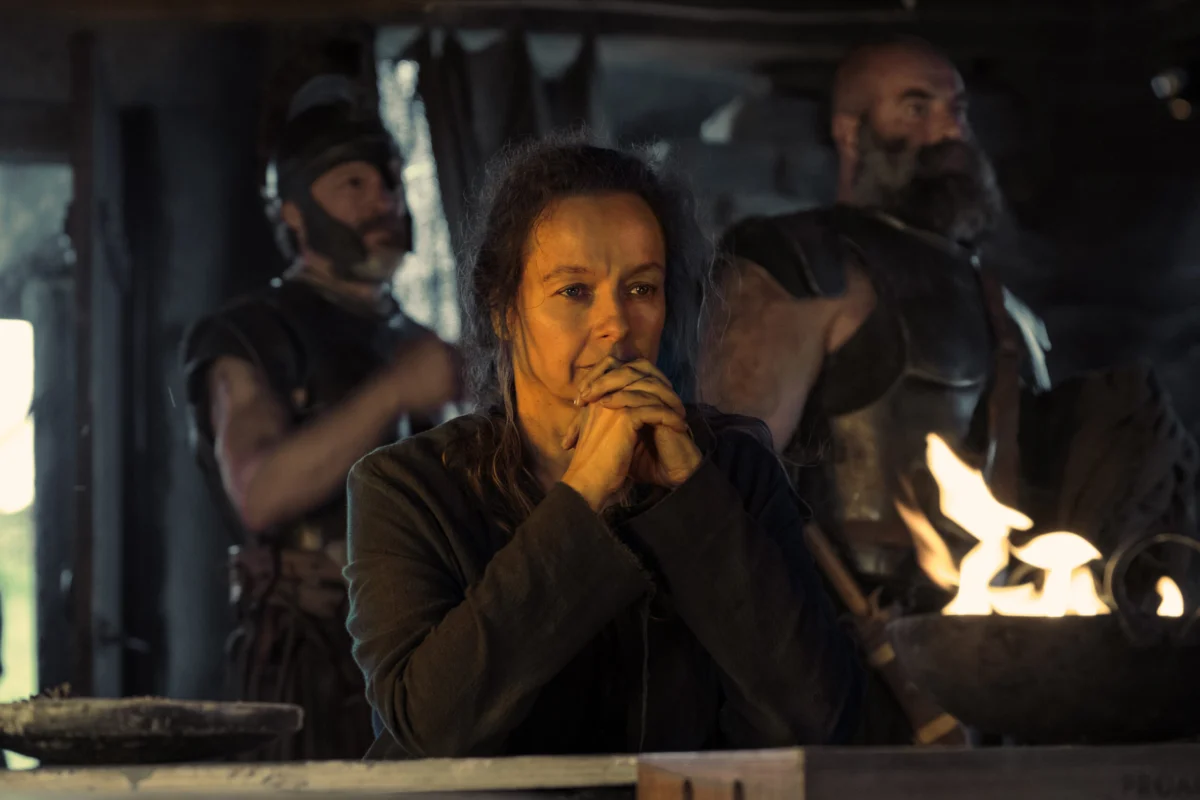
Fortunately for eager audiences and industry observers, Morton’s performance as Circe, the formidable witch goddess of Aeaea, lives up to every ounce of the hype. In what is universally described as a "barnburning sequence," Morton single-handedly transforms the very energy of the massive film, injecting it with a potent blend of mystique, menace, and profound wisdom. The scene unfolds as the desperate survivors among Odysseus’s men, having endured the perils of the sea, wash ashore on a seemingly hospitable yet mysterious beach. Sensing their primal desperation and animalistic hunger, Circe, with a chilling blend of compassion and disdain, promptly transforms them into pigs. This fantastical metamorphosis is executed by Nolan with his signature commitment to practical effects, creating a dazzlingly tangible and unsettling visual spectacle that eschews heavy CGI for a more visceral, in-camera artistry. It is only through the cunning and sheer will of Odysseus (portrayed by Matt Damon), who demonstrates his own capacity for primal instinct by killing a man disguised as a deer, that he convinces Circe to revert his crew to human form. Following this pivotal confrontation, Morton delivers a monologue with singular verve, laying out the treacherous path Odysseus must navigate to return to Ithaca and reunite with his long-suffering family. Her delivery is a masterclass in controlled power, conveying ancient wisdom, raw emotion, and a profound understanding of fate, all within a compressed timeframe.
Samantha Morton’s Illustrious Career: A Legacy of Dynamic Portrayals
Samantha Morton, a British native, has cultivated a dynamic and remarkably varied career spanning over three decades, commencing her acting journey at the tender age of 12. Her filmography is a testament to her versatility and fearless approach to character. Early in her career, she garnered significant critical acclaim, earning Academy Award nominations for her supporting role in Woody Allen’s jazz-era drama Sweet and Lowdown (1999) and later for her lead turn as an Irish immigrant in Jim Sheridan’s poignant In America (2002). These nominations cemented her reputation as an actress of immense depth and emotional intelligence.
More recently, Morton has skillfully balanced high-profile title roles in acclaimed television projects such as The Serpent Queen, where she portrays Catherine de’ Medici with cunning and complexity, and Harlots, showcasing her commanding presence in period dramas. Simultaneously, she has continued to make indelible marks on the big screen, often in smaller yet intensely impactful roles within awards contenders. Her brief but explosive appearances in films like The Whale and She Said served as pivotal moments, taking charge of the narrative and shifting the emotional landscape of these films with just a few minutes of screen time. Her consistent ability to steal scenes, imbue characters with profound authenticity, and deliver memorable performances across diverse genres has made her a respected figure among her peers and critics alike. The Odyssey, however, feels different—it marks a moment of broader, mainstream recognition for an actor who has consistently delivered exceptional, scene-stealing work throughout her career. The sheer power of Nolan’s direction in capturing Circe’s mystical sequence would be unforgettable on its own, but the fact that Morton still manages to stand out to such a remarkable degree speaks volumes about her extraordinary talent and undeniable presence.
The Casting Process: A Dream Realized
Morton’s path to embodying Circe was, for her, a profoundly emotional and surprising journey. She attributes her good fortune to her long-standing relationship with her agents, who have championed her career since she was 19. "They’re always rooting for me and suggesting me to casting directors for things," she shared in a recent interview. It was likely through their efforts that her name reached John Papsidera, Nolan’s renowned casting director. For Morton, the call was a dream come true: "It’s every actor’s dream to work with Christopher Nolan or to get an opportunity to meet him." The moment she received the phone call stating, "Christopher Nolan would like to meet you," she was overwhelmed. "I cried. I was like, ‘Wow, really?’" she recounted.

Intriguingly, Morton went into her initial meeting with Nolan without knowing the specific project or even the source material. Having been a child actor, her formal schooling was abbreviated, meaning she hadn’t delved into Homer’s The Odyssey in depth. Her familiarity was largely limited to popular culture references, including a memorable parody episode of The Simpsons. Yet, upon reading Nolan’s script, she was profoundly moved. "The script blew me away and I was just so moved at how contemporary it felt," she expressed. She developed her own interpretation of Circe, and after discussing it with Nolan, she anxiously awaited the decision. When she ultimately secured the role, her excitement was immense, driven by a desire "to deliver for Chris and [producer] Emma [Thomas] to inhabit what my instinct was."
Interpreting Circe: A Contemporary Vision
Morton’s approach to interpreting Circe was deeply personal and deliberately untainted by existing literary adaptations. While she acquired Madeline Miller’s acclaimed novel Circe, she consciously chose not to read it, fearing it might cloud her unique vision. "The thing about me and my work is, my relationship to a movie script or a play or a TV episode or whatever I’m doing — that’s my special thing," she explained. She recalled an early career experience playing Jane Eyre where excessive external research led to conflict with the script’s choices. This taught her the importance of grounding her performance in the text at hand while acknowledging the necessity of foundational research.
For The Odyssey, Morton adopted an "old-fashioned" approach, focusing solely on the character as written on the page. Her immediate instinct was that Circe felt "incredibly contemporary." She identified with the character on a deeply human level, seeing her as relatable to "my sister, my mother, my gran, my aunt, my neighbor." Circe felt "very real and very condensed," embodying what Morton termed "the essential will of Circe." She lauded Nolan’s portrayal of the women in the film, noting how "whole" and "fully realized" Circe felt despite limited screen time. "In that short timeframe, there’s a lot to achieve, I think. But it doesn’t feel rushed. It doesn’t feel forced. It feels that she’s every woman. She’s all of us." This profound connection allowed Morton to "bring, for want of a better word, myself into it. I just wanted to own it. I wanted to possess it and own it and be it."
Mastering the Epic Scale: Morton’s Approach to Filming
Taking charge on an epic production like The Odyssey, with its immense scale and star power, might intimidate many actors. However, Morton’s life experiences have forged a resilience and a grounded perspective that she brings to every set. Having grown up in the foster care system and children’s homes, she learned early to fight for her voice and relevance. "I was never really welcome in normal society because we were considered scum," she reflected. This background instilled in her a profound sense of self-worth and equality. "When I was very little, in order to just be in a room with other people that were maybe better-educated or came from a normal family, I always used to think: ‘I have a right to be here. I’m a human being. I have a right to be here. We’re all just as important as each other.’"
This philosophy has been a consistent theme throughout her career. She recalls being asked if she was nervous for her first play at the Royal Court at 16, to which she responded, "No, why?… If it doesn’t work out, it doesn’t matter. I’ve had a go." While acknowledging a healthy adrenaline and the desire to deliver, she maintains a core belief: "Ultimately I’ve got nothing to lose. I’ve got everything to give and nothing to lose." This mindset allowed her to approach working with industry giants like Steven Spielberg and Tom Cruise on Minority Report with focus, not intimidation. "They’re people and we’re all there to do a job," she asserts. "You have to just park all of that outside reality stuff at the door, walk in and do the job. The best job we possibly can." This unwavering professionalism meant that even on a Christopher Nolan film with Matt Damon, she remained centered on her craft.
Behind the Scenes: The Practical Magic of Aeaea
The actual filming of Circe’s pivotal sequence, though impactful, was remarkably brief for Morton, lasting approximately ten days. "It wasn’t long enough for me! I just didn’t want to leave," she joked, expressing her deep enjoyment of the experience. Nolan and producer Emma Thomas provided extensive preparation, ensuring Morton felt supported and understood. This meticulous prep meant she could "hit the ground running," asking all necessary questions in advance to prevent on-set surprises.
Morton’s personal history with genre cinema also informed her excitement for the sequence’s otherworldly elements. Growing up with illicit horror films like The Evil Dead and fantasy classics such as The NeverEnding Story and The Dark Crystal, she harbored a childhood dream of playing either a princess or a villain, even aspiring to be Darth Vader. This background meant she approached the fantastical elements of Circe’s magic with genuine enthusiasm. "I loved the magic of it all," she stated, eager to see "how we were going to do that and what I was able to contribute."

Regarding the practical execution of the men turning into pigs, a signature Nolan technique, Morton emphasized her immersive focus. "I don’t know because I was just in the moment all the time," she explained, highlighting her deep immersion into "Circe mode." She consciously chose not to "worrying or overthinking about what was going on around me," prioritizing getting her performance right within the character. Her approach was akin to a puppeteer, becoming "one with, for lack of a better word, Circe’s creations. They were of her, part of her, and it was an extension of her mind." This complete commitment led to an unexpected, spontaneous element in her performance: a hum or song that surprised even her upon later viewing. "I didn’t mean to hum. I didn’t think I was going to hum," she admitted, underscoring the organic nature of her portrayal.
A Legacy of Impact: Short Appearances, Lasting Impressions
Morton has a unique talent for delivering explosive, chemistry-altering performances even in limited screen time, a skill she has honed throughout her career. Reflecting on her impactful scenes in films like She Said and The Whale, she acknowledges this particular strength. "I think that I’m reliable, maybe? They know I’m good for it. I’ll give it 150 percent," she mused. Crucially, she emphasizes that her intensity is never self-serving. "I’m really aware it’s not about me." This collaborative spirit, combined with her dedication, makes her an invaluable asset to any production. "I don’t bring any baggage, I suppose. I just turn up with a little bag and get on with it and then go away."
Her career trajectory, moving seamlessly from lead roles in television (like Catherine de’ Medici in The Serpent Queen) to powerful, concise film appearances (such as in Anemone, Daniel Day-Lewis’s first screenplay), speaks to her versatility and the trust directors place in her. "I think I’m a good egg. I’ll turn up, do the work and be happy with that, thank you," she summarized with characteristic humility.
The Broader Implications: Morton’s Resurgence and Nolan’s Vision
Christopher Nolan’s fervent praise for Samantha Morton’s performance is not merely a director complimenting an actor; it signifies a potent confluence of artistic vision and exceptional talent. Nolan’s method of working, characterized by extensive pre-production collaboration followed by a trust in his actors to deliver on set, proved to be an ideal environment for Morton. She noted that every piece of guidance from Nolan felt "completely poignant and relevant and right and made me better." This symbiotic relationship allowed Morton to fully inhabit Circe, creating a portrayal that has resonated deeply with audiences and critics.
The critical reception for The Odyssey has largely highlighted Morton’s performance as a standout, confirming the director’s early predictions. Reviewers have lauded her ability to command the screen, transforming a mythical figure into a relatable yet awe-inspiring presence. This moment in The Odyssey serves as a powerful reminder of Morton’s consistent brilliance and her unique capacity to elevate any project she touches. For an actress who has navigated the "ups and downs" of a challenging industry, Nolan’s public validation is profoundly meaningful. "Emotional," she described it, "It validates the fact that I’m good at what I do and I care. I’m very grateful and I take it very seriously."
As The Odyssey continues its successful run, Samantha Morton’s Circe will undoubtedly be remembered as a career highlight, a testament to her enduring talent, and a powerful demonstration of what can be achieved when a visionary director recognizes and unleashes an actor’s full potential. Her performance not only enriches Nolan’s ambitious adaptation but also solidifies her place as one of the most compelling and impactful actresses of her generation.