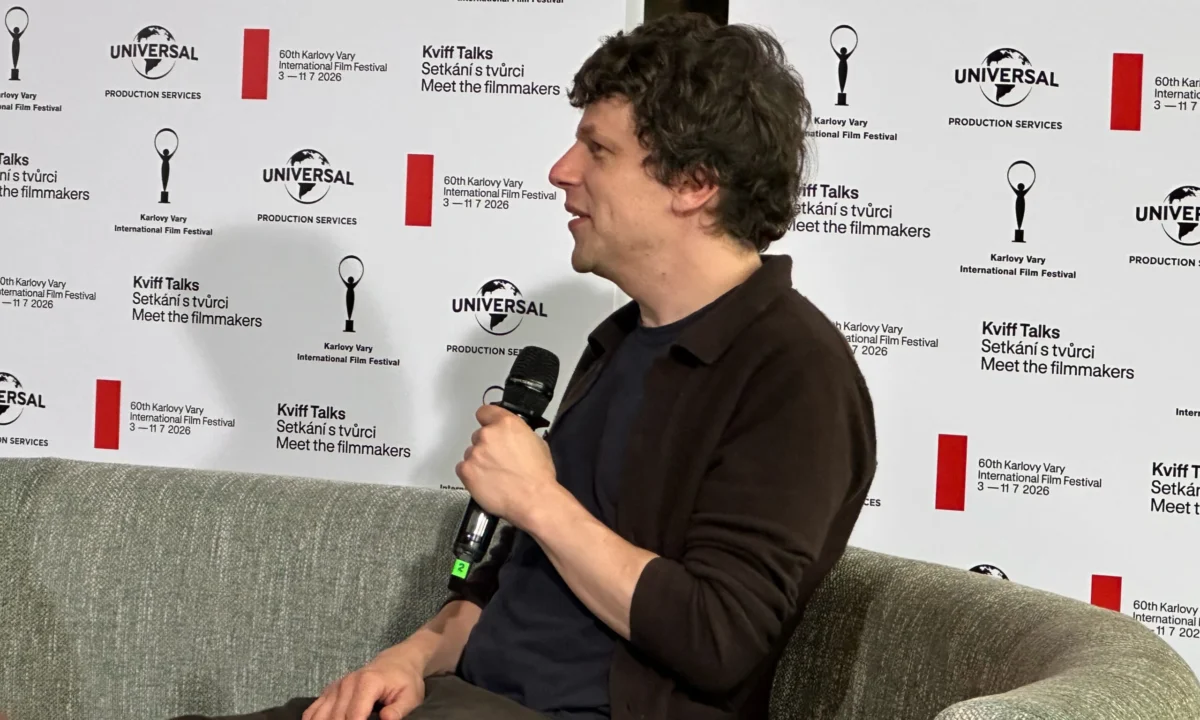
Karlovy Vary, Czech Republic – In a candid and thought-provoking session at the Karlovy Vary International Film Festival (KVIFF) on Saturday, acclaimed actor, writer, and director Jesse Eisenberg offered an unvarnished assessment of Mark Zuckerberg, the Meta Platforms chairman and CEO he famously portrayed in David Fincher’s 2010 film The Social Network. Eisenberg articulated a profound personal disassociation from the tech magnate and the digital empire he built, revealing his deep discomfort with social media and its architects, while also reflecting on his own career trajectory and life’s most profound experiences. His remarks were a highlight of the festival, known for its blend of cinematic excellence and engaging public discourse.
The Genesis of a Character: Zuckerberg and The Social Network
Eisenberg’s portrayal of Mark Zuckerberg in The Social Network remains one of his most iconic and critically lauded roles. The film, directed by David Fincher and written by Aaron Sorkin, chronicled the founding of Facebook and the ensuing legal battles. Released in 2010, it garnered immense critical acclaim, winning three Academy Awards (Best Adapted Screenplay, Best Original Score, Best Film Editing) and receiving nominations for eight others, including Best Picture and Best Actor for Eisenberg. At the time of the film’s production and release, Zuckerberg, though undeniably influential within the tech world, had not yet achieved the omnipresent global recognition and often controversial public profile he holds today.
Recalling the experience at the KVIFF Talk, Eisenberg explained, "He wasn’t very well-known at the time, so the movie seemed like such a strange thing to make because no one really knew who he was… He wasn’t in the public eye a lot, so it was more just an interesting character." This perspective underscores the initial artistic appeal of the role – the opportunity to delve into the psyche of a complex, brilliant, and somewhat enigmatic figure before he became a household name synonymous with a global digital revolution. The film presented Zuckerberg as a socially awkward but intellectually formidable visionary, driven by a desire for connection that ironically led to isolation and legal disputes. Its narrative explored themes of ambition, betrayal, and the nascent impact of social networking on human relationships, all set against the backdrop of Harvard University and Silicon Valley’s explosive growth.
A Deep Dive into Disassociation: Eisenberg’s Stance on Meta
However, the passage of over a decade has dramatically altered both Zuckerberg’s public persona and Eisenberg’s feelings about the association. Facebook, now Meta Platforms, has evolved into a global behemoth with billions of users across its various platforms (Facebook, Instagram, WhatsApp, Messenger). This growth has come hand-in-hand with escalating scrutiny and controversy, ranging from data privacy scandals like Cambridge Analytica, to concerns over misinformation, hate speech, and the platform’s impact on mental health and democratic processes. Zuckerberg himself has transitioned from a relatively reclusive founder to a prominent, often embattled, public figure frequently testifying before Congress and facing international criticism.
It is against this backdrop that Eisenberg’s current views have hardened. "Things have changed since then," he observed at KVIFF. "I thought of it like an interesting character, and then he’s become famous, and now I don’t want to do the movie because they’re doing a new movie. But I don’t want to be associated with him anymore, because I don’t really like the comparison." The "new movie" Eisenberg refers to is likely a potential sequel or a new project exploring the later stages of Facebook’s history, a concept that has been periodically discussed in Hollywood given the platform’s continued evolution and controversies. For Eisenberg, the comparison between himself and the character, or by extension, the real-life Zuckerberg, has become unwelcome.
His critique extended beyond mere discomfort, delving into a moral assessment of Meta’s founder. "I see that the person who created this website is not a person who cares about people. If this guy is the creator of this world, I don’t want to live in that world," Eisenberg declared, delivering a potent condemnation of what he perceives as a fundamental disregard for human well-being in the pursuit of digital connectivity and, implicitly, profit. This statement reflects a growing sentiment among critics of big tech, who argue that the foundational principles of some social media platforms prioritize engagement and data collection over user welfare. Eisenberg’s strong words resonate with widespread public anxieties about the pervasive influence of social media on society, mental health, and political discourse. His evolution from an actor portraying a character to a public figure expressing profound ethical concerns about the real-life individual and his creation highlights the complex relationship between art, reality, and public perception in the digital age.
The Personal Reckoning: A Life Without Social Media
Eisenberg’s disassociation from Zuckerberg and the "world" he created is deeply rooted in his personal philosophy and a staunch refusal to participate in social media himself. He is notably absent from platforms like Facebook, Instagram, and X (formerly Twitter), a rare stance for a public figure in an era where digital presence is often deemed essential for career management and fan engagement.
Explaining his decision, Eisenberg stated, "I talk about myself so much, it’s not healthy. I’m not on any of that stuff. All that stuff scares me so much – Facebook or social media, Twitter, whatever. Already, I feel humiliated to be in public talking about myself. It’s disgusting, so I’m not going to say, ‘Hey, I drank this water.’ All that stuff terrifies me." This candid confession offers insight into the actor’s profound discomfort with self-promotion and the often-trivializing nature of sharing personal minutiae online. For Eisenberg, the very act of discussing his work publicly at events like KVIFF is already a challenge to his sense of privacy and humility. The constant, curated self-representation demanded by social media, with its pressure to share every detail, appears to be anathema to his personal values.
His sentiment taps into a broader cultural conversation about the mental health implications of social media, including issues of self-esteem, anxiety, and the performance of identity. Many individuals, both public figures and private citizens, echo Eisenberg’s fear of the constant surveillance, judgment, and the potentially addictive nature of these platforms. His choice to opt out is not merely a preference but a deeply held conviction, positioning him as a voice for a growing segment of the population wary of the digital sphere’s pervasive influence. In a world increasingly dominated by online interactions, Eisenberg’s deliberate absence from social media platforms serves as a powerful statement, reinforcing his critical perspective on the technologies that have redefined modern communication.
Beyond the Screen: Reflections on Life’s "Magic"
The KVIFF Talk, a popular feature of the festival designed to offer fans intimate discussions with leading industry figures, also delved into more personal territory. During one of the final questions of his appearance, a fan inquired if Eisenberg had ever experienced anything that felt magical or that he couldn’t logically explain. His response was unexpectedly frank and poignant, providing a rare glimpse into his inner life.
"I took acid once," he replied, disarming the audience with his directness. "And I remember thinking, ‘I’m on the floor, and I can’t move.’ And I said to my friend, who was a more regular user of it: ‘Is this normal?’ And he said, ‘No, you should be able to move.’" This humorous anecdote, while revealing a past experimental phase, quickly transitioned to a more profound reflection. Eisenberg then connected this intense, disorienting experience with another, far more conventional, yet equally transformative, aspect of his life: fatherhood.
"And then also having a child," he concluded, bringing his answer to a deeply personal and resonant point. "I guess between taking the Acid and bringing life into this world and nurturing it through happiness and hard times are the two most special experiences of my life." This juxtaposition of a psychedelic experience with the profound, enduring journey of parenthood offers a unique insight into what Eisenberg defines as truly "magical" – moments that defy ordinary explanation and fundamentally alter one’s perception of reality and self. It highlights his capacity for introspection and his willingness to share vulnerable, authentic moments with his audience, further cementing his image as an artist deeply engaged with the human condition beyond the confines of his professional roles. This unexpected revelation added a layer of human depth to a discussion that began with technological critique, underscoring the KVIFF Talk’s ability to foster genuine and memorable exchanges.
A Day of Honors at Karlovy Vary: The President’s Award and Beyond
Jesse Eisenberg’s insightful KVIFF Talk capped off an already busy and distinguished day at the Karlovy Vary International Film Festival. Earlier in the late morning, he was bestowed with the festival’s prestigious President’s Award, an honor recognizing significant contributions to world cinema. The award ceremony was followed by a special screening of The Double, the 2013 black comedy-drama directed by Richard Ayoade, in which Eisenberg delivered a standout dual performance as a meek government clerk and his confident doppelgänger. This role, showcasing his versatility and unique comedic timing, further solidified his reputation as an actor capable of nuanced and compelling character work.
The President’s Award is a testament to Eisenberg’s prolific and varied career, which includes acclaimed performances in films such as Zombieland, Now You See Me, Louder Than Bombs, and his recent ventures into writing and directing, including When You Finish Saving the World (2022) and the upcoming A Real Pain (2024), which premiered at Sundance to critical acclaim. His receipt of the award underscores the festival’s recognition of his ongoing artistic evolution and impact on contemporary cinema.
KVIFF: A Legacy of Cinematic Celebration and Dialogue
Eisenberg’s participation and honors are part of a larger celebration at the Karlovy Vary International Film Festival, which is marking a double anniversary this year: its 60th edition in the 80th year of the Czech fest’s existence. Established in 1946, KVIFF is one of the oldest and most respected film festivals globally, holding a coveted "Class A" accreditation from the International Federation of Film Producers Associations (FIAPF), placing it alongside festivals like Cannes, Venice, and Berlin. Its historical significance is particularly notable, having served as a crucial cultural bridge during the Cold War era, showcasing both Eastern and Western European cinema. In the post-1989 landscape, KVIFF has revitalized its mission, becoming a vibrant hub for independent film, emerging talent, and critical discussion, retaining its reputation as a major cultural event in Central Europe.
The 2024 edition, running from July 3rd to July 11th, has drawn a host of international stars and filmmakers, reinforcing its status as a premier cinematic event. The festival’s opening night ceremony saw other legendary figures recognized for their enduring impact. Dustin Hoffman, the iconic star of The Graduate, Kramer vs. Kramer, and Rain Man, was honored with the Crystal Globe for Outstanding Artistic Contributions to World Cinema. Maggie Gyllenhaal, celebrated for her roles in films like The Lost Daughter (which she also directed) and Secretary, received her own President’s Award, acknowledging her significant and versatile career. Veteran actor Harvey Keitel, known for his roles in classics such as Mean Streets, Taxi Driver, and Reservoir Dogs, was also among the famous names gracing the festival’s expanded red carpet in the picturesque Czech spa town, adding to the glamorous and star-studded atmosphere. These accolades collectively highlight KVIFF’s commitment to celebrating both established masters and contemporary talents, fostering an environment rich in cinematic appreciation and intellectual exchange.
The Artist-Director’s Vision: Jesse Eisenberg’s Future Endeavors
Beyond his acting career, Jesse Eisenberg has increasingly diversified his artistic output, venturing successfully into writing and directing. His directorial debut, When You Finish Saving the World, starring Julianne Moore and Finn Wolfhard, premiered at the 2022 Sundance Film Festival, exploring themes of generational disconnect and online performance. His latest project as a writer and director, The Debut, further exemplifies this creative expansion. The film is set to star an impressive ensemble including Julianne Moore and Paul Giamatti, signaling a continued collaboration with high-caliber talent.
Uniquely, Eisenberg has also taken on the role of composer and lyricist for the musical-within-the-movie segment of The Debut, showcasing a multifaceted artistic talent that extends beyond performance and narrative construction. This ambitious undertaking underscores his commitment to exploring diverse creative avenues and bringing deeply personal projects to fruition. The Debut is slated for a fall release by A24, a production and distribution company renowned for its critically acclaimed and often idiosyncratic independent films, suggesting that Eisenberg’s directorial vision aligns with a distinctive, artist-driven approach to filmmaking. His burgeoning career as a hyphenate filmmaker positions him as a significant voice in contemporary independent cinema, willing to tackle complex themes and experiment with form, much like his candid remarks at KVIFF suggest a willingness to engage with pressing societal issues.
Broader Implications: The Actor, The Algorithm, and Public Perception
Jesse Eisenberg’s forthright comments at Karlovy Vary offer more than just a personal opinion; they contribute to a broader cultural dialogue about the ethics of technology, the responsibility of its creators, and the impact of digital platforms on individual and societal well-being. His journey from portraying a nascent tech visionary to becoming one of his most outspoken critics reflects a growing disenchantment among many with the promises and realities of the digital age.
The implications of an actor disavowing a role due to the real-life evolution of the character’s subject are significant. It highlights the complex relationship between artistic representation and real-world consequences, challenging the notion that a performance exists in a vacuum. For Eisenberg, the comparison to Zuckerberg has become a burden, signifying not merely a role, but an unwitting endorsement of a "world" he finds ethically problematic. This stance could influence how other actors approach roles based on controversial real-life figures, prompting deeper considerations of the long-term associations they might incur.
Furthermore, Eisenberg’s personal rejection of social media resonates with an increasing number of individuals seeking to disconnect or limit their digital presence. His articulate explanation provides a voice for those who feel overwhelmed or repulsed by the demands of online self-presentation and the perceived superficiality of digital interactions. In an era where digital footprints are often seen as inescapable, Eisenberg’s deliberate choice to remain offline serves as a powerful counter-narrative, advocating for a more private, intentional mode of existence.
Ultimately, Eisenberg’s appearance at KVIFF transcended a typical festival Q&A. It became a platform for an actor to grapple publicly with the ethical dimensions of his most famous role, to express profound disquiet about the prevailing digital culture, and to share deeply personal reflections on life’s most transformative moments. His candidness not only enriched the festival’s dialogue but also underscored the evolving role of artists as commentators on the societal forces that shape our modern world, prompting audiences to critically re-evaluate their own relationship with technology and the "worlds" they choose to inhabit.