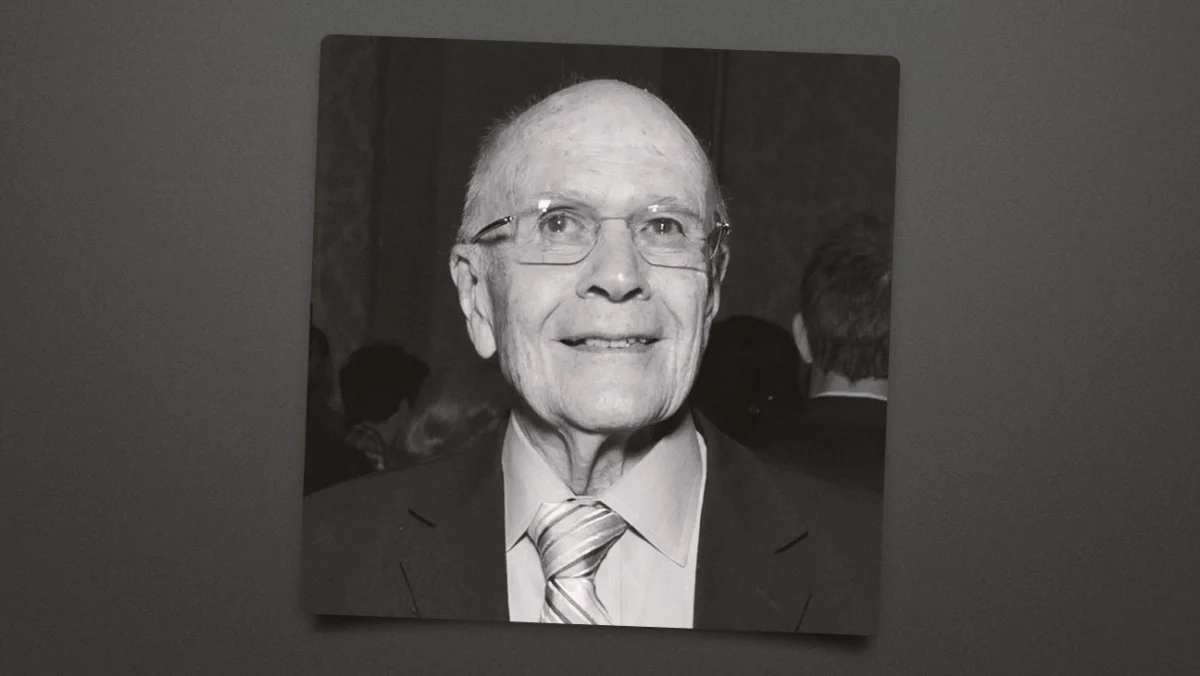
Dixon Q. Dern, a foundational figure in the evolution of entertainment law and a strategic architect behind the business operations of the most influential production companies in television history, has died at the age of 97. His passing, which occurred on Sunday at his residence in Los Angeles, was confirmed by a spokesperson for WME. Dern’s career spanned the transition of television from a nascent medium to a global economic powerhouse, and his legal fingerprints can be found on the contracts and business models that defined the industry’s "Golden Age" and beyond.
Representing a roster of icons that included Lucille Ball, Desi Arnaz, Bob Hope, and Jackie Gleason, Dern was more than a legal counselor; he was a structural engineer of Hollywood’s financial ecosystem. He is perhaps best remembered for his pivotal role at Desilu Productions, where he helped formalize the business affairs that turned television syndication into a sustainable and wildly lucrative economic model. His influence extended into the modern era of talent representation through his instrumental role in the formation of Creative Artists Agency (CAA) in the mid-1970s.
The Desilu Revolution and the Birth of Syndication
Dixon Dern’s tenure as general counsel for Desilu Productions, beginning in 1962, placed him at the center of a seismic shift in how television was produced and monetized. At the time, Desilu was the premier independent production house in Hollywood, responsible not only for the enduring legacy of I Love Lucy but also for a slate of high-octane hits including The Untouchables, Mission: Impossible, and Star Trek.
Under the leadership of Lucille Ball and Desi Arnaz, Desilu pioneered the use of high-quality 35mm film for television production. Dern’s legal expertise was critical in navigating the rights and distribution frameworks for these filmed programs. Before this era, much of television was broadcast live or recorded via low-quality kinescopes, offering little value for future broadcasts. By securing ownership of the physical negatives and structuring distribution deals that favored the production company over the networks, Dern helped establish the concept of the "off-network" rerun.
This shift created the television syndication market, an enduring economic engine that allowed shows to be sold to individual stations after their initial network runs. This model fundamentally changed how programming was financed, shifting the risk and reward balance and allowing independent producers to build massive libraries of intellectual property. Analysts often point to this period as the moment television transitioned from a service industry to an asset-based industry, with Dern’s contracts serving as the blueprint.
The 1975 CAA Breakaway: A Pivotal Moment in Talent Representation
In 1975, the landscape of Hollywood talent representation was dominated by the William Morris Agency. However, five young agents—Michael Ovitz, Ron Meyer, Michael Rosenfeld, Rowland Perkins, and Bill Haber—decided to break away to form their own firm, which would become Creative Artists Agency (CAA).
Recognizing the need for a seasoned legal mind to navigate the complex and potentially litigious transition, the "Young Turks" of CAA approached Dixon Dern. They requested that he not only represent the new agency but also serve as a critical mediator in the transfer of high-profile clients from William Morris to CAA.
"They asked me if I would represent CAA and more importantly serve as a sort of go-between on the shift of clients from William Morris that would follow them," Dern recalled in a 2009 interview for the Television Academy Foundation. His participation provided the fledgling agency with immediate professional credibility and a steady hand during one of the most contentious periods in the history of the talent business. His work during this time helped usher in the era of the "super-agency," which redefined how packages were put together and how stars negotiated their deals.
A Legacy Built on Professionalism and Legal Precision
Born on January 24, 1929, in Colorado Springs, Dixon Quackenbush Dern’s entry into the world was marked by a then-uncommon circumstance: he was adopted by a single woman, a fact his family noted as a rare occurrence for the era. His academic journey led him to Stanford University in 1946, where he earned both his undergraduate and law degrees. He was admitted to the California Bar in 1954, just as the Los Angeles entertainment industry was beginning its post-war boom.
Dern’s early career provided a comprehensive education in the various facets of the industry. He began as an in-house attorney for UPA (United Productions of America), the animation studio famous for Mr. Magoo and The Gerald McBoing-Boing Show. This role gave him early exposure to the intricacies of character rights and animation licensing.
From UPA, he moved to CBS, then known as the "Tiffany Network" for its high-quality programming. At CBS, Dern moved beyond standard employment contracts to work directly on the production side for landmark series such as the legal drama Perry Mason and the Western Rawhide. This experience inside a major network legal department provided him with a unique perspective on the tension between network demands and creative production needs—a perspective that would make him an invaluable asset when he joined Desilu in 1962.
Private Practice and the Representation of Icons
After leaving Desilu in 1965 and a subsequent stint running business and legal affairs at United Artists Television, Dern transitioned into private practice. As a founding partner of Dern, Mason, Swerdlow & Floum, he built one of the most respected boutique law firms in Los Angeles.
His client list read like a "Who’s Who" of 20th-century entertainment. Beyond the Arnaz and Ball families, he represented:
- The Jackson 5: Navigating the group’s legal affairs during their meteoric rise at Motown and their subsequent transition to Epic Records.
- Bob Hope: Managing the complex business interests and intellectual property of one of the world’s most prolific entertainers.
- Jackie Gleason: Handling the contractual nuances for the man known as "The Great One" during his various television iterations.
- The Television Academy: Providing long-term legal guidance to the organization responsible for the Emmy Awards.
Dern was also a sought-after arbitrator and mediator. His deep understanding of labor disputes and entertainment law made him a neutral party whose opinions were frequently cited as industry standards. His leadership extended to professional organizations, where he served as president of the Beverly Hills Bar Association and the Los Angeles Copyright Society, as well as holding high-ranking positions within the State Bar of California and the Los Angeles County Bar Association.
Recognition and Personal Life
In 2009, the Television Academy recognized Dern’s decades of service with the Syd Cassyd Founders Award. This honor is reserved for individuals who have made a significant, positive impact on the Academy through years of dedicated service. The award highlighted not just his legal acumen, but his commitment to the health and longevity of the television community as a whole.
Beyond the boardroom and the courtroom, Dern was known for a wide range of personal interests. He was a passionate aficionado of the opera, an avid reader, and a follower of political discourse. Perhaps most surprisingly for a high-powered Hollywood lawyer, he was a dedicated square dancer.
Dern was also deeply committed to his personal journey of recovery. His family noted that he was incredibly proud of his 50 years of continuous sobriety and was a devoted member of the Alcoholics Anonymous (AA) community, where he mentored others and found a sense of purpose outside of his professional achievements.
Impact and Industry Analysis
The death of Dixon Q. Dern marks the end of an era for the "architects" of the modern television business. While directors, writers, and actors often receive the public accolades, it was lawyers like Dern who built the scaffolding that allowed those creatives to thrive and profit.
His contribution to the "syndication model" cannot be overstated. In the current era of streaming and digital distribution, the industry is undergoing another fundamental shift in how content is valued. However, the principles Dern helped establish—residual payments, backend participation, and the long-term value of a content library—remain the bedrock of current labor negotiations and corporate mergers.
Furthermore, his role in the birth of CAA serves as a reminder of the importance of legal mediation in industry disruption. By facilitating the orderly transition of talent during a period of corporate rebellion, Dern helped ensure that the talent-agency model could evolve without collapsing under the weight of litigation.
Dixon Q. Dern was preceded in death by his wife, Lisa Dunn-Dern, who passed away in 2016. He is survived by his five children—Chelsea, Warren, Peter, Rosalin, and Greg Dern—as well as five grandchildren and several great-grandchildren. He will be interred alongside his wife at Forest Lawn Hollywood Hills, a final resting place shared by many of the icons whose careers he helped build and protect. His legacy remains etched in the very structure of the entertainment industry, a testament to a career defined by integrity, innovation, and an unwavering commitment to the rule of law in the world of make-believe.