Andrei Tarkovsky’s 1983 film, "Nostalghia," emerges as a profound cinematic exploration of alienation and the elusive quest for belonging, its title encapsulating a yearning that transcends mere temporal or spatial displacement. It speaks to a deep-seated existential dissatisfaction, a profound anguish stemming from the perceived inadequacy of the present moment. This cinematic poem, rich in imagery, draws significantly from the lyrical works of the director’s father, the distinguished poet Arseny Tarkovsky, whose verses are woven into the very fabric of the film.
The narrative centers on Andrei (Oleg Yankovsky), a Russian scholar in Italy to immerse himself in the life and travels of Pavel Sosnovsky, a fictional Russian composer who purportedly journeyed to Italy before succumbing to an overwhelming homesickness that led to his return to his homeland. Andrei’s path intersects with Eugenia (Domiziana Giordano), his beautiful and flirtatious interpreter. Their dynamic is immediately established when Eugenia, engrossed in an Italian translation of Arseny Tarkovsky’s poetry, is coldly admonished by Andrei to discard the book, his pronouncement echoing the sentiment that "Poetry is untranslatable, like the whole of art." This assertion, however, carries a poignant irony, as "Nostalghia" itself can be viewed as a translation—a cinematic rendering of Tarkovsky’s artistic vision, co-written with the venerable Italian screenwriter Tonino Guerra, a celebrated collaborator of cinematic giants like Federico Fellini and Michelangelo Antonioni. Guerra, whose prolific career in European cinema spanned decades until his passing in 2012, embodied the spirit of cross-cultural artistic dialogue that Tarkovsky’s film both engages with and questions.
Andrei’s spiritual pilgrimage through Italy, mirroring Sosnovsky’s supposed itinerary, leads him to the Tuscan spa town of Bagno Vignoni, a locale steeped in history and frequented by figures like Saint Catherine. Upon arrival, he appears to be paralyzed by an emotional breakdown, his inner world consumed by a silent, introspective dialogue. This internal turmoil manifests in stark, monochrome dreams and memories of his family back in Russia, underscoring his profound sense of displacement. His reticence and gloomy disposition frustrate Eugenia, who finds herself increasingly drawn to him, sensing a potential for a connection that remains elusive. A pivotal moment occurs when Eugenia, compelled by an unnamed force, visits a local church and shrine alone, where she witnesses a surreal spectacle: birds taking flight from the breast of a statue of the Blessed Virgin Mary. This event, imbued with symbolic weight, hints at a spiritual awakening or revelation that Andrei, in his current state of desolation, seems unable to access.
Further complicating Andrei’s journey is his encounter with Domenico (Erland Josephson), a local man widely regarded as a "lunatic." Domenico, a figure of monkish severity and unnerving calm, is notorious for having imprisoned his wife and children within his home, believing he was shielding them from an imminent apocalypse. Now, his singular conviction is that the salvation of humanity hinges on his ability to carry a lit candle across the town’s thermal baths without its flame extinguishing. Andrei finds himself strangely captivated by Domenico, his fascination extending to a conflation of Domenico’s perceived familial trauma with his own memories of home. Eugenia offers a pragmatic, Western European interpretation of Domenico’s condition, attributing it to the closure of Italy’s asylums. However, the film suggests a deeper, more resonant resonance with the archetypal Russian figure of the "holy fool" or the "wanderer"—the impoverished soul who embodies Christ-like suffering and demands compassion. In stark contrast, Eugenia embodies a more conventional Western European sensibility: a woman of passion and sexual adventurousness, increasingly exasperated by Andrei’s emotional unavailability and entangled with a criminal boyfriend in Rome.

The Shifting Landscape of the Soul and the World
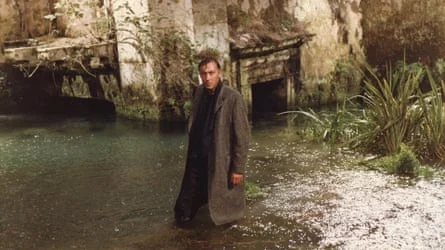
The film’s narrative arc takes a dramatic turn in its third act, mirroring the structural shifts found in Tarkovsky’s earlier masterpiece, "Ivan’s Childhood." The serene, bucolic Italian countryside gives way to the bustling, cacophonous metropolis of Rome. This transition from intimate introspection to the overwhelming sensory experience of a modern city serves to heighten Andrei’s sense of alienation, forcing him to confront his inner demons amidst a world that seems indifferent to his plight. Yet, the narrative ultimately circles back to Bagno Vignoni. By the time Andrei returns, the once-vibrant thermal baths have mysteriously dried out. This ecological and symbolic desiccation—"is this the end of the world?"—sets the stage for Andrei’s ultimate, agonizing endeavor: the long, arduous process of attempting to traverse the barren baths with a lit candle, a ritualistic act of faith or defiance in a seemingly godless landscape.
The Absence of God and the Echoes of Faith
"Nostalghia," much like Tarkovsky’s subsequent film, "The Sacrifice," grapples profoundly with the theme of the absence of God. Domenico’s act of familial imprisonment, driven by a doomsday prophecy, is presented not as a moment of outright madness, but perhaps as a desperate, albeit misguided, attempt to avert a catastrophe he perceived. The film leaves open the chilling possibility that his family emerged from their confinement into a world that had indeed ended—a world where faith had evaporated, and divine presence was no longer recognized. The drying of the baths serves as a powerful metaphor for this spiritual drought. The once-life-giving waters, analogous to divine grace, have drained away, leaving exposed the stark, unflattering realities of existence: the "bulbous, dirty and ugly shapes of the walls and floor" and the "rickety steps." It is a starkly poignant and melancholic portrayal of a world stripped bare of its spiritual foundations.
Cinematic Context and Tarkovsky’s Vision
Released in 1983, "Nostalghia" marked a significant moment in Andrei Tarkovsky’s career. Having left the Soviet Union in 1980, this was his first feature film made outside his native country, a testament to his burgeoning international recognition and his struggle to maintain artistic freedom. The film’s themes of exile, displacement, and the search for spiritual grounding resonated deeply with Tarkovsky’s personal experiences. His collaboration with Tonino Guerra, an Italian screenwriter known for his poetic and existential approach to filmmaking, proved instrumental in shaping the film’s unique blend of Russian soulfulness and Italian landscape. Guerra’s previous work with Antonioni, particularly his contributions to films like "L’Avventura" and "Blow-Up," which explored themes of alienation and existential ennui in modern Italian society, provided a fertile ground for Tarkovsky’s own philosophical inquiries.
The film’s visual language, characterized by long takes, deliberate pacing, and a meticulous attention to detail, is quintessential Tarkovsky. His use of natural light, water, and decaying structures creates a palpable atmosphere of introspection and melancholic beauty. The recurring motif of dreams and memory blurs the lines between subjective experience and objective reality, inviting the viewer to engage with Andrei’s internal landscape. The film’s critical reception was largely positive, with many critics recognizing it as a powerful and deeply personal work that continued Tarkovsky’s exploration of profound existential questions. While some found its deliberate pace challenging, others lauded its artistic ambition and its unflinching portrayal of the human condition.
Thematic Resonance and Enduring Impact
"Nostalghia" continues to resonate with audiences for its timeless exploration of fundamental human desires: the longing for connection, the pain of isolation, and the search for meaning in a world that often feels indifferent or overwhelming. The film’s ambiguous ending, with Andrei’s candlelit journey across the barren baths, offers no easy answers but instead invites contemplation on the nature of faith, perseverance, and the enduring human spirit in the face of existential doubt. It is a film that demands patience and reflection, rewarding viewers with a profound and unforgettable cinematic experience that lingers long after the credits roll. The legacy of "Nostalghia" lies not only in its artistic achievements but also in its powerful testament to the enduring human quest for something more, a yearning for a completeness that often feels just beyond reach.