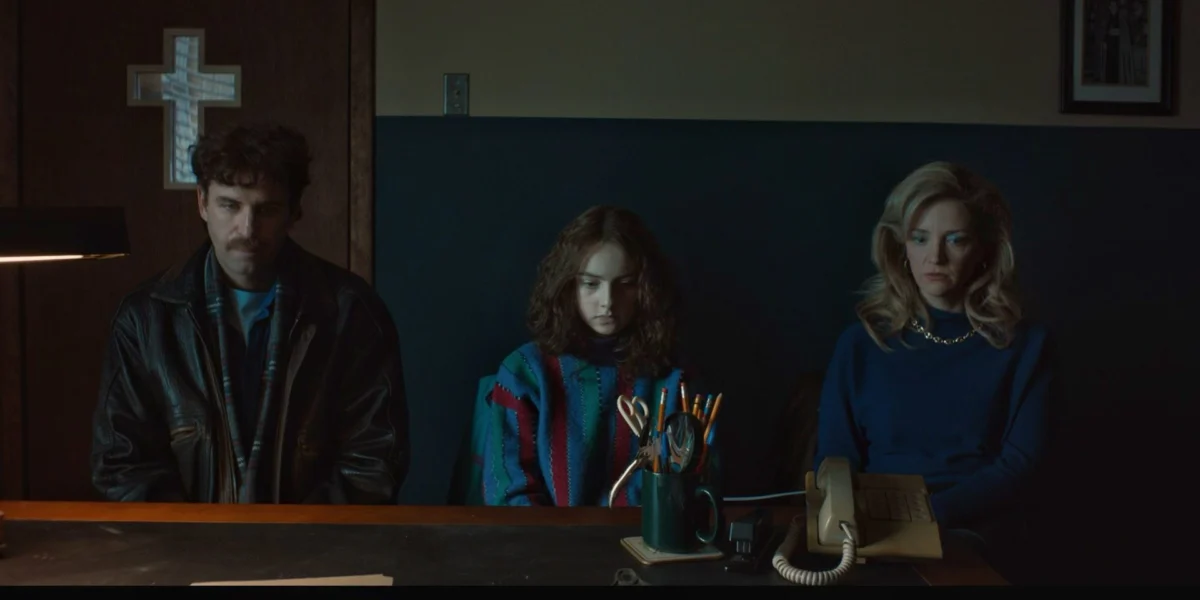
The cinematic landscape of the coming-of-age genre frequently revisits the turbulent terrain of the 1980s, yet few recent independent releases navigate the intersection of domestic upheaval and institutional faith with the nuanced restraint found in the feature film Purgatory. Directed by Lindsay Lanzillotta and penned by screenwriter Christine Speer, the 104-minute feature presents a sharply observed portrait of suburban disintegration viewed through the unvarnished perspective of a thirteen-year-old girl. Anchored by a breakout central performance from newcomer Ruby McGurrin alongside an established supporting cast that includes J.K. Simmons, Abby Elliott, and John Reynolds, the film has drawn attention for its tonal equilibrium, successfully balancing acute melancholia with disarming suburban comedy.
At its core, Purgatory examines the sudden fracturing of a seemingly stable household when maternal self-actualization disrupts the predictable rhythms of 1980s domesticity. While the narrative occasionally stumbles in its distribution of character perspectives, the resulting work offers a substantive exploration of how children process institutional and familial hypocrisy, earning a notable place within contemporary independent cinema.
Narrative Premise and Main Facts
The foundational premise of Purgatory rests on a seismic shift within a traditional suburban family unit during the early 1980s. Thirteen-year-old Beatrice, portrayed with confident precision by McGurrin in her feature film debut, exists within the tightly regulated confines of suburban Catholic life. Her worldview is immediately established in the film’s opening sequence, wherein she unburdens her adolescent grievances to her parish priest, played with grounded authority by J.K. Simmons. These confessions range from petty schoolyard resentments—such as a teacher mispronouncing her name as "Beat-Rice"—to a generalized, deep-seated anxiety regarding impending changes, most notably an upcoming Catholic summer camp and the natural transitions of growing up.
The central conflict ignites when Beatrice and her younger sister, Chloe (played with sharp comedic timing by Lauren MacRae), return home from camp to discover that their parents have initiated a divorce. Their mother, Marianne (Abby Elliott), has abruptly moved out of the family home. Marianne’s departure is driven by a desire to self-actualize—a pursuit she justifies by reflecting on her early marriage and young motherhood. This decision sends shockwaves through the household, forcing Beatrice, Chloe, and their bewildered father, Joe (John Reynolds), to navigate an unfamiliar domestic landscape defined by absence and inept adaptation.
The film’s runtime of 104 minutes is utilized to explore the immediate fallout of this separation. Director Lanzillotta and writer Speer construct scenes that juxtapose sorrow with deadpan humor, such as a hastily arranged, off-key flute-scored toilet funeral for a fish purchased to soften the blow of the divorce, immediately followed by Joe serving dry fish sticks for dinner—an evocative visual shorthand for a father entirely unequipped for the emotional demands of his new reality.
Chronology and Structural Progression
The structural trajectory of Purgatory follows a deliberate chronology that mirrors Beatrice’s internal resistance to change. The narrative timeline can be segmented into distinct phases that dictate the emotional tenor of the film:
- The Status Quo Ante: The film opens with Beatrice’s confession, establishing her reliance on religious structures to process minor grievances and her acute dread of upcoming life transitions, including summer camp.
- The Disruption: The sisters’ departure to camp coincides with the finalization of their parents’ separation. Marianne vacates the premises, leaving Joe and the domestic space in a state of immediate, bewildered disarray.
- The Return and Resistance: Beatrice and Chloe return to a disrupted home environment. Beatrice immediately initiates a campaign of denial, attempting to force the family dynamic back to its pre-separation normal through classic intervention strategies.
- The Crisis of Faith: As Beatrice observes the widening gap between the moral doctrines preached by adults and the hypocritical realities of their behavior—exemplified by both her parents and the church hierarchy—she experiences a profound institutional and personal disillusionment.
- The Resolution of Acceptance: The narrative culminates not in a neat comedic reunion à la The Parent Trap, but in a sobering acceptance of ambiguity, guided by the parish priest’s counsel that neither parents nor religious institutions are infallible.
Supporting Data and Production Details
From a production standpoint, Purgatory relies on a carefully curated ensemble cast and a restrained creative approach to maintain its atmospheric authenticity. The film’s technical specifications and personnel metrics highlight its indie pedigree:
- Purgatory
- Running Time: 104 Minutes
- Director: Lindsay Lanzillotta
- Screenwriter: Christine Speer
- Principal Cast: Ruby McGurrin (Beatrice), Abby Elliott (Marianne), John Reynolds (Joe), Lauren MacRae (Chloe), J.K. Simmons (Parish Priest), alongside Jack Innanen, Mary Walsh, Marcus Ngo, Gemma Rosaria Rae, and Julianne Arrieta.
- Setting: Early 1980s suburban milieu, characterized by period-accurate production design and a subtle, understated musical score that underscores the narrative’s tonal shifts.
The film’s data-driven reception points to McGurrin’s performance as its most significant asset. Critics and audiences alike have highlighted her ability to convey complex emotional states—ranging from incandescent rage to stubborn, performative optimism—without resorting to melodramatic artifice. Furthermore, the supporting dynamics, particularly the rapport between McGurrin and Simmons, provide a stable narrative anchor that prevents the suburban comedy from overshadowing the underlying emotional stakes.
Analytical Perspective: Character Development and Screen Time Allocation
A critical evaluation of Purgatory reveals distinct strengths in its atmospheric and thematic execution, alongside minor structural imbalances. The most prominent analytical critique centers upon the treatment of Marianne, the mother who initiates the familial rupture. Marianne’s motivation—marrying young, having children early, and subsequently seeking personal identity through self-actualization—is handled with commendable sympathy. The screenplay acknowledges the dual nature of her choice: it is simultaneously an act of personal liberation and a profound disruption for her dependents, capturing the evolving discourse surrounding motherhood in the 1980s.
However, from a narrative architecture perspective, Marianne’s character suffers from insufficient screen time. The script pivots immediately to the aftermath of her departure, leaving the audience to experience her motivations almost entirely secondhand through the lens of Beatrice’s anger, confusion, and grief. A more balanced distribution of scenes detailing Marianne’s internal calculus prior to her exit might have enriched the emotional depth of the film, preventing the move from feeling overly abrupt.
Despite this limitation, the film excels in its exploration of hypocrisy and double standards. The script demonstrates keen observational insight when depicting adults who routinely violate the very behavioral codes they impose on their children. When Beatrice attempts to utilize the sacrament of confession to manage her escalating rage, her eventual declaration to the priest that she no longer wishes to be Catholic serves as a natural extension of her disillusionment.
Simmons’ character provides a crucial thematic counterweight. Rather than offering platitudes or enforcing dogmatic compliance, the priest acknowledges the systemic flaws inherent in both parental figures and religious frameworks. His response does not offer a simplistic resolution; instead, it demands that Beatrice cultivate emotional resilience, learning to coexist with imperfection in much the same way she is forced to accept the dissolution of her parents’ marriage.
Broader Impact, Themes, and Cultural Resonance
The broader implications of Purgatory extend into its deft utilization of metaphor, most notably encapsulated in its title. The theological concept of purgatory—frequently understood as a transitional state of suffering and waiting—serves as an apt structural metaphor for a family unit caught in administrative and emotional limbo, existing between a marriage that has disintegrated and a divorce that lacks finality.
While the narrative hints at a classic comedic trope—specifically, Beatrice’s aborted scheme to orchestrate a parental reconciliation reminiscent of traditional cinematic tropes—it intentionally subverts this expectation in favor of a more grounded resolution. This narrative choice reinforces the film’s commitment to realism over Hollywood artifice.
By addressing the collision between childhood idealism and adult frailty, Purgatory secures its position within the canon of substantive coming-of-age cinema. It avoids the nostalgic gloss frequently applied to the 1980s, opting instead to dissect the quiet fractures that occurred behind closed suburban doors. Through its synthesis of understated humor, sharp performances, and unflinching emotional honesty, the film offers a resonant study of endurance, disillusionment, and the arduous process of growing up when the foundational structures of one’s world give way.