The economic realities of the funeral industry have long served as fertile ground for dark comedy, but rarely has a film approached the subject with the logistical pragmatism seen in director Ron Murphy’s satirical feature, Back in Black. Set within an idyllic, wellness-obsessed Canadian municipality where modern safety standards, seatbelt laws, and organic diets have brought the natural mortality rate to a near-zero standstill, the 92-minute production follows a struggling mortician facing imminent bankruptcy. Faced with empty viewing rooms and rising overhead costs, the family business is rescued through an unexpected and deeply illicit enterprise orchestrated by the proprietor’s teenage granddaughter, who takes it upon herself to stimulate local demand through a series of manufactured accidents.
Filmed largely on location in the picturesque Niagara Falls region of Ontario, the production marks a notable cinematic pivot for Murphy, whose previous directorial credits include multiple episodes of the irreverent and chaotic mockumentary series Trailer Park Boys. Co-written alongside screenwriter Nick Torokvei, Back in Black balances a delicate tightrope walk between preposterous premise and satirical social commentary. Anchored by a veteran ensemble cast that features Academy Award winner Christopher Walken alongside Ella Ballentine, Jane Curtin, Deborah Grover, Tony Nappo, Stuart Hughes, Watson Rose, and Josh Richards, the film premiered on the international festival circuit to a curious reception, positioning itself as a quirky entry into the canon of Canadian regional filmmaking.
The Premise: Economic Depression Meets Manufactured Demise
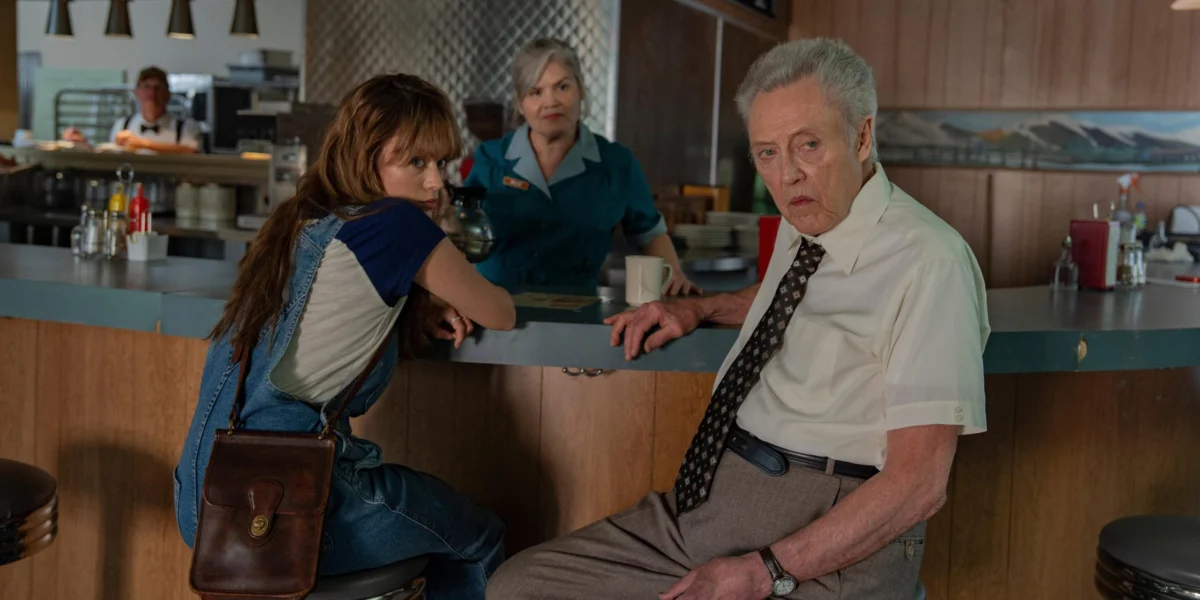
At the narrative center of Back in Black is Clyde Mortimer, portrayed with characteristic sardonicism by Christopher Walken. As the aging patriarch of the town’s sole mortuary, Clyde finds his livelihood fundamentally threatened by the impeccable health of his fellow citizens. In a running motif that highlights the absurdities of modern risk aversion, Clyde openly laments the efficacy of municipal safety protocols, modern medicine, and traffic regulations, complaining bitterly that citizens are simply refusing to die at a rate that can sustain his business model.
The financial peril facing the Mortimer family is absolute. With accounts slipping deep into the red and foreclosure looming, the household’s precarious survival becomes the inadvertent burden of Sam, Clyde’s quietly observant and emotionally detached orphaned granddaughter, played by Ella Ballentine. Serving largely as a silent witness to domestic anxieties, Sam overhears Clyde venting his frustrations to his wife, played by Jane Curtin. Rather than accepting financial ruin, Sam interprets her grandfather’s complaints as a literal call to action, applying an unsettling level of practical logic to their economic dilemma.
Armed with a screwdriver and a chillingly calm demeanor, Sam engineers her first tragedy by sabotaging the equipment of an aggressively unpleasant local shop manager, anticipating a lucrative, well-attended funeral service for the community’s bereavement ledger. However, the plan hits an immediate economic snag: the tight-pursed townspeople, conditioned by a culture of thrift and wellness, refuse to spend lavishly on end-of-life arrangements. This initial financial disappointment forces Sam to expand the scope of her macabre operations, escalating her sociopathic interventions to generate the volume and revenue required to pull the family business out of the red.
Cast Dynamics and Performances
While the narrative mechanics frequently strain credulity, the cinematic weight of Back in Black rests squarely on the shoulders of its principal performers. Christopher Walken delivers a late-career masterclass in deadpan delivery, utilizing his unmistakable physical presence and world-weary cadence to ground an otherwise farcical premise. Walken’s portrayal of Clyde is devoid of traditional warmth; instead, he projects a pragmatic, foul-mouthed weariness that makes his tacit acceptance of his granddaughter’s murderous entrepreneurship both darkly humorous and strangely compelling.
Conversely, Ella Ballentine’s portrayal of Sam occupies a more complex and occasionally problematic narrative space. Ballentine projects a steady, unblinking warmth even as her character engages in deeply chilling, calculated acts of violence. However, critics have noted that the role suffers from a degree of structural passivity. Confined primarily to observant glances and silent execution, Sam’s inner psychological life remains largely opaque, leaving audiences to infer motivations that the script only cursorily addresses through dialogue.
Supporting performances by industry veterans such as Jane Curtin provide essential comedic counterweight, establishing the domestic normalcy that starkly contrasts with the escalating mayhem just outside the parlor doors. Yet, despite the commitment of the ensemble, the character dynamics frequently feel episodic. Romantic subplots and secondary town interactions are telegraphed with minimal emotional resonance, functioning more as narrative placeholders than fully realized explorations of small-town interpersonal bonds.
Production Design, Setting, and Atmospheric Limitations
Visually and atmospherically, Back in Black reflects the budgetary and structural realities of independent regional filmmaking. Shot on location in and around the Niagara Falls area of Ontario, the film utilizes the generic architecture of suburban strip malls, modest motels, and quiet residential streets to construct its fictional wellness-obsessed town.
However, this reliance on real-world locations occasionally works to the film’s detriment. Rather than establishing a distinct, eccentric micro-universe akin to the fictional communities found in classic dark comedies, the setting frequently registers as generic. The locations lack a distinct visual personality, contributing to a somewhat flat aesthetic that can dilute the impact of the unfolding satire. Cinematographically, the project favors a straightforward, functional approach, allowing the dialogue and performance beats to carry the momentum rather than relying on atmospheric lighting or elaborate set pieces.
This episodic framework extends to the narrative’s pacing. As Sam’s exploits grow progressively more elaborate and preposterous, the film struggles to maintain its tonal equilibrium. The escalation of violence reaches heights of cartoonish mayhem that the early acts of the film do not entirely earn, creating a tonal disconnect that can leave viewers feeling as though the narrative has outpaced its own internal logic.
Broader Implications and Satirical Intent
Within the broader landscape of contemporary cinematic satire, Back in Black attempts to engage with substantial existential and economic themes. By framing murder as a service-sector labor solution, the film targets the precarious nature of small-town capitalism, the absurdity of wellness culture, and the systemic vulnerability of traditional, family-owned service industries in an era of hyper-regulated longevity.
Yet, when evaluated alongside international contributions to the dark comedy genre—films that often utilize biting irony to dissect societal hypocrisies with razor-sharp precision—Murphy and Torokvei’s script occasionally pulls its punches. The satire tends to skate the surface of its darker implications, preferring amiable schadenfreude and lighthearted farce over genuine subversion. The systemic critique of economic desperation is ultimately softened by an underlying sweetness and narrative comfort that prevents the film from descending into true nihilism.
For audiences navigating the crowded landscape of independent cinema, Back in Black occupies a peculiar middle ground. It is a modest production that found a brief, illuminating window on the festival circuit, serving primarily as a showcase for Christopher Walken’s enduring star power and comedic timing. While the film may falter under the weight of its own escalating absurdities and constrained budgetary scope, its fundamental charm, committed cast, and unapologetically silly premise ensure that it remains an entertaining, if ultimately ephemeral, cinematic diversion for fans of macabre humor.