
The intersection of academic prestige and psychological exploitation forms the chilling bedrock of the upcoming Netflix feature film Unabomber. Directed at uncovering the formative years of one of America’s most notorious domestic terrorists, the movie shifts its primary lens away from the familiar cabin manhunt and focuses instead on the hallowed, ivy-covered courtyards of Harvard University. Screenwriters Sam Chalsen and Nelson Greaves chose to examine a critically overlooked catalyst in Theodore Kaczynski’s descent: his exposure to aggressive psychological experiments orchestrated by prominent psychologist Dr. Henry Murray.
In the film, Kaczynski is portrayed by Jacob Tremblay, while Academy Award winner Russell Crowe steps into the complex shoes of Professor Henry Murray. While public memory often reduces Kaczynski’s trajectory to his remote Montana cabin and the deadly mail-bomb campaign that terrorized the nation between 1978 and 1995, Chalsen and Greaves argue that the psychological blueprints of his worldview were heavily influenced during his undergraduate years. Recently, the writing duo sat down to discuss the meticulous historical research, the deeply complex personal dynamics of Dr. Murray, and the harrowing reality of the Harvard experiments that inspired their cinematic narrative.
Unearthing the Complex Legacy of Dr. Henry Murray
When beginning their deep dive into the historical record, Greaves and Chalsen quickly realized that Murray’s public persona as a distinguished, highly respected American academic masked a much more eccentric and controversial private reality. Murray, renowned for developing the Thematic Apperception Test (TAT) and serving as a key figure in the Office of Strategic Services (OSS) during World War II, was celebrated within academic circles. However, biographical research into Murray and his lifelong intellectual partner, Christiana Morgan, revealed a deeply unorthodox personal life.
According to Greaves, examining Murray’s personal background exposed a stark contrast between his noble public standing and his turbulent private relationships. This duality provided the screenwriters with a compelling dramatic foundation. Rather than presenting Murray as a straightforward, cartoonish villain, the writers sought to capture the intense psychological friction that defined his interactions with young, impressionable students.
The relationship between Murray and Morgan was particularly telling for the writers. Far from a conventional academic partnership, historical records show they shared a long-term sadomasochistic dynamic defined by complex role-play, alternate identities, and distinct dominant-submissive power structures. Chalsen noted that this real-life dynamic heavily influenced the thematic architecture of the film. The core tension of Unabomber relies on a two-hander dynamic—a dyad of submission and power—which mirrors both the forced compliance of the Harvard experiments and the later philosophical themes of individuality versus institutional control found in Kaczynski’s infamous manifesto.

Furthermore, Murray’s intellectual lineage added another layer of fascination for the filmmakers. Murray had spent time studying under Carl Jung, even constructing a meticulous replica of Jung’s famous lakeside tower at his property in Massachusetts, a location that doubled as a backdrop for his unconventional lifestyle. This blend of brilliant psychoanalytic theory and erratic personal behavior painted a vivid portrait of a man driven by an immense, unyielding ego.
The Harvard Experiments: Institutional Secrecy and Real-World Trauma
Ted Kaczynski entered Harvard University as a remarkably gifted, albeit deeply isolated, prodigy at the tender age of 16 in 1958. Shortly after his arrival, he became a subject in a series of psychological stress tests overseen by Murray. These experiments, which continued for years under the auspices of university research, were designed to test human resilience under extreme emotional pressure.
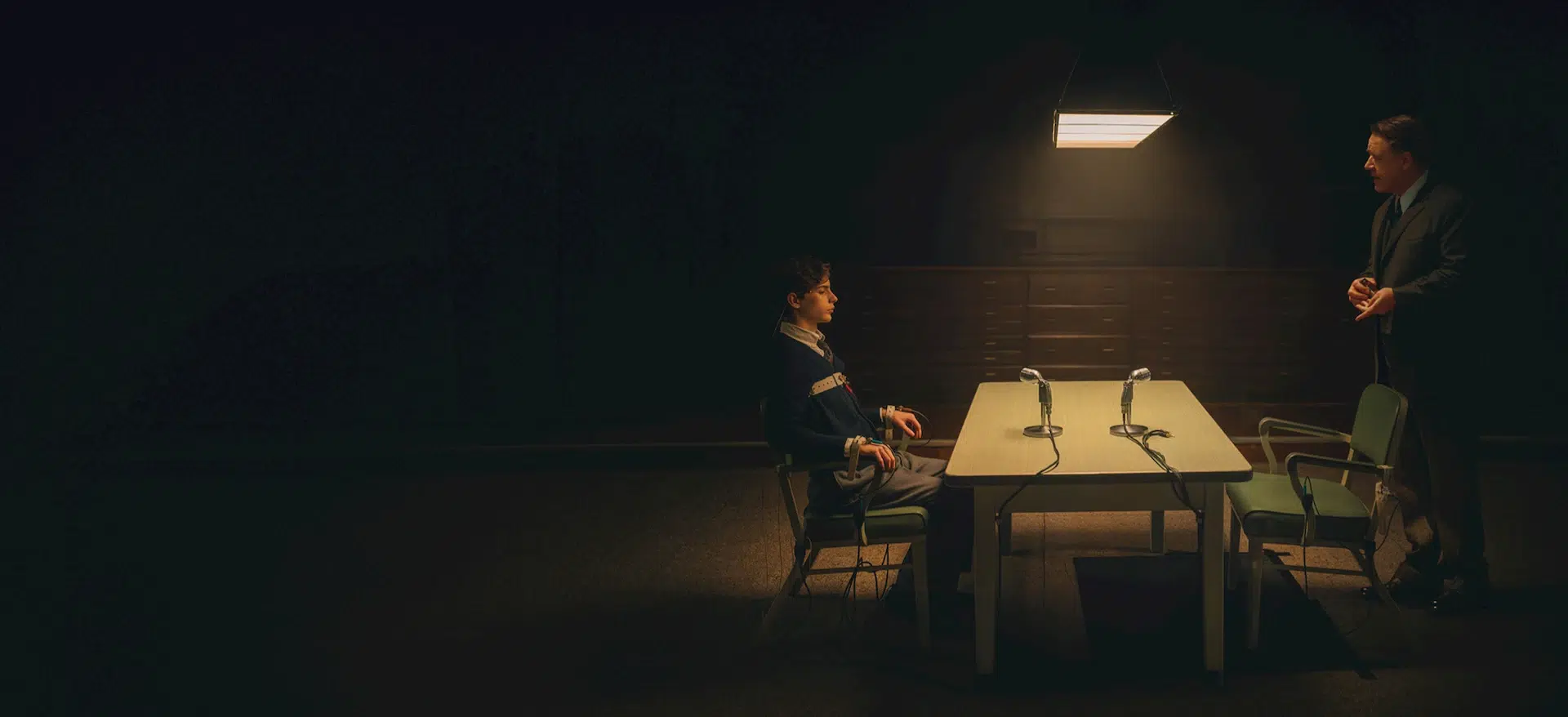
Historical accounts indicate that unsuspecting student participants were led to believe they were engaging in philosophical debates with fellow undergraduates. In reality, they were subjected to aggressive interrogations by law or graduate students. In the actual studies, participants were forced to write detailed essays outlining their personal philosophies, deepest insecurities, and intimate secrets. These personal confessions were then weaponized by the interrogators, who used the private information to launch personal, belittling verbal attacks while subjects were seated under blinding spotlights in overheated rooms, wired to physiological monitoring equipment.
Despite the severe psychological distress inflicted upon Kaczynski and other participants, Harvard University has historically maintained a veil of secrecy surrounding the complete documentation of these tests, keeping the archival records largely sealed. When Greaves and his team attempted to locate unredacted primary sources from the university, they encountered institutional roadblocks typical of academic bodies seeking to shield themselves from historical liability.
Nevertheless, sufficient documentation survived through published reports, emerging audio recordings, and the memoirs of fellow participants to reconstruct the harrowing environment. Chalsen emphasized that the filmmakers exercised remarkably little dramatic license regarding the nature of the tests themselves. The physical stressors, the blinding lights, and the systematic psychological dismantling of the students were historical facts drawn directly from Murray’s own published methodology and contemporary accounts.
Parallels of Ego, Fame, and the Manifesto
A central thematic achievement of the screenplay is the exploration of the profound psychological symmetry between the ambitious academic and the radicalized terrorist. Both figures, according to the screenwriters, were driven by a consuming, uncompromising ego and an insatiable desire for validation and intellectual supremacy.
Greaves pointed out that Murray’s relentless pursuit of the ultimate psychological study was fundamentally rooted in a quest for academic fame and professional prestige. Similarly, Kaczynski’s motivations—culminating in his 35,000-word manifesto, Industrial Society and Its Future—reflected an urgent, desperate demand for society to acknowledge his intellect, engage with his philosophical treatise, and validate his worldview.
While historical records do not feature a direct, explicit acknowledgment from Kaczynski blaming Murray for his radicalization, accounts from his brother, David Kaczynski, confirm that Ted returned from his formative years at Harvard profoundly altered. Kaczynski reportedly reflected on the grueling nature of the experiments later in life, noting that he repeatedly returned to them simply to prove to himself that he could endure the psychological onslaught.
Rather than explicitly claiming that Murray directly manufactured a domestic terrorist, Chalsen and Greaves approached the narrative with journalistic restraint. They present a documented reality: a deeply troubled, vulnerable 16-year-old prodigy was placed under the microscope of one of the nation’s most powerful psychological minds and subjected to systematic exploitation.
Broader Implications and Historical Reckoning
The release of Unabomber arrives at a time of heightened cultural interest in the ethics of mid-20th-century psychological research. The era was marked by a lax regulatory environment regarding human experimentation, leading to numerous studies—such as the infamous Milgram obedience experiments and the Stanford prison experiment—that tested the absolute limits of psychological endurance under the guise of scientific progress.
By bringing the Kaczynski-Murray dynamic to the screen, Chalsen and Greaves do not attempt to excuse the horrific crimes committed by the Unabomber, nor do they absolve him of his individual accountability. Instead, the film offers a sobering exploration of institutional negligence and the long-term societal costs when intellectual ambition supersedes basic human ethics. As audiences prepare to engage with the complex narrative, the film serves as a timely reminder of how hidden academic histories continue to echo through the modern cultural landscape, prompting a necessary re-examination of the institutions that shape our most troubled minds.