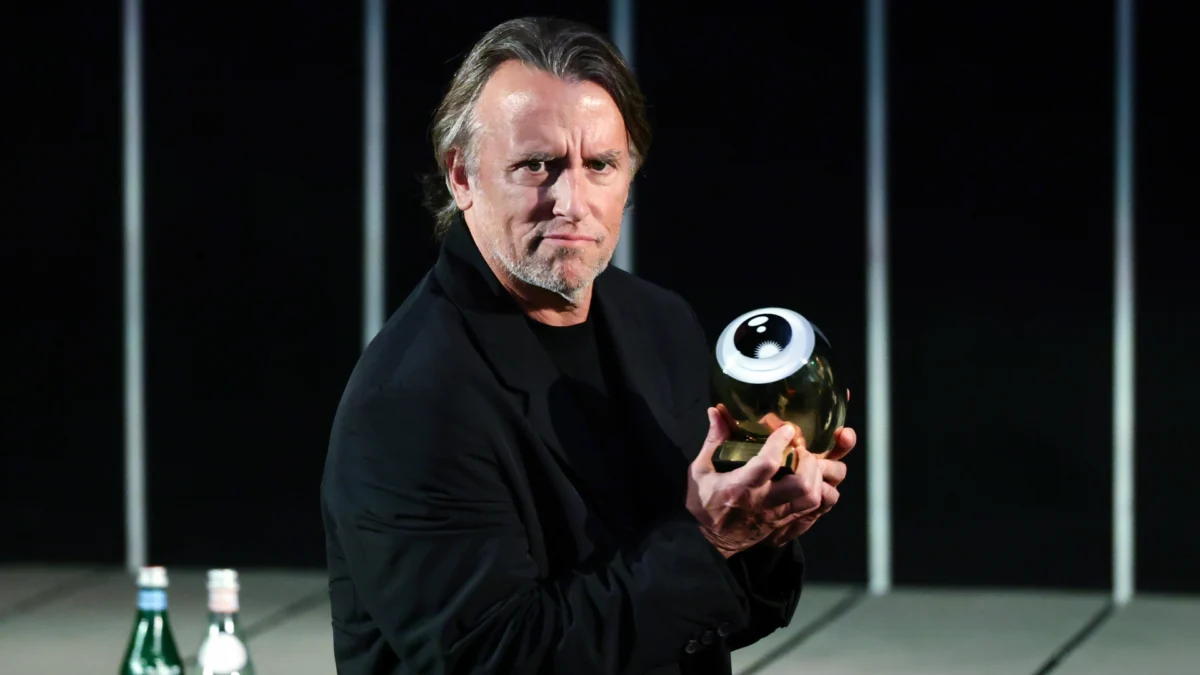
The Zurich Film Festival served as the backdrop for a rare and candid update on one of the most ambitious undertakings in contemporary cinema: Richard Linklater’s decades-long adaptation of the Stephen Sondheim musical, Merrily We Roll Along. During an intimate ceremony held in honor of his career achievement, the American auteur—renowned for his temporal experiments in film—addressed the complexities, public scrutiny, and logistical realities of a project that is not merely a film, but a twenty-year commitment.
A Legacy of Temporal Storytelling
Richard Linklater has long been fascinated by the passage of time. From the spontaneous conversations of the Before trilogy to the monumental achievement of Boyhood, which captured the growth of Ellar Coltrane over twelve years, Linklater has consistently pushed the boundaries of traditional narrative pacing. His latest project, Merrily We Roll Along, takes this methodology to its logical extreme.
Based on the 1981 Broadway musical by Stephen Sondheim and the original 1934 play by George S. Kaufman and Moss Hart, the film follows the life of Franklin Shepard, a composer who gradually abandons his artistic integrity and friendships in favor of commercial success in Hollywood. The narrative structure is unique: it moves backward in time, beginning at the zenith of the protagonist’s success and unspooling toward his idealistic youth.
By casting Paul Mescal, Ben Platt, and Beanie Feldstein, Linklater is capturing their physical and emotional evolution over two decades. This process mirrors the chronological realism that defined his 2014 critical darling, Boyhood, yet the cultural context surrounding this new project is significantly more intense.
The Challenge of Public Oversight
During a 45-minute retrospective discussion with Zurich Film Festival CEO Christian Jungen, Linklater reflected on the stark contrast between his previous long-term projects and the current production. "When I was doing Boyhood, we worked in complete anonymity," Linklater noted, acknowledging that the lack of public awareness during that shoot allowed for a degree of creative insulation that he does not enjoy today.
Because Merrily We Roll Along carries the weight of the Sondheim legacy and features high-profile stars, it exists in a constant state of public visibility. Linklater joked that while the secrecy of Boyhood was a shield, he now finds himself answering status updates on a project that will not reach completion until 2040. "I have to answer this question for 20 years while we’re making it," he told the audience, illustrating the toll that modern media cycles can take on long-gestation artistic projects.
Despite the pressure, Linklater provided a clear roadmap for the film’s progression. The production is divided into nine distinct segments, each capturing a different phase of the characters’ lives. As of late 2024, the team is preparing to shoot the fourth section, placing the project firmly on schedule for its projected 2040 completion date.
Artistic Rationale and Risk Management
Critics and industry observers have often questioned the viability of such an extended production schedule, citing the potential for unforeseen circumstances—illness, scheduling conflicts, or changes in the industry landscape. Linklater, however, remains resolute. He views the extended timeframe not as a gamble, but as a structural necessity.
"That’s just the way the film should be made and that’s the only way to tell the story," he stated during the discussion. He addressed the "what if" scenarios—specifically the risk of a cast member being unable to complete the project—with a philosophy rooted in optimism. "You gotta believe in collaborating with the future of some kind," he remarked, noting that the artistic benefit of capturing genuine aging outweighs the logistical hazards.
This, he argued, is the fundamental difference between the film and a traditional production. By treating the project as a living, breathing entity, Linklater is effectively merging the craft of theater—which relies on the physical presence of the actor—with the permanence of cinema. The score, which he described as "great" and "challenging," serves as the anchor, allowing the film to maintain its emotional core as the world changes around the production.
Contextualizing the Before Trilogy Pay Disparity
The conversation at the Zurich Film Festival also touched upon the history of the Before trilogy, specifically the long-standing discourse regarding pay equity between stars Ethan Hawke and Julie Delpy. Addressing reports that Delpy was compensated significantly less than her male counterpart, Linklater provided historical nuance.
He admitted that while there was a disparity, it was a result of industry gatekeeping rather than intentional undervaluation. "I actually remember fighting for it because I knew how hard the actors were going to have to work," Linklater stated. He recalled producers attempting to capitalize on the fact that Delpy lacked established American credits at the time, pushing to pay her "scale." Linklater’s intervention helped bridge the gap, ensuring that while the pay was not perfectly equal, it was significantly closer than the studio’s initial proposal. This insight serves as a reminder of the evolving standards for parity in Hollywood, a subject that has moved from the periphery of contract negotiations to the center of industry reform.
Honoring a Career of Cinematic Optimism
The Zurich Film Festival honored Linklater with its Golden Eye Award, a recognition that cements his status as a pillar of independent film. His acceptance speech centered on his deep-rooted faith in film culture, which he traces back to the founding of the Austin Film Society in 1985.
Linklater’s career, spanning from the cult classic Dazed and Confused to the widely celebrated School of Rock and the recent Hit Man, has been defined by a commitment to community-based filmmaking. He expressed a profound sense of gratitude for the "optimism" inherent in the medium. "I feel so lucky to be in this world, to work with people in the film culture—not just filmmakers, but the film culture that we all live in too," he told the attendees.
This sentiment was echoed throughout the festival, which, in its 22nd year, continues to prioritize the intersection of auteur-driven projects and public engagement. Linklater’s presence at the festival, alongside other honorees such as Julianne Moore, John Turturro, and Naomi Watts, reinforces the festival’s role as a platform for filmmakers who prioritize the long-term integrity of their work over short-term box office performance.
Implications for the Future of Film
As the industry grapples with the rise of AI, shortened theatrical windows, and the dominance of franchise intellectual property, Linklater’s commitment to a 20-year production timeline serves as a radical act of defiance. It challenges the prevailing industry model that demands rapid output and immediate return on investment.
The success of Merrily We Roll Along will ultimately be measured not just by its critical reception in 2040, but by its ability to maintain its narrative thread over two decades of technological and cultural flux. If Linklater succeeds, he will have provided a blueprint for a new type of "slow cinema," one that leverages the natural human aging process as a narrative tool, potentially inspiring a new generation of filmmakers to explore stories that require more than the standard eighteen-month production cycle.
For now, the project remains a fascinating, if daunting, experiment. As Linklater concluded, "See you in 2040," a statement that serves as both a promise to his audience and a testament to his enduring belief in the power of the medium to capture the passage of human time with unparalleled authenticity.