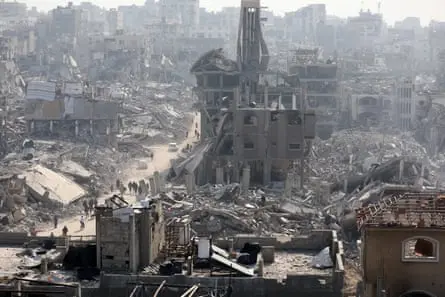
The makers of the award-winning investigative documentary NAZA have fiercely defended their explosive project following a sweeping public dismissal from the Israel Defense Forces (IDF). The film, which examines the mechanics of Israel’s military targeting operations in the Gaza Strip and its reported acceptance of high civilian casualty tolls, is built on a massive foundation of investigative reporting. In response to allegations from Israeli military officials that the documentary contains fundamental factual errors and relies on a narrow, junior-ranking pool of sources, the production team revealed they conducted interviews with more than 1,000 confidential sources over a three-year period, incorporating senior military commanders, intelligence officers, and leaked classified documents.
The clash over NAZA represents a critical flashpoint at the intersection of modern warfare, artificial intelligence, and media ethics. As international scrutiny intensifies over the conduct of contemporary urban combat, the film has moved past the cinematic sphere to ignite a fierce geopolitical debate involving high-ranking government officials, human rights watchdogs, and major journalistic institutions worldwide.
Anatomy of a Controversy: The IDF Rebuttal and the Filmmakers’ Response
The core of the dispute centers on the methodology and findings of NAZA. The film takes its name from an intelligence acronym euphemistically used to indicate the estimated number of civilian deaths anticipated in a planned airstrike. Directed by Yuval Abraham and Rachel Szor, and produced in collaboration with the Guardian, the documentary scrutinizes how algorithms and automated systems are integrated into modern targeting protocols.
Following widespread international acclaim and subsequent threats directed at its creators, the IDF issued a detailed statement aiming to discredit the documentary. The Israeli military claimed that the film presents a distorted, misleading, and unrealistic depiction of its targeting and strike authorization framework. Furthermore, the IDF argued that the project relied heavily on interviews with roughly two dozen intelligence personnel and troops who possessed only a fragmented understanding of the overarching approval process.
The military reiterated its formal rules of engagement, emphasizing that its directives explicitly distinguish between combatants and civilians, prohibit intentional harm to non-combatants, and mandate that commanders take feasible precautions to minimize collateral damage. The IDF also pushed back against specific claims in the film, explicitly denying that it ever planned, approved, or executed a military strike anticipating 500 civilian casualties in pursuit of a single target.
In counter-statement releases, the Guardian and the film’s production collective firmly rejected the military’s characterization. Representatives clarified that the sources featured in and consulted for NAZA were not low-level operatives confined to the periphery of operations. Rather, they included seasoned officers and soldiers embedded across multiple critical stages of the Gaza targeting pipeline, encompassing intelligence collection, tactical operations, and the final authorization desks.
The verification process, according to the production team, involved analyzing leaked classified material, cross-referencing specific strikes against satellite imagery and medical reports, and corroborating accounts through a broader network of confidential journalistic contacts who chose not to appear on camera due to security concerns.
Background Context and the Rise of AI in Modern Targeting
The deployment of artificial intelligence in military operations has accelerated dramatically over the last decade, transforming how intelligence is gathered, analyzed, and translated into kinetic action. In the context of the Gaza conflict, investigative reports by various prominent news publications—including the New York Times, the Washington Post, and the Associated Press—have previously documented the military utilization of AI-driven systems designed to accelerate target generation.
Military analysts note that these computational platforms can process vast quantities of data, such as communications intercepts, drone footage, surveillance data, and open-source intelligence, at speeds unattainable by human analysts alone. However, human rights organizations and legal experts have raised profound ethical and legal questions regarding accountability, algorithmic bias, and the dilution of human judgment in life-or-death decisions.

Critics argue that scaling up target generation through automation inevitably leads to a higher tolerance for collateral damage, compressing the time window human operators have to review and validate lethal strikes. Conversely, military defenders of these technologies maintain that AI assists in reducing human error, optimizing precision, and neutralizing high-threat adversaries embedded within dense civilian environments more efficiently than traditional methods.
Timeline of Events Surrounding the Documentary
The trajectory of NAZA from conception to international controversy spans years of meticulous investigation and subsequent diplomatic fallout:
- 2023–2026: A multi-year journalistic investigation is conducted by reporters and independent filmmakers, involving interviews with more than 100 sources familiar with IDF operational systems and targeting protocols in the Gaza Strip.
- September 2026: The documentary premieres at prominent international film festivals, earning critical praise and prestigious awards, while simultaneously triggering severe political pushback in Israel.
- Mid-September 2026: Israeli Prime Minister Benjamin Netanyahu publicly calls for directors Yuval Abraham and Rachel Szor to be stripped of their Israeli citizenship, amid a wave of intense hostility and death threats against the filmmakers.
- Late September 2026: NAZA holds its high-profile New York City premiere, where the creators address ongoing security threats and the global implications of their findings.
- October 2026: The IDF releases an official statement seeking to discredit the documentary, prompting the Guardian and production team to publish detailed clarifications regarding their extensive source verification methods.
Conflicting Data on Civilian Casualties
A central pillar of the debate surrounding NAZA involves the quantitative assessment of civilian casualties resulting from the military campaign in Gaza. Prime Minister Netanyahu and military spokespersons have frequently asserted that the IDF’s strict operational safeguards have resulted in one of the lowest civilian-to-combatant casualty ratios in modern urban warfare history.
This assertion stands in stark contrast to evaluations compiled by international bodies and humanitarian organizations. The United Nations Commission of Inquiry, alongside research initiatives by non-governmental organizations such as Action on Armed Violence, has repeatedly raised alarms over the scale of non-combatant fatalities and the widespread destruction of critical civilian infrastructure. Furthermore, independent leaks of internal military casualty assessments have often contradicted official public pronouncements, suggesting a systemic divergence between stated intentions and operational outcomes on the ground.
Legal scholars point out that under international humanitarian law, parties to a conflict are bound by the principles of distinction, proportionality, and precaution. Proportionality requires that commanders weigh the anticipated military advantage of an attack against the expected incidental loss of civilian life and damage to civilian objects. The core allegation leveled by NAZA and its sources is that the threshold for acceptable collateral damage shifted significantly during the conflict, permitting higher ratios of civilian casualties per target than previously tolerated under historical military guidelines.
Broader Implications and Media Ethics
Beyond the immediate theater of conflict, the controversy over NAZA underscores enduring tensions surrounding media ethics, source protection, and the accountability of state military apparatuses.
Critics of the film within Israel, including various domestic journalists and commentators, have frequently seized upon the fact that the documentary’s primary military sources are anonymized. These critics argue that the reliance on confidential testimony prevents an objective verification of individual claims and undermines the credibility of the narrative presented.
Media ethicists and investigative journalism advocates counter that source confidentiality is an indispensable pillar of watchdog journalism, particularly when dealing with active military personnel, intelligence officers, and classified state operations where whistleblowers face severe legal prosecution, social ostracization, or physical peril. The defense mounted by the Guardian highlights the standard journalistic practice of corroborating anonymous accounts through documentary evidence, digital forensics, and overlapping testimonies from multiple independent sources.
As the international community continues to grapple with the legal, ethical, and humanitarian dimensions of automated warfare, NAZA has firmly established itself as a touchstone in the global discourse on military transparency. Whether the film’s revelations will lead to formal international investigations or prompt internal military reforms remains uncertain, but its impact on the public understanding of modern algorithmic combat is already profound and far-reaching.