The release of Mike Flanagan’s television adaptation of Carrie on Prime Video has sparked widespread critical discussion across the entertainment industry, prompting a thorough re-evaluation of Stephen King’s seminal 1974 horror novel and its enduring cultural footprint. King’s literary debut, which chronicled the tragic life and telekinetic retribution of an isolated high school student, remains a foundational text in modern horror literature. Its stature was further cemented by Brian De Palma’s acclaimed 1976 feature film, widely regarded as a watershed moment in horror cinema. For decades, attempts to revisit the Carrie mythos—ranging from direct remakes to loose thematic successors—frequently struggled to justify their existence outside the long shadows cast by the novel and the definitive 1970s film. Consequently, Flanagan’s decision to helm an episodic adaptation was initially met with both anticipation and industry skepticism regarding what narrative territory remained unexplored.
However, as the complete first season of the Prime Video series becomes available to audiences, it is evident that Flanagan has implemented a radical structural and thematic overhaul. Eschewing a strict page-to-screen translation, the series introduces sweeping alterations to the timeline, character motivations, supernatural mechanics, and overarching plot arcs. These revisions transform a localized tragedy of domestic abuse and high school cruelty into a sprawling, interconnected narrative concerning the systematic suppression of psychic phenomena. For viewers and literary critics alike, understanding the full scope of these changes requires a systematic examination of the series’ chronological, thematic, and institutional developments.
Chronological Shifts and the Modernized High School Experience
The most immediate contextual adjustment in the Prime Video series lies in its temporal positioning. While Stephen King’s original novel was set in 1979—roughly contemporaneous with its publication window—Flanagan’s adaptation updates the timeline to the year 2026. This contemporary placement retains the core premise of a modern-day high school environment while aggressively integrating twenty-first-century societal stressors into the narrative framework.
Foremost among these updates is the prominent integration of cyberbullying as a primary engine of teenage cruelty. In promotional and post-release interviews, Flanagan emphasized that digital harassment has evolved beyond transient peer conflict into a normalized institutional backdrop. Within the series, this is actualized through the creation of a malicious social media hub titled “Carrie Red,” spearheaded by Carrie’s primary tormentor, Chris Hargensen. Beyond targeting Carrie, the account serves as a digital panopticon that disseminates unverified rumors and compromising media regarding both the student body and faculty members.
This modernization is further reinforced by visual and environmental cues reflective of contemporary secondary education, such as the routine implementation of metal detectors and security protocols. By embedding these institutional realities into the narrative, the series attempts to contextualize the historical alienation of the protagonist within a landscape defined by hyper-connectivity and pervasive surveillance.
Reimagining Carrie’s Upbringing and Public School Integration
A significant departure from both the source material and previous cinematic adaptations involves Carrie’s educational background and social integration. In the novel, Carrie White’s isolation is depicted as a lifelong continuum; she has attended public institutions throughout her youth while enduring persistent, systemic ostracization from her peers.
In contrast, the Prime Video series establishes that Carrie spent the majority of her formative years subjected to rigorous homeschooling. Her introduction to public education does not occur organically as a continuation of her childhood, but rather as a mandated intervention by local authorities following the sudden death of her father and subsequent welfare concerns regarding her mother’s insular domestic practices.
This narrative choice fundamentally alters the audience’s perception of Carrie’s high school experience. Rather than tracking the culmination of years of uninterrupted school-based torment, the series presents her public school enrollment as a sudden, destabilizing transition into an unfamiliar and hostile social ecosystem. This structural modification provides a modern narrative lens through which to explore contemporary cultural discourses surrounding alternative education, religious isolationism, and state oversight of domestic child-rearing practices.
The Expanded Role and Apparition of Ralph White
In King’s original text, Carrie’s father, Ralph White, is deceased prior to the narrative’s commencement, existing purely as a historical footnote of fundamentalist religious fervor whose direct influence on Carrie is entirely mediated through her mother, Margaret.
The television adaptation revises this family dynamic by depicting Ralph’s survival well into Carrie’s teenage years. Though he ultimately meets his demise through a workplace accident—consistent with the lore of the source material—his prolonged presence redefines the domestic environment. Following his death, Carrie experiences persistent visions of an apparition of her father, transforming him into an active psychological participant throughout the series.
Furthermore, the adaptation frames Ralph not merely as a religious zealot, but as a former military veteran whose survivalist training and authoritarian methodologies contributed directly to the structured isolation of the White household. This background provides a tangible, strategic rationale for the survivalist skills Carrie displays, offering a grounded explanation for her resilience that replaces the purely mystical isolation of the original text.
Nuance and Context in the Characterization of Chris Hargensen
Chris Hargensen occupies a legendary space in horror antagonists as the quintessential high school sadist, driven by entitlement, class snobbery, and an unreasoned hatred of the vulnerable. While her actions in Flanagan’s series remain undeniably malicious, the narrative invests significant screen time in humanizing her domestic reality.
The Prime Video adaptation introduces a complex familial backstory for Chris, revealing that she navigates a fractured home environment complicated by her father’s severe financial instability and pending legal troubles. This contextualization portrays Chris’s outward aggression not merely as an inherent malice, but as a displacement of personal isolation and loss of control within her own life. While these narrative additions risk drawing polarizing reactions from purists accustomed to the unmitigated villainy of the literary archetype, they align with the series’ broader thesis regarding the cyclical nature of adolescent trauma and domestic instability in the modern era.
The Inheritance of Power: Margaret White’s Psychic Abilities
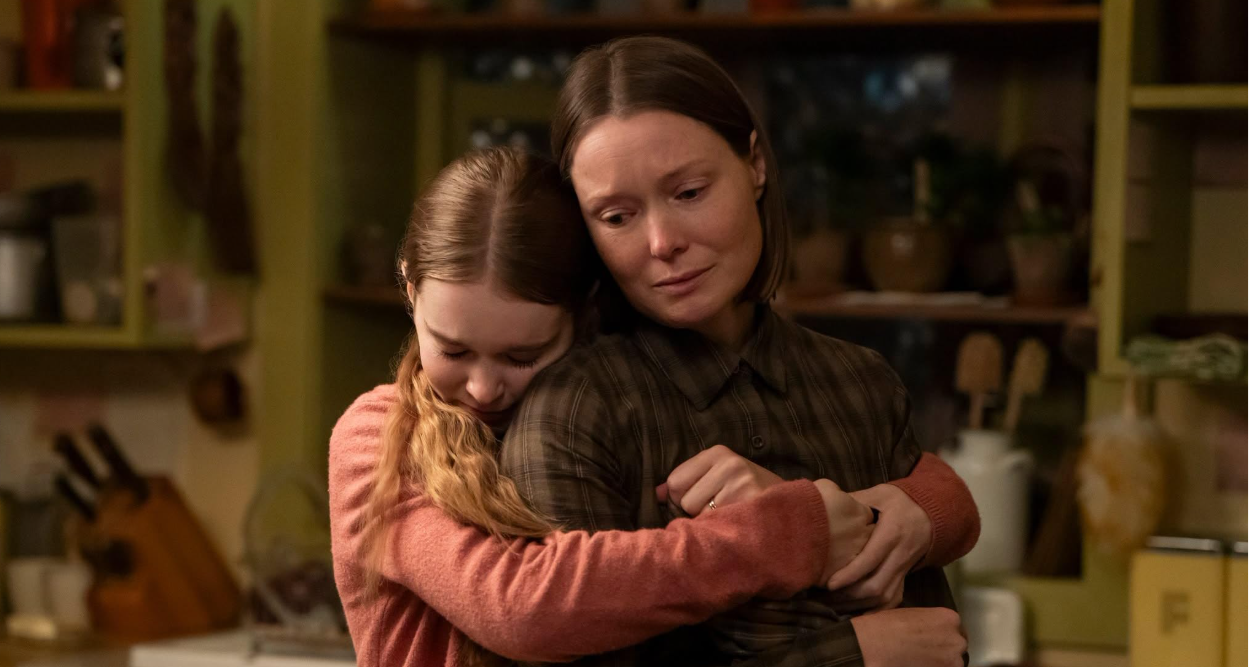
Perhaps the most consequential and debated departure from established Carrie lore centers upon Margaret White, traditionally portrayed as a fanatical, unyielding religious extremist whose abusive dogmatism seals her tragic fate. While actress Samantha Sloyan and showrunner Mike Flanagan previously noted an intent to provide Margaret with a complex protective rationale—framing her harshness as a deeply cynical, albeit toxic, attempt to shield her daughter from a cruel world—the introduction of supernatural parity between mother and daughter represents a massive tonal shift.
In the Prime Video series, it is revealed that Margaret possesses latent psychic abilities comparable to Carrie’s. While King’s novel briefly gestures toward a genetic throughline by mentioning that Margaret’s grandmother exhibited similar paranormal traits, those abilities remained strictly dormant or anecdotal. Here, Margaret actively utilizes her powers, notably employing telekinesis to survive the catastrophic structural collapse of the White family home.
The thematic implications of this revelation are twofold. First, it addresses contemporary anxieties surrounding genetic determinism and inherited psychological or physiological traits—a recurring thematic fascination in Flanagan’s filmography. Second, it reinterprets Margaret’s overbearing control not merely as madness or religious zealotry, but as an informed, experiential terror. Having lived through the burdens and societal threats associated with psychic phenomena, Margaret’s attempts to suppress Carrie’s powers are reframed through a lens of defensive self-preservation, escalating the tragedy of their maternal dynamic.
Emaline and the Collectivization of Psychics
The expansion of the supernatural scope extends beyond the White household through the introduction of Emaline, a peer at Carrie’s public school who initially appears as an imaginary companion or psychological manifestation of Carrie’s escalating trauma. As the narrative progresses, this assumption is subverted: Emaline is revealed to be a fellow telekinetic operating via astral projection to mentor Carrie and encourage the embrace of her paranormal potential, eventually materializing in the physical world.
The presence of secondary psychics shifts the narrative from an isolated tragedy of an individual anomaly to an exploration of an interconnected community. While King’s universe acknowledges the global existence of other gifted individuals through passing documentary fragments, the active mentorship and psychological influence Emaline exerts upon Carrie fundamentally alter the protagonist’s trajectory, providing her with both validation and external strategic direction.
The Prom Massacre and Collective Agency
The iconic prom sequence—the emotional and narrative climax of the Carrie mythos—receives a radical reimagining in the Prime Video adaptation. While the inciting incident remains anchored to the public humiliation of the pig blood prank, the execution of the ensuing massacre is no longer depicted as the exclusive, unmediated wrath of Carrie White.
During the chaotic sequence, as Carrie unleashes her powers to disrupt the facility—short-circuiting electronics, collapsing architecture, and initiating fires—audio cues and narrative framing indicate the active intervention of Emaline, who instructs Carrie to relinquish control. The resulting escalation of extreme violence is thus implied to be a shared or externally influenced phenomenon rather than an isolated psychological break by Carrie alone.
Industry analysts have noted two primary interpretations for this structural choice. From a cultural perspective, diffusing responsibility away from a singular school shooter archetype reflects modern sensitivities surrounding the depiction of mass violence in media. From a world-building perspective, it reinforces the overarching concept of psychics operating as a collective, interconnected force within the series universe, paving the way for larger institutional conflicts.
Shadow Organizations and the Survival of Carrie White
The culmination of Flanagan’s adaptation diverges entirely from the established conclusions of both the 1976 film and the 1974 novel, wherein Carrie perishes from her injuries amid the smoking ruins of Chamberlain.
In the Prime Video series, the broader universe of supernatural phenomena is brought to the forefront through the introduction of clandestine governmental or corporate shadow organizations dedicated to hunting, cataloging, and neutralizing individuals with psychic capabilities. The presence of these entities is foreshadowed through covert surveillance, including operative teams disguised as documentary crews recording the events leading up to the prom.
The consequences of this institutional presence are immediate and fatal for Margaret White, who survives the destruction of her home only to be assassinated by operatives of this mysterious syndicate. Meanwhile, Carrie herself defies her traditional fate: rather than succumbing to her wounds or her guilt, she survives the night and departs alongside Emaline, evading the pursuing shadow organizations.
Critical Implications and Future Prospects
The comprehensive alterations implemented in Mike Flanagan’s Carrie represent a bold, albeit polarizing, reinvention of a horror classic. By transitioning the narrative focus from a localized study of abuse and isolation to an expansive mythology involving genetic inheritance, astral mentorship, and clandestine surveillance syndicates, the series positions itself as a long-form sci-fi thriller rather than a strict psychological horror.
While these departures have generated considerable debate among literary purists and long-time fans regarding the dilution of Stephen King’s intimate core themes, they clearly lay the groundwork for subsequent television seasons. Showrunner statements indicating a desire to expand the narrative far beyond the boundaries of the original novel confirm that this adaptation was conceived not as a definitive remake, but as a foundational chapter in an expanded universe of supernatural suspense. Whether this macro-scale approach ultimately justifies its divergence from one of horror literature’s most tragic conclusions will depend upon the execution of its future narrative arcs.