Plot Premise and Narrative Context
The story of Haru to Gen revolves around the life of Gen, a 70-year-old man who has lived a life defined by regret and estrangement. Decades prior to the start of the narrative, Gen was separated from his wife and daughter following a difficult divorce. He lived the subsequent years in isolation, drifting further from his family members. However, the trajectory of his twilight years is irrevocably altered following the untimely death of his daughter. Faced with the sudden responsibility of caring for his three-year-old granddaughter, Haru, Gen is thrust into the role of a primary caregiver.
The narrative explores the profound cultural and emotional chasm between a man who neglected his family in his younger years and a toddler who represents his last remaining connection to his kin. The manga, which relies on a vertical-scrolling, full-color format, captures the "unexpected twists and turns" of late-life parenting. It addresses themes of redemption, the evolution of masculinity, and the challenges of child-rearing at an age typically associated with retirement and reflection rather than the high-energy demands of toddlerhood.
Production Chronology and Development
The development of the Haru to Gen anime project has followed a steady, deliberate timeline. Yuka Ōshima initially launched the original manga series on Kadokawa’s TATESC Comic label in December 2022. The series quickly gained traction due to its emotional resonance and its unique adaptation of the vertical-scrolling webcomic format. Recognizing the success of the source material, Kadokawa published the first compiled book volume in March 2024, providing a tangible footprint for the series in the physical market.
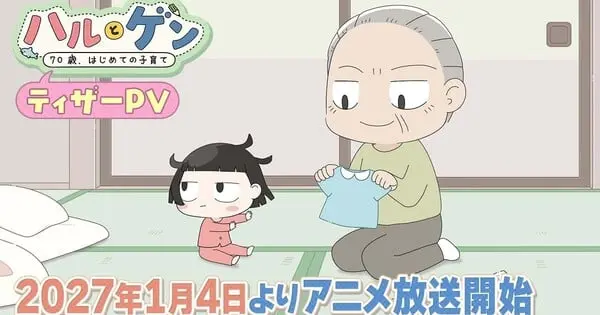
The official announcement of the anime adaptation followed in mid-September 2026, signaling the transition from static web-based content to a television format. Following the initial announcement, the production committee—comprised of various industry partners—worked to finalize the technical staff and broadcast logistics. The release of the teaser video on October 21, 2026, represents the primary marketing push ahead of the January 2026 broadcast premiere.
Creative Team and Technical Leadership
The production of Haru to Gen is a collaborative effort involving several prominent studios and industry veterans. Kōdai Satō, known for his work on Tom to Jerry Gokko, has been appointed as the director of the project. The animation is being produced through a partnership between IMAGICA Infos and Imageworks Studio, with additional support from Studio Nanahoshi.
The technical crew responsible for the auditory experience of the show is equally experienced. Taeko Miura, whose credits include Kanagawa Elves and Hyakki Yakou Shou, serves as the sound director. The sound effects department is headed by Maki Takuma, a professional noted for her work on After-School Hanako-kun and Love Live! Nijigasaki High School Idol Club. The musical score is being composed by bermei.inazawa, who has previously contributed to Potion, Waga Mi o Tasukeru and Marukano. Finally, Kazuya Takahashi, recognized for his executive oversight on Love and Lies and Saiyuki Reload Blast, occupies the position of executive producer. This assembly of talent suggests a production aimed at maintaining a high quality of emotional storytelling, prioritizing sound design and pacing to suit the short-format nature of the episodes.

Analysis of the Short-Format Anime Genre
The decision to produce Haru to Gen as a short-format television anime is consistent with a growing trend in the Japanese animation industry. Short-format series, typically ranging from three to ten minutes per episode, have become an increasingly popular medium for adapting slice-of-life manga that may not require a full 24-minute runtime to convey their narrative arc.
From an industry perspective, this format allows for lower production overhead while maintaining high creative visibility. By focusing on concise, poignant segments, the creators of Haru to Gen can emphasize the daily interactions between Gen and his granddaughter without the need for filler content. This format is particularly well-suited for the source material, which relies on intimate moments rather than grand, plot-heavy spectacles. Furthermore, this approach allows the series to fit more easily into late-night broadcast slots, such as the 9:55 p.m. time on TV Kanagawa, catering to viewers looking for brief, emotionally resonant entertainment before the conclusion of their day.
Broader Implications for the Kadokawa Group
The adaptation also highlights the strategic integration of Kadokawa’s intellectual property portfolio. By leveraging the TATESC Comic label—a platform designed for mobile-first, vertical consumption—Kadokawa is effectively creating a pipeline for content migration. A successful webcomic is digitized, serialized, and, if it gains enough traction, developed into an anime. This strategy serves to maximize the lifespan and revenue potential of each title.
It is worth noting that Kadokawa World Entertainment (KWE), a subsidiary of the Kadokawa Corporation, remains a major influence in the dissemination of such content to international markets. The involvement of various Kadokawa-affiliated companies in the production of this anime underscores the conglomerate’s commitment to controlling the lifecycle of its properties, from the initial digital release to the final broadcast on domestic television.
Audience Expectations and Future Outlook
As the January 4 premiere approaches, industry observers and fans of the original manga are looking toward the show’s ability to handle its complex themes with appropriate sensitivity. The premise of a 70-year-old man raising a toddler is fraught with potential for both comedic misunderstanding and deep, heartbreaking realizations. The success of the show will likely depend on the balance between these two poles.
The teaser video, while brief, suggests that the animation style will remain faithful to the aesthetic of the original webcomic, utilizing a warm color palette and soft character designs to reflect the gentle, though often challenging, nature of the story. With the production team now in place and the broadcast date locked, the focus for the remainder of the year will shift toward further promotional efforts and the eventual rollout of the series.
In conclusion, Haru to Gen ~70-sai, Hajimete Kosodate~ represents a significant entry in the 2026 winter anime lineup. By tackling the realities of aging, regret, and the late-life discovery of familial love, the series stands out as a unique narrative in a market often dominated by high-octane action and fantasy themes. The collaboration between experienced directors and dedicated animation studios suggests that the emotional weight of Yuka Ōshima’s work will be handled with the care required to resonate with a broad, mature audience. As the premiere on TV Kanagawa nears, the project remains a focal point for those interested in the evolving landscape of Japanese animation and the continued success of the short-format storytelling model.