The third episode of the animated series Devils’ Crest marks a significant turning point in the narrative, shifting the focus from immediate survival combat to the psychological and physiological ramifications of the protagonists’ entrapment. With a community score of 3.5, the episode explores the unsettling transformation of the main cast as they navigate an environment that defies conventional logic. As the survivors reconcile with their new, unnatural reality, the series begins to pivot toward the core mystery: the nature of the "tower" and the biological mutations affecting those who awaken within it.
Chronology of the Crisis
The narrative arc of the third episode follows the immediate aftermath of a high-stakes confrontation. Following the successful neutralization of a significant hostile entity—a creature capable of structural demolition—the core trio, consisting of Yuma, Sawa, and Kenji, succeeds in locating the remainder of their classmates. This reunion serves as a catalyst for the episode’s primary inquiry: the status of Sawa.
Sawa, who emerged from her stasis pod significantly earlier than her peers, has displayed a consistent, albeit unexplained, mastery over the environmental mechanics of the tower. Her possession of knowledge regarding the application of "magic" in a physical space, coupled with her awareness of the total lack of external intervention, suggests a period of acclimatization that Yuma and Kenji have yet to experience. The episode establishes that Sawa’s early awakening was not merely a temporal advantage but a transformative event that has fundamentally altered her physiology.
Physiological Alterations and Biological Implications
The physical manifestation of these changes serves as a focal point for the episode’s tension. Upon close inspection, Sawa’s appearance has deviated from human norms. Observers have noted the presence of vestigial wings and distinct changes to her extremities, including darkened pigmentation on her nails. These features are not auxiliary garments or accessories; they appear to be biological integrants of her current form.
Yuma’s confrontation with Sawa regarding these changes is pivotal. Having witnessed the radical mutation of another survivor, Sumika, Yuma’s concern is rooted in the fear of progressive dehumanization. Sawa’s admission that she is struggling to reconcile her newfound knowledge with her shifting physical state provides a necessary character layer, emphasizing the psychological toll of the tower’s influence. Furthermore, the revelation that Yuma himself is undergoing similar, albeit more subtle, changes—such as altered hair pigmentation and the development of vestigial cranial protrusions—suggests that the mutation process is not an isolated incident but a universal consequence of the tower’s environment.
Analysis of Anomalous Power Dynamics
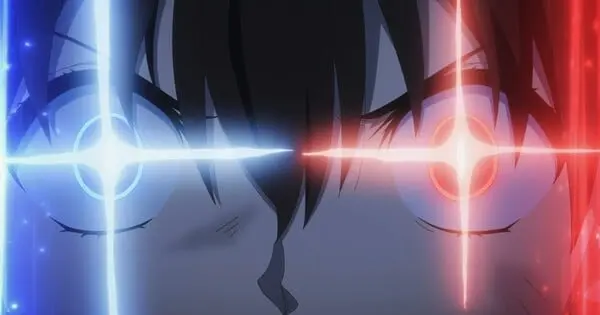
Central to the plot is the emergence of non-systemic abilities. During the episode, Yuma demonstrates a capability that operates outside the established parameters of the tower’s game-like architecture. By accessing a mnemonic representation of the Permian-Triassic extinction event, Yuma successfully executes a spatial-temporal split, allowing him to perform simultaneous, independent actions.
This development poses significant questions regarding the source of power within the tower. If the tower operates under a defined rule set, these anomalous abilities represent either a flaw in the system’s design or an evolutionary leap forced upon the participants. The inference, based on Sawa’s early aptitude, is that these powers are tied to the length of time spent in an active, non-stasis state. This implies that the tower is not merely a prison but a laboratory designed to catalyze specific biological or metaphysical evolutions.

The Social Fracture: Trust and Paranoia
The final segment of the episode highlights the impending breakdown of social cohesion among the survivors. As the class reunites, the internal dynamics are increasingly strained by suspicion. Teruki, a prominent figure among the student body, voices a sentiment that likely reflects the broader consensus: the survivors who have engaged in combat and displayed supernatural abilities are now viewed as potential threats.
The "monstrous doppelganger" theory articulated by the characters reflects a classic narrative trope of internal group instability. As the protagonists demonstrate the power to destroy entities that the average student finds terrifying, they effectively alienate themselves from the collective. This creates a dual conflict: the external threat of the tower’s inhabitants and the internal threat of ostracization and leadership disputes.
Broader Context and Series Background
Devils’ Crest, currently distributed via Amazon Prime Video, occupies a niche in the speculative fiction genre, utilizing the "trapped in a hostile environment" framework to examine existential themes. The series draws parallels to historical cataclysms—such as the aforementioned Permian-Triassic extinction—to underscore the stakes of the protagonists’ current predicament. By integrating these real-world scientific references into the fantasy narrative, the show attempts to ground its abstract conflict in a tangible, if hyperbolic, reality.
Data from the first three episodes suggests that the narrative pacing is accelerating. While the first two episodes focused on the establishment of the setting and the basic rules of survival, episode three functions as a mid-arc expansion that introduces the "cost" of survival. The show’s production values, particularly in the design of the transformed characters, emphasize a body-horror aesthetic that complements the dark fantasy tone.
Implications for Future Episodes
The trajectory of the series indicates that the forthcoming reunions will be anything but harmonious. With the class now fully aware of the existence of combatants and the physical mutations resulting from the tower’s influence, the narrative will likely shift toward internal political conflict.
The primary implication of the third episode is that the "game" may not be the ultimate objective. Rather, the tower appears to be an instrument of selection. If the physical changes observed in Sawa and Yuma are precursors to a larger evolutionary process, the series may conclude not with an escape, but with a transformation of the human condition.
The role of the administration or the entities behind the tower remains obscured. However, the consistent focus on "grace" and the "bond between siblings" suggests that the emotional anchor of the series will remain the relationship between Yuma and Sawa. Whether this bond can survive the inevitable conflict with their peers—and the potential loss of their humanity—remains the central tension for the remainder of the season.
As the production continues, the audience is left to consider the ethical implications of the characters’ actions. To what extent is one responsible for their actions when their very biology is being rewritten by an external force? This inquiry, paired with the ongoing mystery of the tower’s origin, ensures that Devils’ Crest remains a complex, if challenging, viewing experience for its audience. The transition from the "pod" environment to the "tower" landscape continues to serve as a metaphor for the difficult passage from innocence to experience, albeit with the addition of wings, horns, and extinction-level trauma.