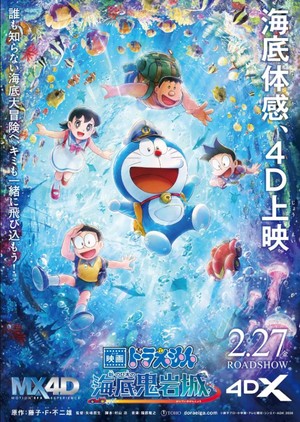
The latest installment in the beloved Doraemon film franchise, Eiga Doraemon: Shin Nobita no Kaitei Kiganjō (Doraemon the Movie: New Nobita and the Castle of the Undersea Devil), has continued its impressive box office run, maintaining the number one spot for its third consecutive weekend. This enduring popularity highlights the franchise’s consistent appeal across generations. The film, a remake of the classic 1983 adventure, has captivated audiences with its blend of nostalgia and fresh storytelling, reinforcing Doraemon‘s status as a cinematic powerhouse.
Doraemon Continues Its Reign at the Top
Eiga Doraemon: Shin Nobita no Kaitei Kiganjō has demonstrated remarkable staying power since its release, a testament to its broad appeal. Over its third weekend, the film sold an impressive 274,600 tickets, generating 357,032,400 yen (approximately US$2.23 million). This strong performance has propelled the film’s cumulative earnings to a significant 1,894,756,550 yen (about US$11.85 million) with a total of 1.47 million tickets sold.
The film’s initial debut on February 27th was equally triumphant, immediately claiming the top spot at the box office. In its opening three days, it sold a staggering 621,000 tickets, earning a substantial 779,681,350 yen (about US$4.96 million). This robust opening weekend set a strong precedent for the film’s subsequent success.

This 45th installment in the 2D anime film series (excluding the Stand By Me Doraemon CG films) revisits the beloved 1983 narrative of Doraemon the Movie: Nobita and the Castle of the Undersea Devil. The remake is helmed by director Tetsuo Yajima, a seasoned veteran of the Doraemon television anime and a contributor to previous theatrical releases such as Doraemon the Movie: Nobita’s New Great Adventure into the Underworld and Eiga Doraemon: Nobita no Chikyū Symphony. Yajima’s extensive experience within the franchise undoubtedly contributes to the film’s ability to resonate with long-time fans while attracting new viewers. The screenplay was penned by Isao Murayama, another experienced member of the television anime’s production team, known for his work on series like Witchy Precure! and Star Twinkle Precure. Their collaborative efforts have evidently paid off, creating a film that honors the original while offering a compelling new experience.
Golden Kamuy Sequel Makes a Strong Debut
Following closely behind Doraemon, the live-action adaptation Golden Kamuy: Abashiri Kangoku Shōgeki-hen (Golden Kamuy: Attack on Abashiri Prison) Arc, the second film in the series based on Satoru Noda’s acclaimed manga, has opened at number three in the box office rankings. The film’s strong opening weekend suggests a significant appetite for this historical adventure series in live-action format.
Golden Kamuy: Abashiri Kangoku Shōgeki-hen garnered 246,900 ticket sales and earned 368,611,300 yen (US$2.30 million) within its first three days of release. This performance indicates that the sequel has successfully captured the momentum generated by its predecessor and expanded its audience reach. The film is also being presented in IMAX screenings, a strategic move aimed at enhancing the viewing experience and potentially attracting a broader demographic of filmgoers seeking immersive cinematic events.
The film sees the return of Kento Yamazaki as the iconic Saichi Sugimoto and Anna Yamada as Asirpa, reprising their roles from the first installment. Their established chemistry and faithful portrayals are crucial to the film’s appeal. The cast has been further bolstered by the addition of Yō Inaba as Tokishige Usami, Sōkō Wada as Toshiyuki Kadokura, and Tetta Sugimoto as Anji Toni, all of whom are expected to bring depth and nuance to their respective characters.
Directed by Kenji Katagiri, with a screenplay by Tsutomu Kuroiwa, the film continues the collaborative spirit of its predecessor. Yutaka Yamada returns to compose the musical score, ensuring a consistent auditory experience, while Ainu culture and language supervisors Hiroshi Nakagawa and Debo Akibe provide crucial authenticity. The theme song, "Kowarete Kieru made" (Until It Breaks and Disappears), is performed by the popular rock band 10-FEET, adding another layer of established talent to the production.
The success of the first live-action Golden Kamuy film, which opened in January 2024 and topped the box office, selling 356,000 tickets for 533,848,690 yen (about US$3.44 million) in its opening three days, laid a strong foundation for this sequel. The continuity in cast, crew, and thematic elements suggests a well-executed strategy to build upon the franchise’s cinematic success.
Cosmic Princess Kaguya Enjoys Extended Theatrical Run and Streaming Success
Shingo Yamashita’s directorial debut feature film, Cosmic Princess Kaguya! (Chō Kaguya-hime!), has seen its popularity surge, climbing from tenth to fifth place in its fourth weekend at the box office. This impressive rise follows the film’s limited one-week theatrical screening run in Japan, which was notably extended due to overwhelming demand. The film earned 286,511,000 yen (about US$1.79 million) from Friday to Sunday, bringing its cumulative earnings to a substantial 1,116,389,400 yen (about US$6.98 million).
The film’s limited theatrical run, which commenced on February 20th, was met with unprecedented enthusiasm. Tickets sold out rapidly, compelling some theaters to increase the number of daily screenings significantly. The initial three-day box office performance of 223,485,400 yen (about US$1.43 million) after the extension underscored the strong audience connection to this unique cinematic offering. Simultaneously, Cosmic Princess Kaguya! began streaming on Netflix on January 22nd, providing a dual platform for its accessibility and contributing to its widespread recognition.

Yamashita, known for his work on Pokémon: Twilight Wings, the opening animations for Jujutsu Kaisen and Chainsaw Man, and the 2022 Urusei Yatsura, has made a significant mark with his feature-length directorial debut. The film is a collaborative effort between his Studio Chromato and Studio Colorido, bringing together distinct creative energies. Character design is a highlight, with Hechima responsible for the Tsukuyomi designs and Akihiro Nagae handling the real-world character designs. This dual approach likely contributes to the film’s visual richness and thematic depth.
The musical score features contributions from prominent Vocaloid producers, including Ryo (supercell), kz (Livetune), 40mP, HoneyWorks, Aqu3ra, and yuigot. The theme song, "Ex-Otogibanashi" ("Ex-Fairy Tale"), is performed by Saori Hayami, who also voices Yachiyo, with the song composed by Ryo. The integration of these popular music creators further enhances the film’s appeal, particularly to younger audiences familiar with the Vocaloid scene. The film’s blend of innovative animation, diverse musical talent, and a captivating narrative has clearly resonated with audiences, leading to its extended theatrical success and strong streaming performance.
Himitsu no AiPri Film and That Time I Got Reincarnated as a Slime Sequel Round Out the Box Office
The anime film Eiga Himitsu no AiPri Mankai Bazulium Live!, part of the Himitsu no AiPri (Secret AiPri) mixed-media project, debuted at number eight in the box office, earning 105,373,000 yen (about US$659,500) in its initial three days. This film offers a unique interactive experience, allowing viewers to participate vocally during screenings, a feature that aims to foster a more engaging and communal viewing environment. The plot centers around the Ring Princess inviting participants to a "Spring Float Race," which is disrupted by an unforeseen incident, and includes a concert segment, promising a blend of narrative excitement and musical performance.
The film is produced by TAKARA TOMY A.R.T.S and syn Sophia, with Avex Film Labels handling distribution and OLM and DongWoo Animation undertaking the animation production. The returning cast ensures continuity for fans of the Himitsu no AiPri series.

Meanwhile, That Time I Got Reincarnated as a Slime the Movie: Tears of the Azure Sea (Gekijō-ban Tensei Shitara Slime Datta Ken: Sōkai no Namida-hen), the second film in the popular That Time I Got Reincarnated as a Slime franchise, has dropped from sixth to tenth place in its third weekend. The film grossed 74,104,010 yen (about US$463,800) over the weekend, bringing its cumulative total to 659,819,410 yen (about US$4.12 million). The film premiered on February 27th, securing the third spot in its opening weekend with 225,000 tickets sold and 301,175,600 yen (about US$1.91 million) in its first three days.
Crunchyroll has acquired the worldwide theatrical rights, with Sony Pictures Entertainment planning theatrical screenings in the near future, indicating continued international interest in the franchise. The film features returning cast members from the television anime, alongside new additions such as Saori Ōnishi as Yura, Kōichi Domoto as Zodon, and Kōji Yusa as Djeese. Notably, Hinatazaka46 members Nao Kosaka and Kaho Fujishima voice original characters, shrine maidens Mio and Yori, adding a popular idol element to the cast. Animation is handled by 8-Bit. The film boasts an impressive musical lineup, with TRUE performing the theme song "Utopia," Saori Ōnishi singing the insert song "Sōkoku" (Blue Moment), and the unit ARCANA PROJECT performing "Ren’ai-nō" (Talent for Romance). STEREO DIVE FOUNDATION and ASH DA HERO collaborated on the insert song "Harmonics."
Additionally, Shin-Gekijōban Gintama: Yoshiwara Daienjō (Gintama New Film Version: Yoshiwara in Flames), a compilation film for the Gintama anime based on Hideaki Sorachi’s manga, has exited the top rankings in its fifth weekend. In the mini-theater circuit, a 4K remaster of Hiroyuki Okiura and Mamoru Oshii’s Jin-Roh – The Wolf Brigade film achieved a strong third-place debut in its opening weekend, signaling continued appreciation for critically acclaimed anime classics.
The robust performance of these diverse film offerings underscores the vibrancy and multifaceted nature of the Japanese animation and film industry, with established franchises like Doraemon continuing to draw massive audiences while newer properties and beloved classics find their niche.