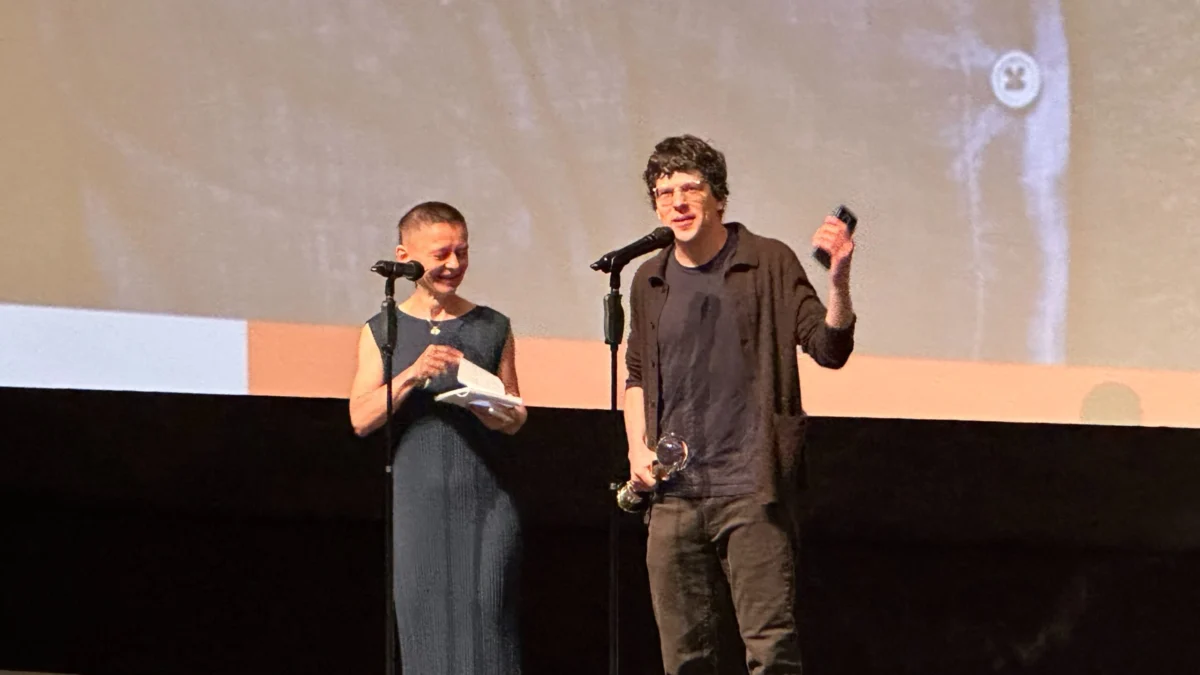
Actor, writer, and director Jesse Eisenberg, known for his acclaimed roles in films such as The Social Network and A Real Pain, announced on Saturday his imminent acquisition of Polish citizenship, signaling a deliberate shift in his professional focus towards filmmaking opportunities in Central Europe. The revelation came during a poignant ceremony at the Karlovy Vary International Film Festival (KVIFF) in the Czech Republic, where Eisenberg was presented with the prestigious President’s Award. His decision, rooted in both personal heritage and a critical assessment of contemporary film production trends, underscores a growing sentiment among independent filmmakers regarding the challenges of creating artistically driven, mid-budget projects within the current Hollywood paradigm.
Eisenberg articulated his motivations from the Grand Hall of the Hotel Thermal, the central hub of the Czech festival, stating, "Being here has particular meaning for me right now, because in exactly one week I am receiving my Polish citizenship. I pursued Polish citizenship because of my family’s heritage, but also because I want to spend more time in my life and my career working in Europe, specifically Central Europe." He elaborated on the evolving landscape of cinema, noting, "In America, many of the kind of films that I love so much — human scale, strange mid-budget films — have become increasingly difficult to make, but in Europe, those movies are thriving and celebrated." The announcement, met with a standing ovation, preceded a screening of Richard Ayoade’s 2013 film The Double, in which Eisenberg plays the lead, a work he described as "wonderfully strange" and one that "owes so much to Central European cinema."
The Significance of Polish Citizenship and Ancestral Ties
Eisenberg’s pursuit of Polish citizenship is deeply personal, linking back to his family’s heritage. For many descendants of Polish immigrants, particularly those of Jewish background, the process of reclaiming citizenship is a way to reconnect with roots severed by historical events. Poland’s citizenship law operates primarily on the principle of Jus Sanguinis, or "right of blood," meaning that citizenship is inherited from parents or ancestors, rather than Jus Soli, or "right of soil." This pathway allows individuals whose ancestors were Polish citizens to apply for recognition of their Polish citizenship, even if they were born abroad. The historical context is crucial here; mass emigration from Poland throughout the 20th century, notably spurred by World War II and subsequent political upheavals, led to a significant Polish diaspora. For Jewish families, the devastating impact of the Holocaust and subsequent waves of anti-Semitism in post-war Poland often resulted in displacement and the loss of national ties. Eisenberg’s public acknowledgment of this heritage adds a profound layer to his professional reorientation, blending personal identity with artistic aspiration.
Hollywood’s Mid-Budget Conundrum
Eisenberg’s critique of the American film industry’s current state resonates widely within independent filmmaking circles. The landscape of Hollywood has undergone a dramatic transformation over the past two decades. Major studios increasingly prioritize tentpole blockbusters, expansive cinematic universes, and franchise properties that promise massive global box office returns and synergistic marketing opportunities. These films, often boasting budgets well over $100 million, dominate production pipelines and marketing spend. Simultaneously, the rise of streaming platforms has fueled a demand for high-volume content, leading to a proliferation of direct-to-streaming movies that often fall into either the micro-budget indie category or the large-scale event series.
The segment that has suffered most significantly is the "mid-budget" film — projects with budgets ranging from $10 million to $60 million. These are typically the "human scale, strange" narratives Eisenberg champions: character-driven dramas, sophisticated comedies, and genre films that prioritize artistic vision over pure commercial spectacle. Such films often struggle to secure financing, attract distribution, and find an audience in a crowded marketplace where they are neither blockbuster nor niche arthouse. The economic model for these films has become precarious in Hollywood, leading many talented filmmakers and actors to seek alternative avenues where such stories are still valued and financially viable.
Europe: A Haven for Auteur-Driven Cinema
In stark contrast, Europe has long maintained a robust ecosystem for diverse cinematic storytelling, often supported by public funding mechanisms. National and regional film funds, cultural ministries, and public broadcasters across countries like France, Germany, the UK, Poland, and the Czech Republic actively invest in films that might be considered too risky or commercially unviable by Hollywood standards. These funding models prioritize cultural enrichment and artistic expression, often leading to a greater diversity of narrative and stylistic approaches.
Co-production treaties between European nations further facilitate the pooling of resources and talent, enabling ambitious projects that might otherwise struggle for financing. Furthermore, European film festivals, such as Cannes, Venice, Berlin, and Karlovy Vary, play a crucial role not only as showcases for these films but also as vital markets and networking hubs, fostering a vibrant independent film culture. Eisenberg’s observation that "in Europe, those movies are thriving and celebrated" is a direct acknowledgment of this supportive environment. His move could potentially inspire other American talents to explore similar pathways, further blurring the lines of national film production and fostering greater international collaboration.

Karlovy Vary International Film Festival: A Prestigious Platform
The Karlovy Vary International Film Festival, where Eisenberg made his pivotal announcement, holds a distinguished place in the global cinematic calendar. Celebrating its 60th edition in its 80th year – a double anniversary marking a significant milestone – KVIFF is one of the oldest and most prestigious film festivals in Central and Eastern Europe. Held annually in the picturesque spa town of Karlovy Vary, Czech Republic, it has a long-standing tradition of showcasing arthouse cinema, independent films, and emerging talents, alongside honoring established figures. The festival, which runs from July 3-11, attracts a diverse audience of industry professionals, critics, and cinephiles, renowned for its vibrant atmosphere and commitment to cinematic excellence.
Eisenberg received the festival’s President’s Award, an honor bestowed upon individuals who have made significant contributions to world cinema. The "massive collective hug, figuratively speaking" he received from the audience underscored the warmth and appreciation for his body of work and his artistic integrity. Just the day before, on Friday’s opening night, legendary actor Dustin Hoffman was honored with the Crystal Globe for Outstanding Artistic Contributions to World Cinema, while Maggie Gyllenhaal also received a President’s Award. The festival’s expanded red carpet this year saw numerous luminaries, including Harvey Keitel, adding to the celebratory mood of this landmark edition. KVIFF’s recognition of Eisenberg not just as an actor, but as a "multifaceted figure in contemporary cinema," as they described him a month prior when announcing the honor, highlights the festival’s appreciation for artists who push creative boundaries across various roles.
Eisenberg’s Multifaceted Career: From Acclaimed Actor to Auteur
Jesse Eisenberg’s career trajectory is indeed a testament to his versatility and evolving artistic ambitions. He first gained significant notice for his nuanced performance in the 2002 film Roger Dodger, which earned him an award for most promising young actor at the San Diego film festival. His role in Noah Baumbach’s critically acclaimed family drama The Squid and the Whale (2005) further solidified his reputation, garnering nominations for the Independent Spirit Award and the Critics’ Choice Award. While he also experienced commercial success with films like the apocalyptic horror comedy Zombieland (2009), it was his portrayal of Facebook founder Mark Zuckerberg in David Fincher’s The Social Network (2010) that brought him global recognition, earning him his first nominations for an Oscar, a Golden Globe, and a BAFTA Award.
Beyond acting, Eisenberg has steadily cultivated a career as a writer and director, demonstrating a clear vision for the types of stories he wishes to tell. His directorial and screenwriting debut, When You Finish Saving the World, starring Julianne Moore and Finn Wolfhard, premiered at prestigious festivals like Sundance and Cannes, signaling his arrival as a serious filmmaker. The film explored complex family dynamics with a distinctive voice, aligning with the "human scale" narratives he now champions.
His second feature, A Real Pain (2024), further cemented his status as an auteur. In this film, Eisenberg co-stars with Kieran Culkin as cousins embarking on a journey to explore their heritage. The project received widespread critical acclaim, particularly for its screenplay, which earned Eisenberg nominations for an Oscar and a Golden Globe, and secured a BAFTA Award, the Waldo Salt Award at the Sundance Film Festival, and an Independent Spirit Award, among numerous other prizes. His performance also garnered a Golden Globe nomination for best actor, and Kieran Culkin’s portrayal earned him an Oscar for best supporting actor, highlighting Eisenberg’s talent for both writing compelling narratives and eliciting powerful performances.
Looking Ahead: "The Debut" and a European Future
Eisenberg’s upcoming project, The Debut, further illustrates his commitment to independent, artist-driven filmmaking. As writer and director, he has assembled an impressive cast including Julianne Moore and Paul Giamatti. Intriguingly, Eisenberg also co-stars in the film and took on the additional creative role of writing the music and lyrics for a musical-within-the-movie. This multi-hyphenate approach exemplifies the comprehensive artistic control and creative freedom often sought by filmmakers who feel constrained by the traditional studio system. The Debut is slated for a fall release by A24, a distribution company known for championing independent and critically acclaimed films, further aligning with Eisenberg’s artistic sensibilities.
His decision to pursue Polish citizenship and focus on Central European cinema is more than a personal preference; it’s a significant statement about the evolving global film industry. It highlights the growing divide between commercial blockbusters and artistically ambitious, character-driven narratives. By leveraging his heritage and actively seeking opportunities in a region that culturally and financially supports the kind of films he wants to make, Eisenberg is not only charting a new course for his own career but also potentially paving the way for other American talents. His move serves as a compelling case study in the broader conversation about the future of independent cinema and the increasing importance of international co-productions and diverse funding models in sustaining a rich and varied cinematic landscape. The Karlovy Vary International Film Festival, by honoring such a forward-thinking artist, reaffirms its role as a beacon for global cinematic dialogue and artistic innovation.