The Hollywood landscape has undergone a seismic shift over the last half-decade, marked by a volatile transition from the "growth at all costs" era of the streaming wars to a more austere focus on bottom-line profitability. For years, the prevailing narrative among labor advocates and industry analysts has suggested that the rapid emergence of generative artificial intelligence (AI) is the primary engine driving a massive contraction in the creative workforce. However, a comprehensive new study released by the Otis College of Art and Design, in partnership with Westwood Economics and Planning Consultants, challenges this assumption. The report, titled "Creative Disruption: AI and California’s Creative Economy: 2022–2025," suggests that while AI is fundamentally altering the nature of creative labor, it is not the primary culprit behind the loss of over 114,000 jobs in the Golden State’s creative sector.
The Landscape of Contraction: 2022–2025
Between 2022 and 2025, California’s creative economy—a broad ecosystem encompassing film, television, sound, gaming, fashion, advertising, and architecture—contracted by 14 percent. This represents a staggering loss of 114,000 roles. The decline was most acutely felt in the traditional bastions of Hollywood: the film, television, and sound sectors saw a nearly 30 percent drop in employment, while traditional media experienced a 34 percent decline.
This period of contraction coincided with two major industry-altering events. First, the 2022 release of ChatGPT and other generative AI tools like Midjourney and DALL-E created a sense of existential dread among creative professionals. Second, 2022 marked the year that major streaming platforms, led by Netflix, shifted their business models in response to plateauing subscriber growth and rising interest rates. The "Peak TV" era, characterized by an unprecedented volume of original content production, came to a grinding halt.
According to Patrick Adler, a founding partner of Westwood Economics and Planning Consultants and co-author of the report, the timing and nature of these job losses do not align with a narrative of AI-driven displacement. Adler notes that the pattern of loss suggests structural economic shifts rather than a sudden technological takeover. "The pattern of job loss in terms of the types of jobs that are being lost and when they’re being lost does not support the fact that there’s been this displacement of workers by AI," Adler stated. Instead, the research suggests that AI is functioning as a catalyst for changing how work is done, rather than a replacement for the workers themselves.

The Paradox of AI Exposure and Job Growth
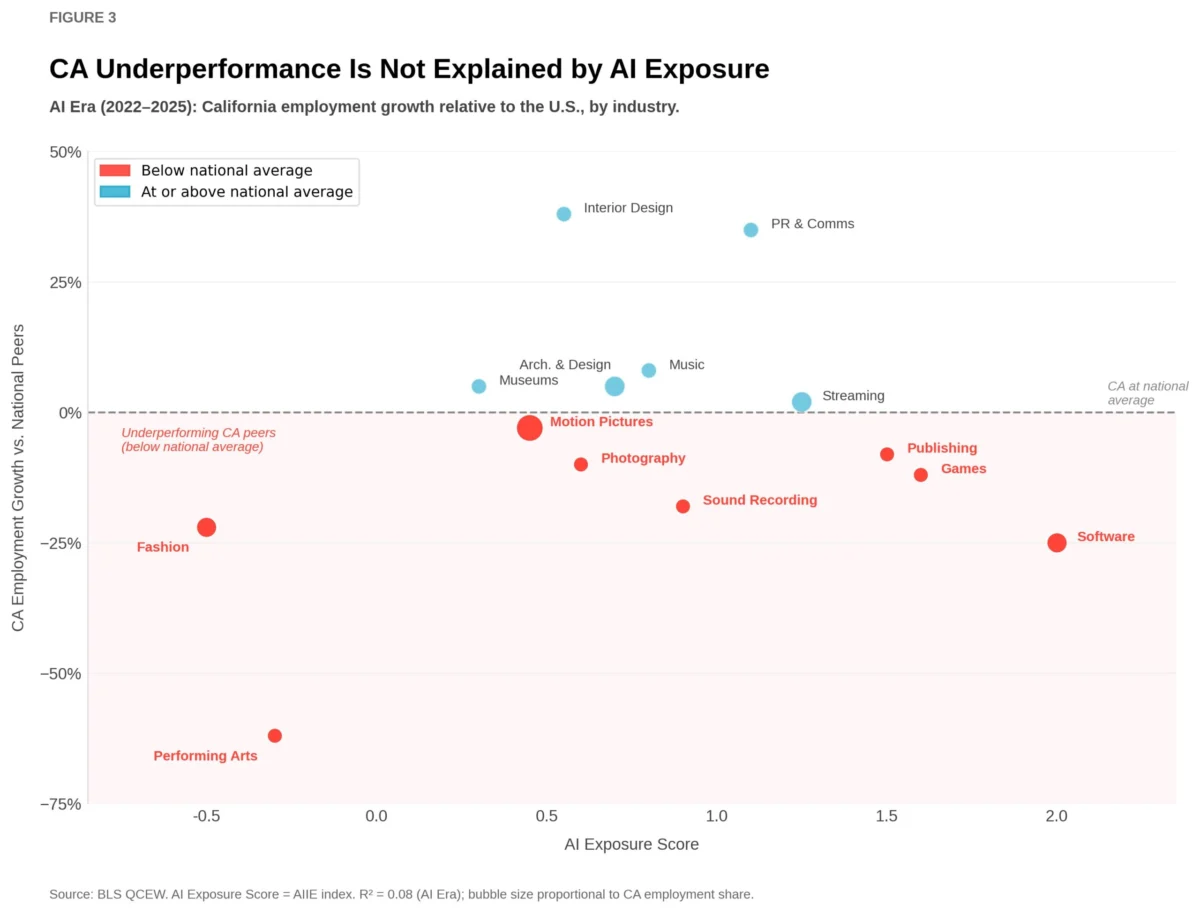
One of the most striking findings in the Otis College report is the resilience of roles most traditionally viewed as "exposed" to AI automation. In economic theory, "exposure" refers to the degree to which a machine or algorithm can perform the core tasks of a human worker. By this metric, writers, software developers, and graphic artists should have been the first to see their numbers dwindle.
However, the data shows the opposite. Job postings and total employment for these high-exposure creative roles have actually grown or remained stable during the period of 2022 to 2025. This paradox suggests that while AI can draft a script or generate an image, the demand for human expertise to direct, refine, and validate that output has increased.
The real driver of job loss in California appears to be a combination of "Peak TV" exhaustion and the high cost of living. As studios slashed production budgets to appease Wall Street, lower-paying and entry-level roles—often the backbone of the creative economy—were the first to be eliminated. Many of these workers have since left California entirely, driven out by the state’s soaring housing costs and the lack of mid-tier employment opportunities. Furthermore, the industry has seen a continued trend of "runaway production," where work is outsourced to states like Georgia or countries like Canada and the United Kingdom to take advantage of aggressive tax incentives.
AI as a Task-Based Tool, Not a Role Replacement
The qualitative portion of the research, which involved extensive interviews with creative professionals, provides a nuanced look at how AI is being integrated into modern workflows. A recurring theme emerged: AI is replacing specific tasks, not entire human beings.
In fields like visual effects (VFX) and post-production, AI is being utilized for labor-intensive, repetitive tasks such as rotoscoping (tracing over footage frame by frame) and wire removal. While these tools save time, they have not yet demonstrated the ability to handle complex creative decision-making. In fact, the report highlights that the use of AI often creates a new category of labor: the human "fixer."

One VFX company owner cited in the report described a major television production that attempted to use AI to streamline its pipeline. The result was not a smaller staff, but a redirected one. "They have 15 artists that are sitting at workstations fixing the AI," the owner noted. When the cost of these high-level artists is factored in against the time saved by the AI, the financial benefits often vanish. This phenomenon suggests that current generative AI models still require a high degree of human intervention—a "human-in-the-loop"—to meet the rigorous quality standards of professional entertainment.
The "Good Enough" Standard and Creative Devaluation
While the report offers some relief regarding total job displacement, it raises significant alarms about the quality and ethics of creative work in the AI era. Creative professionals interviewed for the study expressed concerns that management is increasingly prioritizing speed and cost-efficiency over artistic excellence.
One motion creative director highlighted a shift in the industry’s philosophical approach to quality, quoting a supervisor who said, "At a certain point, you just have to say it’s good enough." This "good enough" standard is viewed by many as the greatest threat posed by AI. There is a growing fear that as standards are lowered to accommodate the limitations of AI-generated content, the intrinsic value of human craft will be devalued, leading to a "race to the bottom" in terms of both creative output and compensation.
Furthermore, the report found that many workers are using AI in secret. Fearing they might be seen as replaceable or "lazy" by their peers or supervisors, some creatives hide their use of automation tools. This lack of transparency creates a fractured workplace culture where the true impact of the technology cannot be accurately assessed or regulated.
Recommendations for a Stable Creative Future
The authors of the report, Adler and Taner Osman, argue that the path forward for California’s creative economy requires a shift in how organizations manage technological transitions. The report suggests that the current atmosphere of skepticism and fear is actively hindering the productive adoption of AI.

To combat this, the researchers recommend that creative firms implement "firing freezes" or clear labor protections during the rollout of new AI tools. The logic is rooted in behavioral economics: workers who feel secure in their positions are more likely to experiment with new technologies, share insights with their colleagues, and help the company find the most effective ways to integrate AI. "Workers who know they will not be adopting themselves out of a job will experiment more openly," the authors explain.
Additionally, the report calls for a renewed focus on California’s competitiveness as a production hub. Addressing the cost-of-living crisis and expanding tax incentives for local production are seen as more critical to the state’s economic health than curbing AI development.
Conclusion: A Period of Structural Transformation
The Otis College of Art and Design 2026 report serves as a vital correction to the "AI-as-job-killer" narrative. While the loss of 114,000 jobs is a devastating blow to California’s creative workforce, the evidence points toward a complex intersection of post-pandemic economic correction, shifting consumer habits in the streaming market, and the end of the "Peak TV" spending spree.
AI is undoubtedly a disruptive force, but its current role is that of a powerful, albeit flawed, assistant. The challenge for the next five years will not be fighting the existence of AI, but rather managing the ethical and professional standards of its use. As Patrick Adler concluded, the adoption of AI would be "a lot faster, a lot deeper if creative workers had more trust in it." Building that trust will require a concerted effort from studio heads, labor unions, and policymakers to ensure that technology serves to enhance human creativity rather than merely diminish its cost.
The findings underscore a broader truth about the modern economy: technology rarely destroys work in a vacuum. Instead, it reshapes the landscape, creating new demands while making old methods obsolete. For California to remain the global capital of creativity, it must navigate this transition by protecting its most valuable asset—the human creators who turn data and algorithms into stories that resonate with the world.