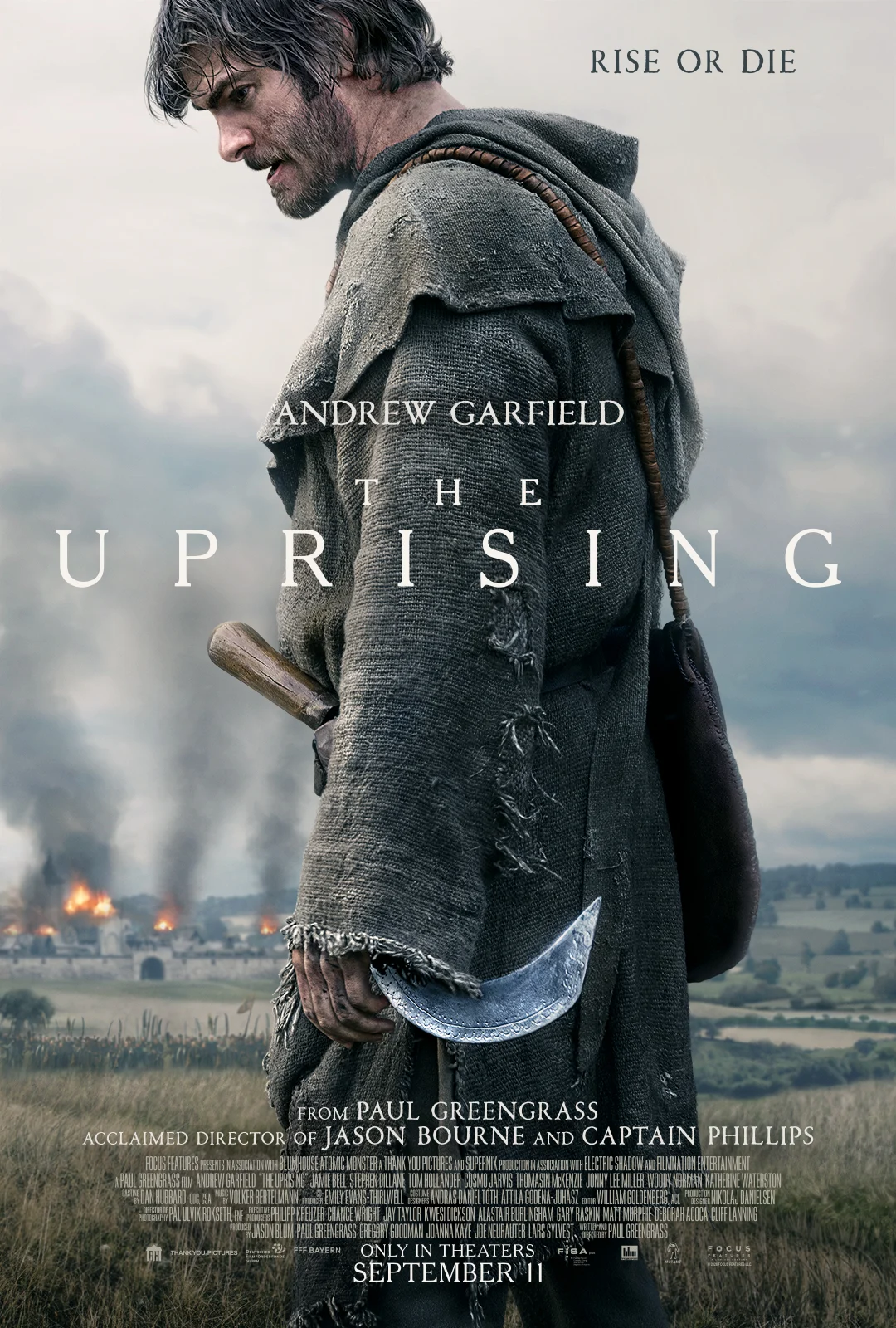
Focus Features has officially unveiled the first trailer for The Uprising, an expansive historical epic directed by Academy Award nominee Paul Greengrass. The film features a high-profile ensemble cast led by Andrew Garfield and is scheduled for a wide theatrical release on September 11. Set against the turbulent backdrop of 14th-century England, the production marks a significant return to large-scale historical storytelling for Greengrass, who also penned the screenplay. The narrative focuses on a pivotal moment in British history, centering on a populist revolt against the monarchy, specifically targeting the perceived tyranny of King Richard II.
The cast supporting Garfield includes several notable industry veterans and rising stars, such as Jamie Bell, Stephen Dillane, Tom Hollander, Cosmo Jarvis, Thomasin McKenzie, Jonny Lee Miller, Woody Norman, Katherine Waterston, and Sky Yang. The production is a collaborative effort involving Focus Features, which handles domestic distribution, and Universal Pictures International, managing the film’s global reach. As the trailer suggests, the film aims to blend visceral action sequences with a grounded exploration of social and political upheaval, a hallmark of Greengrass’s established directorial style.
Historical Foundation: The Reign of King Richard II and the 1381 Rebellion
The Uprising draws its primary inspiration from the Peasants’ Revolt of 1381, a major uprising across large parts of England. While the film’s synopsis emphasizes the "ferocious rebellion against the tyranny of King Richard II," historical context provides a more complex picture of the era. Richard II ascended to the throne in 1377 at the age of ten, inheriting a kingdom strained by the economic devastation of the Black Death and the ongoing financial drain of the Hundred Years’ War with France.
The immediate catalyst for the historical rebellion was the imposition of a third poll tax in 1381, which was viewed as a regressive and unfair burden on the lower classes. Historically, the revolt was led by figures such as Wat Tyler and the radical cleric John Ball. The rebellion saw thousands of people from Kent and Essex march on London, where they captured the Tower of London and executed high-ranking officials, including the Chancellor and the Archbishop of Canterbury. Andrew Garfield’s character appears to be a composite or a dramatized version of these legendary leaders, representing the voice of a populace pushed to the brink of survival.
The inclusion of King Richard II as a central antagonist provides a rich dramatic landscape. Richard II’s reign was characterized by a belief in the divine right of kings and an increasingly autocratic style of governance, which eventually led to his deposition in 1399. By focusing on this specific conflict, The Uprising explores themes of social inequality, the limits of sovereign power, and the cost of civil disobedience—themes that have historically resonated across different eras of filmmaking.
A High-Profile Ensemble and Creative Pedigree
The casting of Andrew Garfield in the lead role signifies a major acquisition for the project. Garfield, a two-time Academy Award nominee known for his work in Hacksaw Ridge and tick, tick… BOOM!, has a history of portraying characters driven by intense moral conviction. His involvement in a Paul Greengrass project suggests a focus on intense, character-driven drama amidst the chaos of historical warfare.

The supporting cast brings additional depth to the production. Jamie Bell, known for his versatility in films ranging from Billy Elliot to Rocketman, and Thomasin McKenzie, who gained acclaim for Jojo Rabbit and Last Night in Soho, represent a younger generation of talent capable of anchoring the film’s emotional stakes. The presence of veteran actors like Stephen Dillane (Game of Thrones) and Tom Hollander (The White Lotus) ensures that the political machinations of the royal court are portrayed with the necessary gravitas.
Paul Greengrass, the director at the helm, is renowned for his distinct visual language. Having directed three films in the Bourne franchise, as well as the critically acclaimed United 93 and Captain Phillips, Greengrass is famous for his use of handheld cameras and rapid-fire editing to create a sense of immediate, documentary-like realism. His previous foray into the historical genre, the Western News of the World starring Tom Hanks, demonstrated his ability to translate his kinetic style into a period setting. The Uprising appears to continue this trend, utilizing a gritty, desaturated palette to depict the harsh realities of medieval warfare.
Production Timeline and Release Strategy
The development of The Uprising has been a subject of industry interest for several months. Principal photography took place across various locations in the United Kingdom, utilizing historical sites to maintain a sense of period authenticity. The production design and costume departments were tasked with recreating the 14th-century aesthetic, focusing on the stark contrast between the opulence of the royal court and the destitution of the agrarian peasantry.
The decision to release the film on September 11 is a strategic move by Focus Features. This date places the film at the beginning of the autumn movie season, a period typically reserved for prestige dramas and potential awards contenders. By opting for a mid-September release, Focus Features allows the film to distance itself from the summer blockbuster window while establishing a presence before the crowded holiday season.
Industry analysts have noted that the release timing suggests a specific path for the film’s promotion. There is significant speculation regarding the film’s potential premiere at the Venice International Film Festival, which typically occurs in late August and early September. A successful debut at Venice could provide the critical momentum necessary for an awards campaign. However, the September 11 theatrical date makes it less likely that the film will follow the traditional festival circuit of Telluride, the Toronto International Film Festival (TIFF), or the New York Film Festival (NYFF), as those events often coincide with or follow the film’s commercial rollout.
Analyzing the Market and Genre Trends
The Uprising enters a cinematic landscape where historical epics have seen a resurgence in both interest and production scale. Following the footsteps of recent entries like Ridley Scott’s The Last Duel and Napoleon, as well as Robert Eggers’s The Northman, Greengrass’s film seeks to capture an audience that values high-stakes drama grounded in historical fact.
However, the genre faces specific economic challenges. Historical epics are notoriously expensive to produce, requiring extensive budgets for costuming, set construction, and large-scale practical effects. Focus Features, known for its curated slate of independent and prestige films, is taking a calculated risk with a production of this magnitude. The success of The Uprising will likely depend on its ability to transcend the "period piece" label and connect with contemporary audiences through its themes of rebellion and the struggle for justice.

Market data suggests that while the "sword and sandal" or medieval epic genre can be volatile at the box office, films that feature recognizable stars and high-intensity action tend to perform better internationally. The global appeal of Andrew Garfield, combined with the brand recognition of Paul Greengrass as an action-thriller director, provides the film with a competitive edge in foreign markets.
Broader Implications and Thematic Resonance
Beyond its entertainment value, The Uprising is positioned to spark discussions regarding the nature of governance and the rights of the governed. The trailer emphasizes the "army of the people," highlighting a populist movement that challenges the status quo. In a contemporary global climate characterized by political polarization and social movements, the film’s depiction of a 14th-century revolt may serve as a historical mirror for modern-day anxieties.
The narrative’s focus on King Richard II’s "might" versus the "people’s justice" frames the conflict in binary terms that are common in cinematic storytelling but remain relevant in political discourse. By dramatizing the fight for "justice and survival," the film taps into universal archetypes of the underdog hero standing against a monolithic power structure.
Furthermore, the film’s technical execution will be a point of interest for critics and audiences alike. The use of modern filmmaking techniques to portray historical events often results in a "visceral" experience that differs from the more stilted, theatrical historical dramas of the mid-20th century. If Greengrass succeeds in applying his signature tension-building techniques to the 14th century, The Uprising could redefine how medieval warfare is depicted on screen for the next decade.
Official Responses and Industry Outlook
While official statements from the cast and crew have been limited to promotional materials, the early reaction to the trailer among industry insiders has been focused on the film’s scale and Garfield’s performance. Focus Features has expressed confidence in the project, positioning it as one of their tentpole releases for the latter half of the year.
The film’s performance will be closely watched by studios considering similar mid-to-high-budget historical projects. If The Uprising manages to capture both critical acclaim and a significant theatrical audience, it may encourage further investment in adult-oriented historical dramas that prioritize narrative depth alongside spectacle.
As the September 11 release date approaches, Focus Features is expected to ramp up its marketing efforts, potentially including behind-the-scenes featurettes that highlight the historical research and physical training undertaken by the cast. The coming weeks will be crucial in determining whether The Uprising can transition from a highly anticipated trailer to a dominant force in the autumn cinematic calendar. For now, the film stands as a testament to the enduring power of historical narratives and the collaborative potential of some of the industry’s most respected creative voices.