The landscape of cinematic science fiction underwent a permanent paradigm shift in March 1956 with the theatrical release of Fred M. Wilcox’s groundbreaking feature film Forbidden Planet. Decades before the genre was dominated by modern space operas and philosophical odysseys like 2001: A Space Odyssey and Star Wars, this Metro-Goldwyn-Mayer production established a new benchmark for speculative storytelling, special effects, and world-building on the silver screen. Now, boutique home media distributor Arrow Video has officially released a brand-new trailer for a definitive 4K Limited Edition Blu-ray restoration of the classic film. Set to launch on September 28, 2026, this upcoming physical media release promises to present the quintessential space-age milestone in a format that honors its rich historical and visual legacy.
Main Facts and Release Details
The newly minted 4K Ultra HD and Blu-ray release, curated and distributed by Arrow Video, brings the mid-century classic back into the spotlight with unprecedented technical fidelity. For the first time in home video history, Forbidden Planet will be presented in its original theatrical Cinemascope aspect ratio of 2.55:1, accompanied by its historic "Perspecta" stereo soundtrack.
The comprehensive Limited Edition package is scheduled to hit the market on September 28, 2026. Pre-orders and purchase information are currently live via Arrow Films’ official distribution portal. The release targets cinephiles, classic film preservationists, and science fiction enthusiasts alike, offering a pristine digital restoration derived from archival elements to capture the vibrant color palette, intricate matte paintings, and pioneering optical effects that dazzled audiences nearly seven decades ago.

Historical Chronology and Production Background
To fully comprehend the significance of Arrow Video’s 2026 restoration, one must examine the timeline of the film’s creation and its subsequent cultural footprint:
- 1952–1955 (Development and Pre-Production): Writers Irving Block and Allen Adler conceived the initial narrative treatment, which screenwriter Cyril Hume later developed into a full-length feature script. The project was championed by producer Nicholas Nayfack at MGM, who envisioned a high-budget space adventure that drew heavy structural and thematic inspiration from William Shakespeare’s classic tragicomedy The Tempest.
- March 1956 (Theatrical Debut): Forbidden Planet premiered in United States cinemas, stunning viewers with its sophisticated depiction of interstellar travel, fully realized futuristic technology, and an eerie, groundbreaking all-electronic musical score composed by Louis and Bebe Barron.
- 1960–1964 (Career Context): Directed by Fred M. Wilcox—whose career included directing iconic animal-centric pictures like Lassie Come Home (1943) and Courage of Lassie (1946)—the film stood as one of his final cinematic endeavors before his passing in 1964, following his 1960 drama I Passed for White.
- 2006 (50th Anniversary): Warner Home Video celebrated the film’s golden jubilee with a special-edition DVD release, introducing retrospective documentaries and audio commentaries to a new generation of home video collectors.
- September 2026 (4K Restoration Era): Arrow Video steps in to provide the ultimate physical media treatment, utilizing advanced restoration technology to reintroduce the film in its original wide-screen theatrical dimensions.
Narrative Premise and Setting
Set in the 23rd century, the plot of Forbidden Planet follows the crew of the United Planets starship C-57D, dispatched on a deep-space rescue and reconnaissance mission to the remote, isolated world of Altair IV. Their objective: to determine the fate of the Bellerophon, an exploratory expedition that vanished decades earlier without a trace.
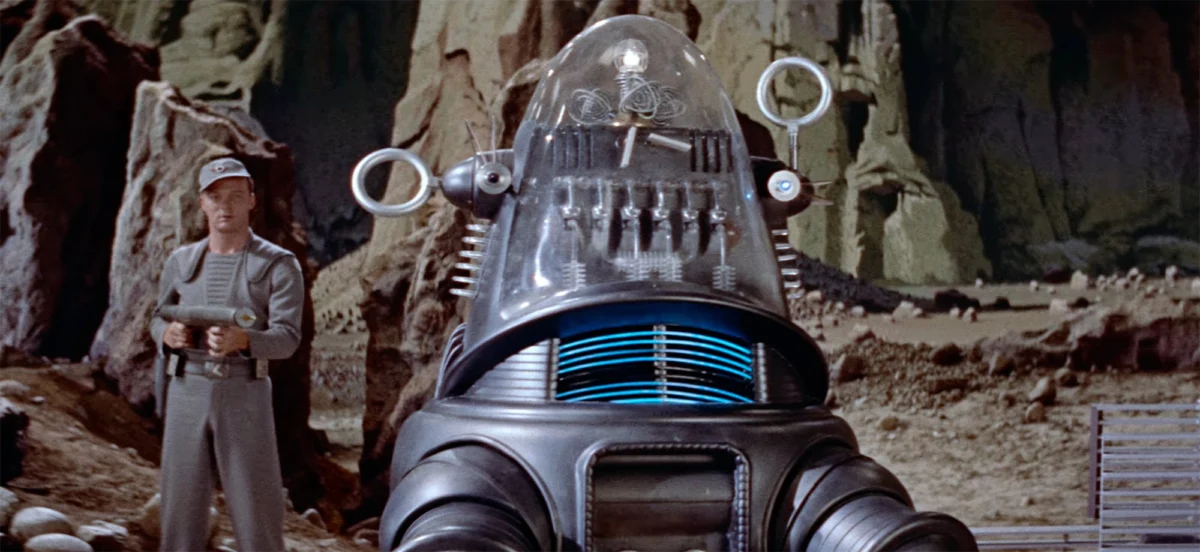
Upon arrival, the rescue crew—led by Commander John Adams, portrayed by a young Leslie Nielsen—receives stern, urgent warnings from the planet’s surface demanding that they turn back immediately. Ignoring the broadcast, Adams and his officers land and encounter the sole survivors of the ill-fated Bellerophon expedition: Dr. Edward Morbius, played with intense gravity by Walter Pidgeon; his strikingly naive daughter, Altaira, played by Anne Francis; and Robby the Robot, an engineering marvel who would instantly cement his status as one of the most recognizable mechanical icons in pop culture history.
As the narrative unfolds, Commander Adams and his crew discover that the entire Bellerophon crew was obliterated by a terrifying, unseen entity—a destructive force native to Altair IV that has awakened once more. The ensuing mystery forces the characters to confront the dormant, subterranean remnants of a hyper-advanced, long-extinct alien civilization known as the Krell, whose boundless technological achievements ultimately served as their own undoing.

Cast and Creative Ensemble
The enduring legacy of Forbidden Planet is anchored by a remarkable ensemble cast and a visionary behind-the-scenes creative team. Walter Pidgeon delivers a towering performance as Dr. Morbius, capturing the tragic hubris of a brilliant scientist whose intellect blinds him to the dangers of his own subconscious. Anne Francis brings a unique innocence and grace to the role of Altaira, the young woman raised entirely in isolation from human society.
Meanwhile, Leslie Nielsen demonstrates formidable dramatic presence as Commander John Adams, long before his transition into iconic comedic roles in films like Airplane! and The Naked Gun. Supporting performances are rounded out by Warren Stevens as the ship’s pragmatic medical officer, Lieutenant "Doc" Ostrow. Behind the scenes, the physical construction of Robby the Robot—designed by Arnold Gillespie, Irving Block, and masterminded by the MGM prop department—cost an estimated $100,000 at the time, making it one of the most expensive and sophisticated cinematic props of the 1950s.
Industry Significance and Cultural Implications
Film historians widely regard Forbidden Planet as the foundational blueprint for modern science fiction cinema. Before its release, cinematic science fiction was frequently relegated to low-budget, campy B-movies laden with rubber monsters and cardboard sets. MGM’s financial and artistic investment in Forbidden Planet elevated the genre, proving that speculative fiction could command serious production values, philosophical depth, and sophisticated art direction.
The film’s impact on subsequent generations of filmmakers is immeasurable. The sleek aesthetics of the C-57D starship, the sterile efficiency of futuristic command decks, and the concept of autonomous robotic companions directly influenced landmark franchises such as Star Trek, Star Wars, and Ridley Scott’s Alien. Furthermore, the eerie, avant-garde sound design crafted by Louis and Bebe Barron represents a milestone in electronic music history, predating the widespread use of synthesizers in mainstream media by more than a decade.

By partnering with rightsholders to issue this comprehensive 4K Limited Edition Blu-ray, Arrow Video continues a vital tradition of cinematic preservation. As high-definition and ultra-high-definition home video formats push the boundaries of visual clarity, historical restorations ensure that foundational works like Forbidden Planet remain accessible, pristine, and visually arresting for contemporary audiences. The September 28, 2026 release offers a rare opportunity for movie lovers to experience a piece of cinematic history restored to the exact specifications intended by its creators nearly seventy years ago.