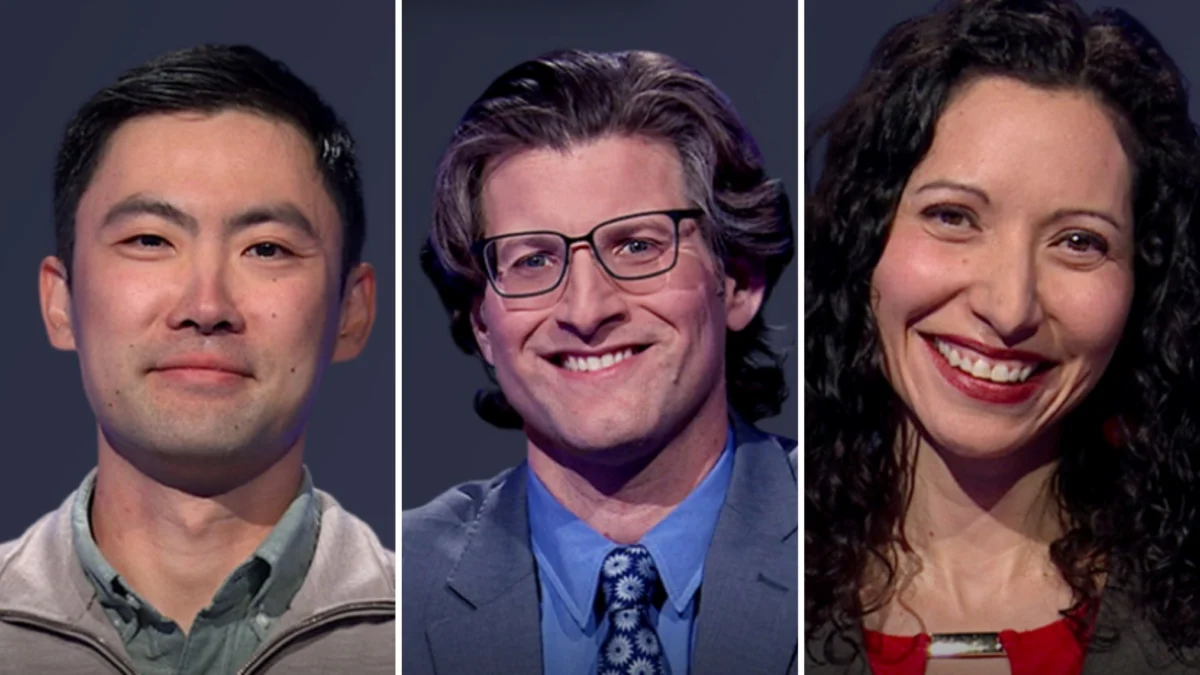
The landscape of the current Jeopardy! season shifted significantly on May 26 as Chris D’Angelo, a content manager hailing from Washington, D.C., successfully defended his podium for the fifth consecutive time. This milestone victory not only bolstered his career earnings to nearly six figures but also officially punched his ticket to the prestigious Tournament of Champions (ToC). Entering the episode with a four-day total of $83,600, D’Angelo faced off against two formidable challengers: Rebecca Joseph, a senior cost accountant from Denver, Colorado, and Chenfei Lu, a data scientist from San Francisco, California. The resulting match was a masterclass in strategic wagering and category dominance, despite a late-game stumble in the Final Jeopardy! round that ultimately did not impede D’Angelo’s path to the winner’s circle.
The Jeopardy! Round: A Battle for Early Momentum
The game commenced with a high-speed exchange of knowledge between D’Angelo and Lu. From the first clue, it was evident that the match would be a contest of reflexes as much as intellect. Lu, leveraging his background as a data scientist, showed early proficiency in technical and analytical categories, while D’Angelo maintained the steady, methodical pace that had characterized his previous four victories. By the first commercial break—traditionally occurring after the 15th clue—the scores reflected a tightly contested game. D’Angelo held a narrow lead with $3,600, closely pursued by Lu at $3,000, while Joseph struggled to find her rhythm in the early going.
The momentum shifted decisively on the 20th clue of the round when D’Angelo uncovered the first Daily Double in the category "Archaeology." At this juncture, D’Angelo held $4,600, a mere $600 lead over Lu. Demonstrating the aggressive "game theory" approach often utilized by modern Jeopardy! champions, D’Angelo opted for a "True Daily Double," wagering his entire $4,600. The clue was: "In 2025, 22 massive stone blocks were recovered from the Mediterranean seabed off Egypt, remnants of this ancient wonder." D’Angelo correctly identified the "Lighthouse of Alexandria," doubling his score to $9,200. This strategic move provided him with the financial cushion necessary to dictate the pace for the remainder of the round. At the conclusion of the first half, D’Angelo sat comfortably at $10,800, with Lu in second at $4,800 and Joseph trailing at $400.
Double Jeopardy! and the Impact of Daily Double Misses
As the contestants moved into the Double Jeopardy! round, the game was defined by the high-stakes nature of the remaining Daily Doubles. These pivotal clues often serve as the "great equalizer" in Jeopardy!, allowing trailing contestants to leapfrog the leader or cementing a frontrunner’s "runaway" status. In this instance, the Daily Doubles acted as a barrier for the challengers rather than a bridge.
The first Daily Double of the second round was found by Rebecca Joseph on the seventh clue in the category "2-Word Magazine Titles." With $2,000 in her bank, Joseph wagered $1,000, seeking to close the gap. The clue stated: "It now publishes a large-print edition to go along with its familiar 5.5-inch by 7.5-inch version." Joseph incorrectly guessed TV Guide, a logical but ultimately incorrect response. The correct answer was Reader’s Digest, causing her total to drop to $1,000.
Shortly thereafter, Chenfei Lu located the final Daily Double on the 11th clue in "Overseas Territories." Holding $7,600 and trailing D’Angelo’s mounting total, Lu wagered $2,500. The clue read: "This island found by the Royal Navy in 1767 is still British territory, so mutineers, think twice about heading there." Lu responded with "Bermuda," failing to identify the historical reference to the HMS Bounty mutineers. The correct response, Pitcairn Island, resulted in Lu dropping to $5,100.
These two misses proved catastrophic for the challengers. By the end of the Double Jeopardy! round, D’Angelo had amassed a massive lead of $19,200. Lu remained in second place with $5,100, while Joseph held $2,200. Because D’Angelo’s score was more than double that of his nearest competitor, he entered the Final Jeopardy! round with a "runaway," meaning he had mathematically secured the win regardless of the final outcome, provided he did not wager an excessive amount.
Final Jeopardy! and the Literary Conundrum
The Final Jeopardy! category was "Famous Lines From Literature," a category that typically rewards contestants with a deep knowledge of 19th-century classics. The clue presented to the three players was: "Both the first line & the last line of this 1859 novel begin with ‘It.’"
The clue required contestants to recall the specific phrasing of Charles Dickens’ A Tale of Two Cities. The novel famously begins with "It was the best of times, it was the worst of times," and concludes with the reflection of Sydney Carton: "It is a far, far better thing that I do, than I have ever done; it is a far, far better rest that I go to than I have ever known."
Both Joseph and Lu correctly identified the novel. Joseph wagered $2,100, bringing her final total to $4,300. Lu, playing conservatively to protect his second-place standing, wagered a mere $67, finishing with $5,167. D’Angelo, however, provided an incorrect response, guessing Uncle Tom’s Cabin (which was published in 1852, not 1859). Despite the error, his wager of $5,800 was calculated to ensure victory even with a miss. He finished the game with $13,400, bringing his five-day winnings to $97,000.
Historical Context and Tournament of Champions Eligibility
D’Angelo’s fifth victory is a significant milestone in the context of Jeopardy! history. For many years, the show maintained a "five-game limit," where champions were retired after their fifth win. This rule was famously abolished in 2003, paving the way for legendary runs by Ken Jennings, James Holzhauer, and Amy Schneider. Today, reaching the five-game mark is the traditional "gold standard" for qualifying for the Tournament of Champions.
The Tournament of Champions is an annual (or semi-annual) event featuring the most successful players from the previous season. While the show’s producers occasionally invite four-day champions with high total winnings, a five-day win streak virtually guarantees a spot in the field. D’Angelo joins an elite group of players for the upcoming ToC cycle. His average winning per game of $19,400 places him as a statistically solid competitor, though he will face stiff competition from "super-champions" who have achieved double-digit win streaks.
The D.C. native’s performance has been characterized by strong "Coryat" scores—a measure of a player’s performance that excludes wagering—suggesting that his success is rooted in a broad knowledge base rather than lucky breaks on Daily Doubles alone. His ability to recover from a missed Final Jeopardy! clue and still walk away with a five-figure daily total speaks to the efficiency of his gameplay in the first two rounds.
Broader Implications and the Competitive Landscape
D’Angelo’s ascent comes at a time when Jeopardy! viewership remains high, fueled by the intrigue of long-running champions. The "ToC Tracker," a fan-monitored leaderboard, now officially lists D’Angelo as a qualified participant. For the show’s producers, having a steady stream of five-day champions is essential for maintaining the prestige of the Tournament of Champions.
Analysts of the game note that D’Angelo’s success may be attributed to his "buzzer timing," a crucial and often overlooked element of the game. In his match against Lu and Joseph, D’Angelo successfully "in-buzzed" his opponents on several high-value clues in the Double Jeopardy! round, preventing them from gaining the momentum needed to hunt for Daily Doubles. This defensive style of play is increasingly common among champions who seek to "lock" the game before the final segment.
Furthermore, D’Angelo’s background as a content manager may provide him with a unique advantage in parsing clue phrasing. Jeopardy! clues are often written with "pins" or "hints" embedded in the text, and a professional familiarity with language structure can assist in deciphering complex clues under time pressure.
Looking Ahead: The Quest for a Sixth Win
With his fifth win secured and his place in Jeopardy! history cemented, Chris D’Angelo moves on to his sixth game. The psychological pressure of qualifying for the ToC often results in a "release" for champions, allowing them to play more freely in subsequent matches. Conversely, the physical and mental exhaustion of a multi-day filming schedule—where five episodes are typically taped in a single afternoon—can become a factor.
The upcoming match on Wednesday will determine if D’Angelo can break into the six-figure earnings bracket and continue his climb up the all-time leaderboards. Regardless of the outcome of his next game, D’Angelo has established himself as the dominant force of the current stretch of the season. His journey from a Washington, D.C. content manager to a nationally recognized Jeopardy! champion serves as a testament to the enduring appeal of the program and the high level of competition found on the Alex Trebek Stage.
As the season progresses, fans will be watching to see how D’Angelo’s stats compare to other qualifying champions. For now, he stands as a proven winner, a strategic gambler, and the latest member of the elite Tournament of Champions roster. Jeopardy! continues to air on weekdays, with viewers encouraged to check local listings for exact times, or stream episodes the following day on platforms such as Hulu and Peacock.