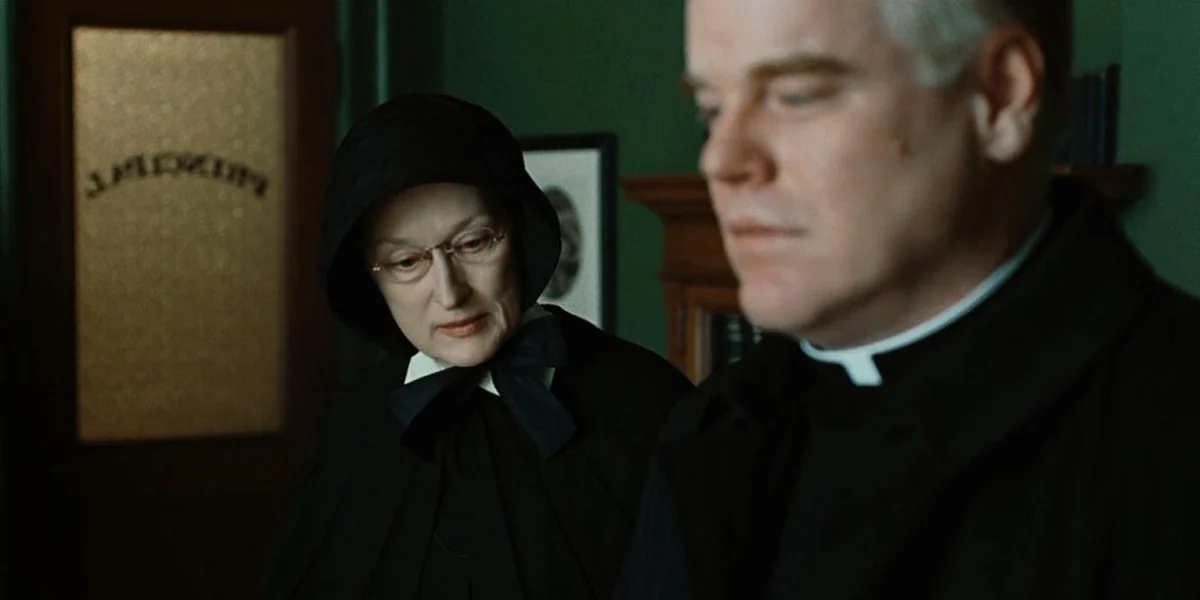
The 2008 film adaptation of John Patrick Shanley’s Pulitzer Prize and Tony Award-winning play, "Doubt: A Parable," serves as a rigorous exploration of the tensions inherent in institutional transition, the nature of moral certainty, and the complexities of human conviction. Directed by Shanley himself and set against the backdrop of St. Nicholas Church and School in the Bronx during the autumn of 1964, the narrative captures a pivotal moment in American history. This period was characterized by the intersection of the Roman Catholic Church’s internal modernization and the broader societal upheavals of the 1960s. The film features a central conflict between Sister Aloysius Beauvier (Meryl Streep), a rigid school principal, and Father Brendan Flynn (Philip Seymour Hoffman), a progressive and charismatic priest, triggered by an allegation of misconduct involving the school’s first African American student.
Historical Context and the Catalyst of Vatican II
To understand the friction within "Doubt," one must examine the ecclesiastical climate of 1964. The Roman Catholic Church was in the midst of the Second Vatican Council (Vatican II), which lasted from 1962 to 1965. Initiated by Pope John XXIII, the council sought an aggiornamento, or a "bringing up to date," of the Church’s practices to better engage with the modern world. These reforms included the transition from the Latin Tridentine Mass to the vernacular (the local language of the people), the priest facing the congregation rather than the altar, and a general move toward a more pastoral, community-oriented approach.
In the film, Father Flynn represents this "New Church." He advocates for a more relatable clergy, suggests including secular music like "Frosty the Snowman" in the Christmas pageant, and emphasizes the importance of compassion over fear. Conversely, Sister Aloysius embodies the "Old Church"—an institution built on strict hierarchy, discipline, and the preservation of tradition. For her, the modernization of the Church is not progress but a dilution of the moral fortitude required to protect the faithful. The clash between these two figures is a microcosm of the global Catholic experience during the mid-1960s, where generational divides were exacerbated by rapid theological shifts.
The Socio-Political Landscape of 1964
The year 1964 was a transformative period in American history, providing a volatile setting for a story about the erosion of traditional authority. By the time the film’s events unfold, the United States had recently mourned the assassination of President John F. Kennedy, the nation’s first Catholic president. The Civil Rights Act of 1964 had been signed into law, legally ending segregation in public places and banning employment discrimination. However, racial tensions remained high, as evidenced by the film’s inclusion of Donald Miller, the first Black student at St. Nicholas.
The broader counterculture movement was also gaining momentum. The publication of Betty Friedan’s "The Feminine Mystique" in 1963 had ignited second-wave feminism, challenging the traditional roles of women in society and the Church. Simultaneously, the escalation of the Vietnam War and the burgeoning anti-war protests signaled a growing skepticism toward government and institutional leadership. This pervasive atmosphere of questioning and unrest informs the character of Sister Aloysius, who views the changing world with deep suspicion, and Father Flynn, who attempts to navigate it with empathy.
Chronology of the Conflict
The narrative progression of "Doubt" is structured as a series of intellectual and moral skirmishes that escalate into a definitive confrontation.
- The Sermon on Doubt: Father Flynn delivers a sermon to the congregation regarding the nature of doubt, suggesting that it can be a bonding experience as powerful as certainty. This immediately draws the scrutiny of Sister Aloysius.
- The Observation: Sister Aloysius instructs the younger, more impressionable Sister James (Amy Adams) to remain vigilant of Father Flynn’s interactions with the students.
- The Incident: Sister James observes a private meeting between Father Flynn and Donald Miller, after which the boy appears distressed and smells of alcohol. She reports this to Sister Aloysius.
- The Pageant Meeting: Under the guise of discussing the Christmas pageant, Sister Aloysius confronts Father Flynn with her suspicions. Flynn provides a plausible explanation: he caught Donald drinking altar wine and was protecting the boy’s position as an altar boy.
- The Escalation: Unsatisfied with Flynn’s explanation and lacking concrete evidence, Sister Aloysius begins a "crusade" to remove him. She contacts the boy’s mother, Mrs. Muller (Viola Davis), and eventually threatens to contact Flynn’s previous parishes to uncover a history of misconduct.
- The Resolution: Faced with Sister Aloysius’s relentless pressure and her claim (later revealed to be a strategic lie) that she had spoken to a nun at his former parish, Father Flynn resigns.
Analytical Data and Critical Reception
Upon its release in December 2008, "Doubt" received significant critical acclaim, particularly for its screenplay and performances. The film holds a "Certified Fresh" rating on Rotten Tomatoes, with critics praising the "acting masterclass" provided by the lead quartet.
The film’s impact is reflected in its award season performance:
- Academy Awards: The film received five nominations, including Best Actress (Streep), Best Supporting Actor (Hoffman), Best Supporting Actress (both Adams and Davis), and Best Adapted Screenplay (Shanley). This marked a rare instance where all four lead and supporting actors in a single film were nominated for Oscars.
- Box Office: Produced on a modest budget of approximately $20 million, the film grossed over $50.9 million worldwide, demonstrating a strong public interest in serious, dialogue-driven adult drama.
- Cultural Influence: The film is frequently cited in academic discussions regarding the "parable" nature of the story, where the audience is left to weigh the lack of physical evidence against the intuitive certainty of the characters.
The Significance of the Supporting Performances
While the central duel between Streep and Hoffman drives the plot, the roles of Sister James and Mrs. Muller provide the necessary ethical and social dimensions to the story. Amy Adams’ Sister James represents the "innocent bystander" or the average individual caught between conflicting authorities. Her struggle to maintain her faith in both her superior and her colleague reflects the confusion felt by many during times of institutional crisis.
Viola Davis’s single-scene performance as Mrs. Muller is often cited as one of the most powerful moments in modern cinema. Her character introduces the reality of 1964 racial dynamics. Mrs. Muller’s primary concern is her son’s survival and his opportunity for an education in a hostile environment. Her refusal to join Sister Aloysius’s crusade—even if the allegations are true—highlights a pragmatic, survivalist perspective that complicates Sister Aloysius’s black-and-white moral worldview. Davis’s performance underscores the fact that for many marginalized communities, institutional "morality" is often a secondary concern to physical and social safety.
Technical Execution and Visual Language
Director John Patrick Shanley collaborated with acclaimed cinematographer Roger Deakins to translate the stage play’s intimacy to the screen. To heighten the sense of psychological instability, Deakins utilized "Dutch angles" (canted frames) during moments of high tension, particularly in the office confrontations. The visual language of the film emphasizes the isolation of the characters within the cold, stone architecture of the church and school.
The use of natural elements, such as wind and rain, serves as a recurring motif for the "winds of change" sweeping through the institution. The lighting often leaves characters in partial shadow, visually representing the "grey areas" and the "doubt" that the title suggests. These technical choices ensure that the film transcends being a mere "filmed play" and becomes a distinct cinematic experience that utilizes visual cues to reinforce its thematic depth.
Broader Implications and Institutional Legacy
"Doubt" remains a relevant text in the study of institutional power and the burden of proof. It poses difficult questions about the ethics of "doing the right thing for the wrong reasons." Sister Aloysius succeeds in removing Father Flynn, but she does so by stepping outside the rules of her order—lying and bypassing the male-dominated hierarchy of the Church that she otherwise purports to respect.
The film also serves as a precursor to the real-world revelations regarding the Catholic Church’s handling of clergy misconduct. While the film purposefully leaves Father Flynn’s guilt or innocence ambiguous, it highlights the systemic vulnerabilities within an institution where authority is rarely questioned and internal "crusades" are the only means of accountability.
Ultimately, the film’s conclusion—where Sister Aloysius breaks down and confesses, "I have such doubts"—suggests that certainty is often a mask for fear. In the context of 1964, a year of monumental change, "Doubt" argues that the loss of absolute certainty is not necessarily a failure of faith, but a necessary, albeit painful, part of the human condition. The film stands as a testament to the idea that in the face of rapid societal transformation, the most dangerous position is not doubt, but the refusal to acknowledge the possibility of being wrong.