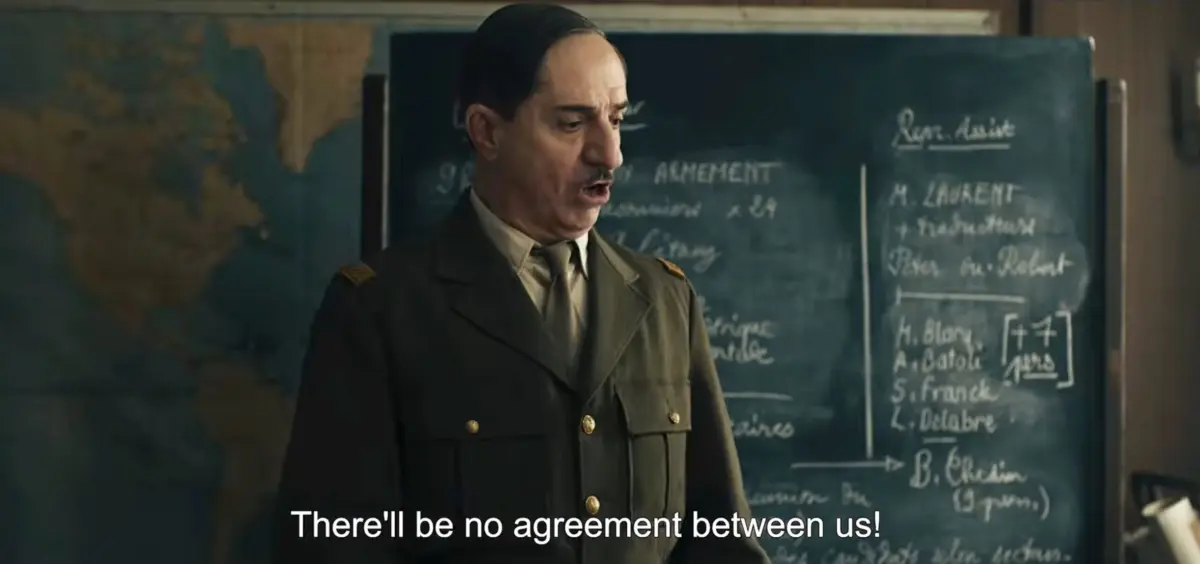
Samuel Goldwyn Films has officially unveiled the final United States trailer and official promotional poster for De Gaulle – Part II: Liberty, the concluding half of director Antonin Baudry’s sweeping two-part historical epic centered on the life and wartime leadership of French statesman and general Charles de Gaulle. Following the theatrical and Video-on-Demand rollout of the first installment, titled De Gaulle – Part 1: Resistance (known in France by its domestic titles Tilting Iron and The Sovereign Edge), this second feature brings the ambitious biographical project to its emotional and historical climax. Both films originally made their global debut at the 2026 Cannes Film Festival before opening in French cinemas earlier this year. With the first part arriving in North American markets in November, Part II is scheduled for its domestic debut on December 4, 2026.
Chronology of a Statesman: From Collapse to Liberation
The cinematic narrative of Baudry’s duology spans the most turbulent and transformative years of modern French history, beginning in the catastrophic summer of 1940. The plot chronicles the rapid collapse of France in June 1940, the signing of the armistice with Nazi Germany, and the refusal of a relatively unknown brigadier general to accept defeat. Against all odds, Charles de Gaulle fled to London to establish the Free French Forces, rallying a disparate group of exiled soldiers, rebellious students, and underground resistance fighters across England, France, and colonial Africa.

While the first installment focuses heavily on the uphill political and moral battle to establish a legitimate government-in-exile, De Gaulle – Part II: Liberty shifts its narrative weight toward the dramatic military campaigns and high-stakes geopolitical maneuvering of 1944 and 1945. Set against the backdrop of the D-Day landings and the triumphant march toward Paris, the second film portrays De Gaulle’s fierce diplomatic and political outfoxing of his primary rival, General Henri Giraud—played by Thierry Lhermitte—for control over liberated France’s provisional government. Simultaneously, the plot highlights the brilliant battlefield tactics of his protégé, General Leclerc, portrayed by Niels Schneider, as he leads the intrepid L Force against the formidable German Panzerarmee in southern Tunisia at the Mareth Line and Ksar Ghilane.
Production Background and Creative Vision
The monumental two-part project is helmed by Antonin Baudry, marking his sophomore feature-film directing effort following his critically acclaimed 2019 directorial debut, The Wolf’s Call (Le Chant du Loup). Baudry co-wrote the screenplays alongside Bérénice Vila, drawing inspiration from historian Julian Jackson’s acclaimed biographical work, De Gaulle: A Certain Idea of France. The duology is produced by Axelle Boucaï and Pathé, representing one of the most financially ambitious and visually grand historical undertakings in recent French cinema.
Leading the massive international cast is acclaimed actor Simon Abkarian, who steps into the formidable role of Charles de Gaulle. Abkarian’s performance anchors the narrative, capturing the stubborn resilience, visionary authority, and relentless nationalist fervor that defined the historical figure. The supporting ensemble features notable French talent, including Thierry Lhermitte as General Henri Giraud and Niels Schneider as General Leclerc, supported by rigorous period detail, sprawling battle sequences, and meticulous set design intended to authentically recreate the friction of the Second World War.

Strategic Distribution and Marketing Approach
Samuel Goldwyn Films has structured the North American rollout of the duology as a sequential theatrical and digital event. De Gaulle: Resistance was released on November 6, 2026, establishing the foundational stakes of the narrative for American audiences before the December 4 release of De Gaulle – Part II: Liberty. The newly released trailer leans heavily into the kinetic action of the war story, highlighting sweeping desert warfare, tense underground resistance operations, and grand geopolitical summits alongside historical heavyweights such as Winston Churchill and Franklin D. Roosevelt.
This marketing strategy reflects a deliberate effort to position the European historical drama not merely as a localized biography, but as an internationally accessible war epic. By highlighting the tactical engagements in North Africa alongside the liberation of Paris, the distributors aim to engage viewers drawn to classic military history while maintaining the political drama inherent to De Gaulle’s rise to power.
Historical Implications and Cultural Resonance
The release of the De Gaulle duology arrives at a time of renewed global interest in biographical cinema that examines the fragile nature of democratic institutions and national identity during times of crisis. Charles de Gaulle remains one of the most polarizing and revered figures in modern European history, having transformed from a dissenting exile into the foundational architect of the French Fifth Republic.

Film critics and historians note that Baudry’s films avoid hagiography by focusing on the intense political friction, institutional resistance, and personal isolation De Gaulle faced during the early years of World War II. By illustrating the friction between the Free French and Allied leadership—particularly regarding sovereignty, military autonomy, and post-war governance—the films provide contemporary audiences with a detailed examination of statecraft under extreme duress.
As De Gaulle – Part II: Liberty prepares for its North American theatrical and VOD release in December 2026, it completes a cinematic journey nearly a decade in the making. Whether the duology will achieve enduring status alongside classic European war epics remains to be seen, but its technical ambition, scale, and uncompromising focus on a pivotal historical pivot point ensure its place as a significant cultural artifact of contemporary French cinema.