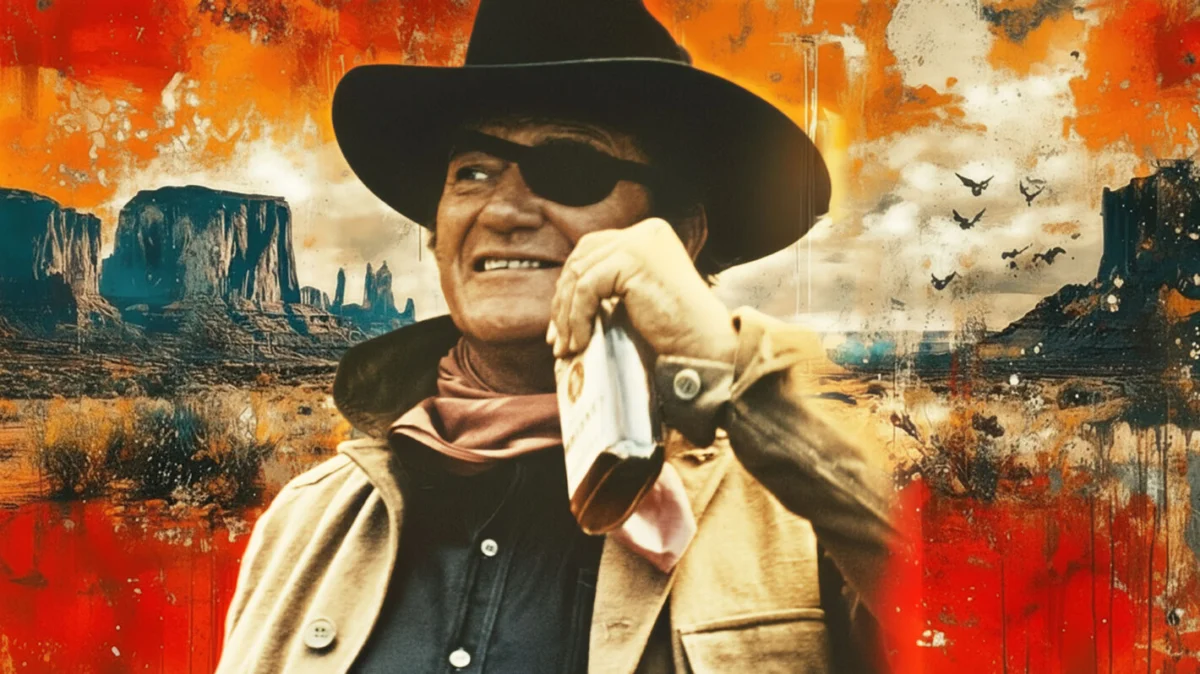
The release of the motion picture True Grit in the summer of 1969 marked a transformative moment in American cinema, signaling both the evolution of the Western genre and the crowning achievement of John Wayne’s prolific five-decade career. Based on the 1968 novel by Charles Portis, the film introduced audiences to Reuben "Rooster" Cogburn, a U.S. Marshal characterized by his one eye, heavy drinking, and uncompromising approach to frontier justice. While John Wayne had long been the face of the American hero, his portrayal of Cogburn offered a more complex, "craggy and cranky" antihero that resonated with a changing cultural landscape. The film’s success was not merely a result of its star power; it was the product of a high-quality screenplay by Marguerite Roberts, a meticulously crafted source novel, and a production that bridged the gap between traditional Hollywood and the burgeoning New Hollywood era.
The Literary Foundation: Charles Portis and the Genesis of Rooster Cogburn
The journey of True Grit began with Charles Portis, a former journalist for the New York Herald Tribune, whose second novel became an immediate literary sensation. Published in 1968, the novel is narrated by Mattie Ross, a 14-year-old girl seeking to avenge her father’s murder at the hands of a drifter named Tom Chaney. To accomplish this, she enlists the help of Rooster Cogburn, described as the "meanest" U.S. Marshal available.
Portis’s writing was praised for its spare, rhythmic prose and its authentic recreation of 19th-century Arkansas and the Indian Territory (modern-day Oklahoma). The novel was serialized in The Saturday Evening Post before its hardcover release, quickly garnering critical acclaim and catching the attention of Hollywood producers. Unlike many Westerns of the era, True Grit focused on the unlikely partnership between a headstrong young girl, a grizzled lawman, and a Texas Ranger, blending dry humor with stark violence. This unique tonal balance provided the perfect blueprint for a cinematic adaptation that would stand apart from the standard "oater" Westerns of the mid-20th century.
The Production Context: Marguerite Roberts and the Hollywood Blacklist
One of the most significant aspects of the production of True Grit was the involvement of screenwriter Marguerite Roberts. Her participation was noteworthy not only for the quality of her work but for the political context surrounding her career. Roberts had been a successful screenwriter in the 1930s and 40s but was blacklisted in 1951 after refusing to testify before the House Un-American Activities Committee (HUAC). She did not work for a major studio for nine years, only returning to the industry as the blacklist began to crumble in the 1960s.
John Wayne, a staunch conservative and a prominent figure in the Motion Picture Alliance for the Preservation of American Ideals, was known for his vocal anti-communist stances. However, in a move that surprised many industry observers, Wayne championed Roberts’ work. He famously referred to her adaptation of True Grit as "the best script I’ve ever read." Wayne’s insistence that Roberts receive full screen credit and his public support for her contribution underscored a professional pragmatism that prioritized the quality of the art over the political divisions of the time. This collaboration between a conservative icon and a formerly blacklisted writer remains a poignant chapter in Hollywood history, illustrating the unifying power of a compelling narrative.
Chronology of Production and Casting
The development and filming of True Grit followed a structured timeline that maximized the film’s impact upon its 1969 release:
- 1968 (Early): Charles Portis’s novel is published and becomes a bestseller. Paramount Pictures secures the film rights for $300,000, a significant sum for the time.
- 1968 (Mid): Veteran director Henry Hathaway is brought on board. Hathaway, known for his disciplined and traditional directing style, had previously worked with Wayne on films like The Sons of Katie Elder (1965).
- 1968 (Late): Casting begins. While Wayne was the immediate choice for Cogburn, the role of Mattie Ross was more difficult to fill. Mia Farrow was initially considered but declined. Kim Darby, then 21 but possessing a youthful appearance, was eventually cast. Country music star Glen Campbell was selected for the role of Texas Ranger La Boeuf to appeal to younger audiences and the burgeoning country-pop demographic.
- September – December 1968: Principal photography takes place. Filming primarily occurred in the San Juan Mountains of Colorado, specifically around Ouray and Ridgeway, as well as at Mammoth Lakes and Sherwin Summit in California. The mountainous terrain provided a lush, scenic backdrop that contrasted with the grittier, desert-based Westerns of the era.
- June 11, 1969: True Grit premieres in the United States, receiving immediate critical and commercial success.
Supporting Data: Box Office and Critical Performance
True Grit was a major financial success for Paramount Pictures. Produced on a budget of approximately $4.5 million, the film grossed over $31 million at the North American box office. Adjusted for inflation, this remains one of the most successful Westerns in cinematic history.
Critics were nearly unanimous in their praise for John Wayne’s performance. While he had played variations of the "tough lawman" for decades, the role of Rooster Cogburn allowed him to lean into his age and physicality. At 61 years old, Wayne used his real-life health struggles—having lost a lung to cancer surgery in 1964—to inform the character’s labored breathing and weary movements. The "one-eyed" look, achieved with a distinctive eye patch, became an instant iconographic image.
The film’s supporting cast also received attention, though reactions were more mixed. Kim Darby’s portrayal of Mattie Ross was lauded for its tenacity and verbal precision, while Glen Campbell’s performance was viewed by some critics as less seasoned, though his star power undoubtedly contributed to the film’s broad appeal. The antagonists, played by Robert Duvall (Ned Pepper) and Dennis Hopper (Moon), represented the rising generation of "New Hollywood" actors, adding a layer of contemporary grit to the production.
The 42nd Academy Awards: A Career-Capping Victory
The climax of the True Grit narrative occurred on April 7, 1970, at the 42nd Academy Awards. John Wayne was nominated for Best Actor, facing stiff competition from Richard Burton (Anne of the Thousand Days), Dustin Hoffman (Midnight Cowboy), Jon Voight (Midnight Cowboy), and Peter O’Toole (Goodbye, Mr. Chips).
Wayne’s victory was seen by many as a "lifetime achievement" honor, but it was also a recognition of the specific brilliance he brought to Rooster Cogburn. In his acceptance speech, Wayne humorously remarked, "If I’d known that, I’d have put that patch on 35 years ago." The win solidified his legacy, proving that he could transition from the romantic lead and wartime hero into a character actor capable of depth, humor, and vulnerability. The film also received a nomination for Best Original Song for "True Grit," performed by Glen Campbell.
Broader Impact and Cultural Implications
The success of True Grit had several long-lasting implications for the film industry and the Western genre:
The Evolution of the Western Hero
True Grit helped transition the Western genre from the moral certainties of the 1940s and 50s into the more cynical and morally grey territory of the late 60s and 70s. Rooster Cogburn was not a "white hat" hero; he was a man with a violent past, a penchant for public intoxication, and a disregard for the finer points of the law. This archetype paved the way for the "revisionist Westerns" that would follow, where the lines between lawmen and outlaws were increasingly blurred.
Political Reconciliation in Hollywood
The collaboration between John Wayne and Marguerite Roberts served as a symbolic end to the blacklist era. It demonstrated that even in a highly polarized political environment, the shared goal of creating a high-quality cultural product could bridge ideological divides. This professional relationship is often cited in film history as a turning point in the restoration of the careers of those targeted during the McCarthy era.
Influence on Future Adaptations
The enduring power of Portis’s story led to a 1975 sequel, Rooster Cogburn, starring John Wayne and Katharine Hepburn, and a 1978 television movie. More significantly, in 2010, Joel and Ethan Coen released a new adaptation of True Grit. While the 1969 version was viewed as a John Wayne vehicle, the Coen brothers’ version sought to be more faithful to the novel’s dark tone and Mattie Ross’s perspective. The fact that the story could support two vastly different but equally successful cinematic interpretations speaks to the strength of the original source material.
Conclusion
True Grit (1969) remains a landmark of American cinema, representing the perfect alignment of literary excellence, veteran craftsmanship, and a legendary star performance. By bringing Rooster Cogburn to life, John Wayne did more than just win an Oscar; he provided a definitive end-cap to the classic Western era while acknowledging the complexities of the modern world. The film stands as a testament to the collaborative nature of filmmaking, where a blacklisted writer and a conservative icon could unite to create a character that remains etched in the global cultural consciousness. As a study of justice, perseverance, and the fading frontier, True Grit continues to be a vital reference point for historians and cinephiles alike.